
How to Spot a Competitor's Winning Ad Before It Scales
Use competitor ad monitoring to read public ad-library signals, spot likely winners early, and act before a rival’s scaling campaign becomes obvious.
Chris Edington
16 min read
Competitor Ad Monitoring: How to Spot Scaling Signals Before They’re Obvious
You can often spot a competitor’s likely winning ad before it fully scales by watching three public signals: how long an ad stays live, how many creative variations cluster around it, and whether it is running across multiple platforms at once. Two supporting signals—landing page consistency and a competitor narrowing its focus to one theme—add useful context but are not reliable alone.
None of this proves that an ad is converting. Think of it as a prioritisation framework, not a prediction model. It shows where a competitor is probably placing their bets, so you know where to investigate further. Consistent competitor ad monitoring is what turns that framework into a genuine head start.
Most UK marketing teams I speak to only notice a competitor’s ad after it is already everywhere—in their own retargeting, shared by friends on Instagram, and pushing CPMs higher because half the market is suddenly bidding on the same audience. By then, you are not competing on strategy; you are reacting.
The good news is that the same public ad libraries available to everyone—including the Meta Ad Library, Google’s Ads Transparency Center, TikTok Creative Center, and LinkedIn’s ad archive—can give you a genuine head start. The key is understanding what each platform shows and checking often enough to catch a trend while it is forming.
Why Early Detection Matters in Competitor Ad Monitoring
Here is the uncomfortable truth about competitive ad tracking: by the time a winning ad looks “obvious”, it is usually too late to respond strategically. The competitor has captured mindshare, refined its creative across several variations, and other advertisers bidding into the same audience may already have noticed their costs rising.
The Advertising Association/WARC Expenditure Report has consistently shown UK ad spend growing year over year, with paid social among the fastest-moving formats. Exact figures shift by quarter, and it is better not to rely too heavily on a single headline number. The more useful point is what that growth does to auction dynamics. When more advertisers compete for the same Meta or TikTok audiences with proven creative, CPMs rise for everyone in that space—including you, whether or not you are driving the increase.
Here is the practical cost. If a competitor scales budget behind a proven creative for four to six weeks before you notice, you lose that entire window of learning. They are using it to test follow-on variations and reach new audiences. You are starting your response from zero against an audience partly saturated by their message and made more expensive by their spend.
That is not a small gap. It can be the difference between shaping the conversation in your category and reacting to it.
Early detection flips that dynamic. When you spot a pattern forming—not after it is obvious, but while it is still just a signal—you have real options:
- Counter-position against their angle before it becomes the default expectation in your category.
- Adjust your own creative testing to explore whether their angle, or the gap it leaves open, works for your audience too.
- Deliberately hold a different angle, because you have confirmed where they are focusing their energy rather than guessing.
None of that is possible if you find out about a competitor’s winning ad the same week your sales team mentions that a prospect quoted it back to them.
The Signals That Suggest a Competitor Ad Is Scaling
A single ad appearing in a competitor’s ad library is not much of a signal. Brands test constantly, and most tests fail quietly or remain unchanged because nobody is paying close attention. What you are looking for is a pattern: evidence that a competitor has moved from testing into confident, deliberate investment.
Three core signals do most of the work, with two supporting signals providing additional context. For each one, it is useful to understand what to observe, what it might mean, and what else could explain it.
1. Ad Longevity
- Observe: An ad running for three or more weeks with largely unchanged creative and copy.
- May imply: The ad is converting well enough to keep funding, or at least is not losing money quickly enough to be removed.
- False-positive risk: It could be an evergreen brand-awareness ad, a low-budget always-on placement, or a contractual sponsorship with no direct link to performance. Some brands also reuse the same creative because of slow production cycles or internal habits rather than strong conviction.
Longevity is one of the most useful signals available in the Meta Ad Library, where an active-since date can help you track how long a particular ad has been running. It is still a proxy for investment behaviour, not proof of performance.
2. Creative Multiplication
- Observe: One core message appearing in three to five variants, such as different video cuts, static versions, alternate hooks, or new opening frames.
- May imply: Active testing around a concept that has already shown promise. Producing several variations takes budget and effort, making this a stronger signal than longevity alone.
- False-positive risk: Agencies sometimes batch-produce variants for a campaign regardless of early performance. Variations may also be localisation or aspect-ratio versions for different placements rather than genuine creative tests. Check whether the assets differ meaningfully or are simply resized versions of the same creative.
Creative multiplication can act as a useful spend proxy. It does not reveal the competitor’s budget, but a growing family of related ads suggests that the advertiser is investing resources in a specific message or offer.
3. Cross-Platform Presence
- Observe: The same offer or angle appearing on Meta, Google, and TikTok within the same period.
- May imply: Budget is being deliberately allocated towards a promising message rather than spread across unrelated experiments. Running one message across several paid channels simultaneously usually reflects a deliberate media plan.
- False-positive risk: Some brands use identical creative everywhere as standard practice, regardless of performance. Cross-platform presence is more convincing when it represents new behaviour for that advertiser rather than its normal operating pattern.
Cross-platform activity is particularly useful as part of broader ad intelligence. A message appearing across several channels may indicate that the competitor is treating it as a central campaign theme rather than an isolated test.
Supporting Signal: Landing Page Consistency
If the destination URL behind an ad has not changed for several weeks, that may suggest the advertiser has stopped testing the funnel because it is working. On its own, however, this is a weak signal. Many brands simply do not update landing pages often, regardless of ad performance.
Treat landing page consistency as a tie-breaker alongside the core signals, not as standalone proof.
Supporting Signal: A Narrowing Focus on One Theme
When a competitor stops launching many unrelated ads and instead keeps producing variations around one core idea, that can indicate they have found a message worth scaling. It may also reflect a quieter production month, so weigh it alongside longevity, creative multiplication, and cross-platform presence.

A Worked Example: Deciding Whether to Investigate
Say you are tracking a UK skincare competitor—call them “Northern Skincare Co.”—in the Meta Ad Library as part of a weekly routine.
In week five, you log an ad that has been live unchanged since week one: a £24.99 serum bundle, UK-only targeting, and free delivery over £30. On its own, that is a “maybe”. It could simply be a background always-on ad.
However, your log also shows four hook variations for the same offer appearing over the past fortnight. The same bundle and price point now appear on the competitor’s TikTok feed and Google Shopping listings too.
That is three aligned signals: longevity, creative multiplication, and cross-platform presence. In your weekly log, the combination would move from monitor to investigate. It is worth a short team discussion about whether to counter-position on price, delivery threshold, or bundle value before the competitor’s framing becomes the category default.
Compare that with an ad that has been live for five weeks with no variations and no presence elsewhere. That ad stays in monitor, because it is more likely to be a low-priority evergreen ad than a scaling winner.
The rule of thumb is simple: no single signal is sufficient. Look for at least two, and ideally three, aligned signals before treating something as a genuine scaling pattern rather than noise.
One caveat is important: none of these signals confirms profitability. The Meta Ad Library shows creative, copy, and start dates, but not spend, impressions, or ROAS for standard commercial ads in the UK or elsewhere. You are reading investment behaviour, not a performance dashboard.
That is still useful because brands rarely continue funding production and testing around a message that is clearly failing. It remains an inference, however, rather than a measurement.
Reading Ad Duration and Frequency Across Platforms
Each platform’s ad library provides a different, partial view of competitor activity. None is as comprehensive as marketers sometimes assume, and availability can vary for UK advertisers. The table below summarises what each platform typically shows and how it can support competitor ad monitoring.
| Platform | What You Can See | What’s Not Visible | Best Use |
|---|---|---|---|
| Meta Ad Library | Active-since date per ad, creative, copy, and associated Page; you can browse an advertiser’s active set and manually group similar creatives | Spend, impressions, reach, conversions, or ROAS for standard commercial ads | Best source for longevity and for identifying creative clusters around one concept |
| Google Ads Transparency Center | Advertiser presence, ad copy, and creative across Search, Display, and YouTube | Consistent “active since” duration data comparable to Meta; spend or performance figures | Spotting recurring copy or creative resurfacing over time; treat duration as directional |
| TikTok Creative Center | Trending branded content and top ads by industry and region, updated regularly | A full advertiser archive; it surfaces trending and top content rather than every active ad | Identifying emerging formats and hooks, often before they appear in paid Meta campaigns |
| LinkedIn Ad Library | Ads from advertisers that have opted into the EU/UK ad archive; generally lower-volume and B2B-focused | Consistent global coverage; verify what is available for UK-targeted advertisers | Useful for B2B teams, where a two- to three-week unchanged run can be meaningful |
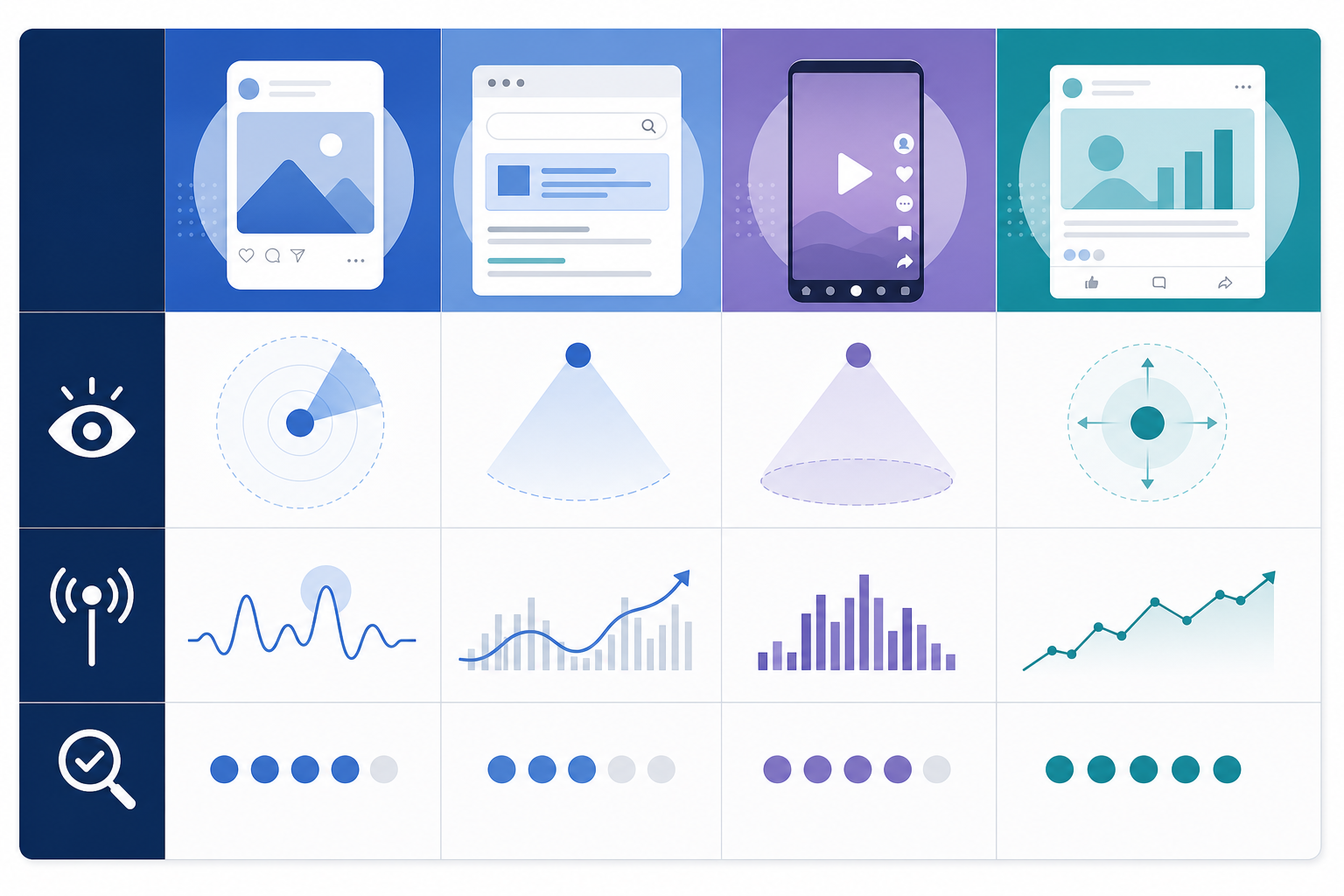
Meta’s library is the strongest starting point for most consumer-facing brands because it reliably shows how long a specific ad has been active. It is one of the closest public indicators of “this might be working” available without spend data. You will usually need to manually group an advertiser’s ads to identify creative clusters, since Meta does not provide a ready-made variation count.
Google’s Ads Transparency Center does not provide clean duration data, but the same ad copy resurfacing across Search and Display over several weeks can still indicate sustained investment. TikTok Creative Center is better for identifying trending formats than for tracking one advertiser over time. It can help you catch messaging that consumer brands test before it graduates to paid Meta campaigns.
LinkedIn is worth checking for B2B teams because overall ad volume is lower. A modest two- to three-week run may mean more there than it would on Meta. Confirm what is available for UK-targeted advertisers before building a process around it, since regional coverage can change.
The real value comes from cross-referencing. A message that persists on only one platform might be a low-priority evergreen ad. A message that is persistent and appears across two or three platforms simultaneously is a stronger indication that a competitor has found something worth scaling—and worth your attention.
How Weekly Monitoring Catches What Manual Checks Miss
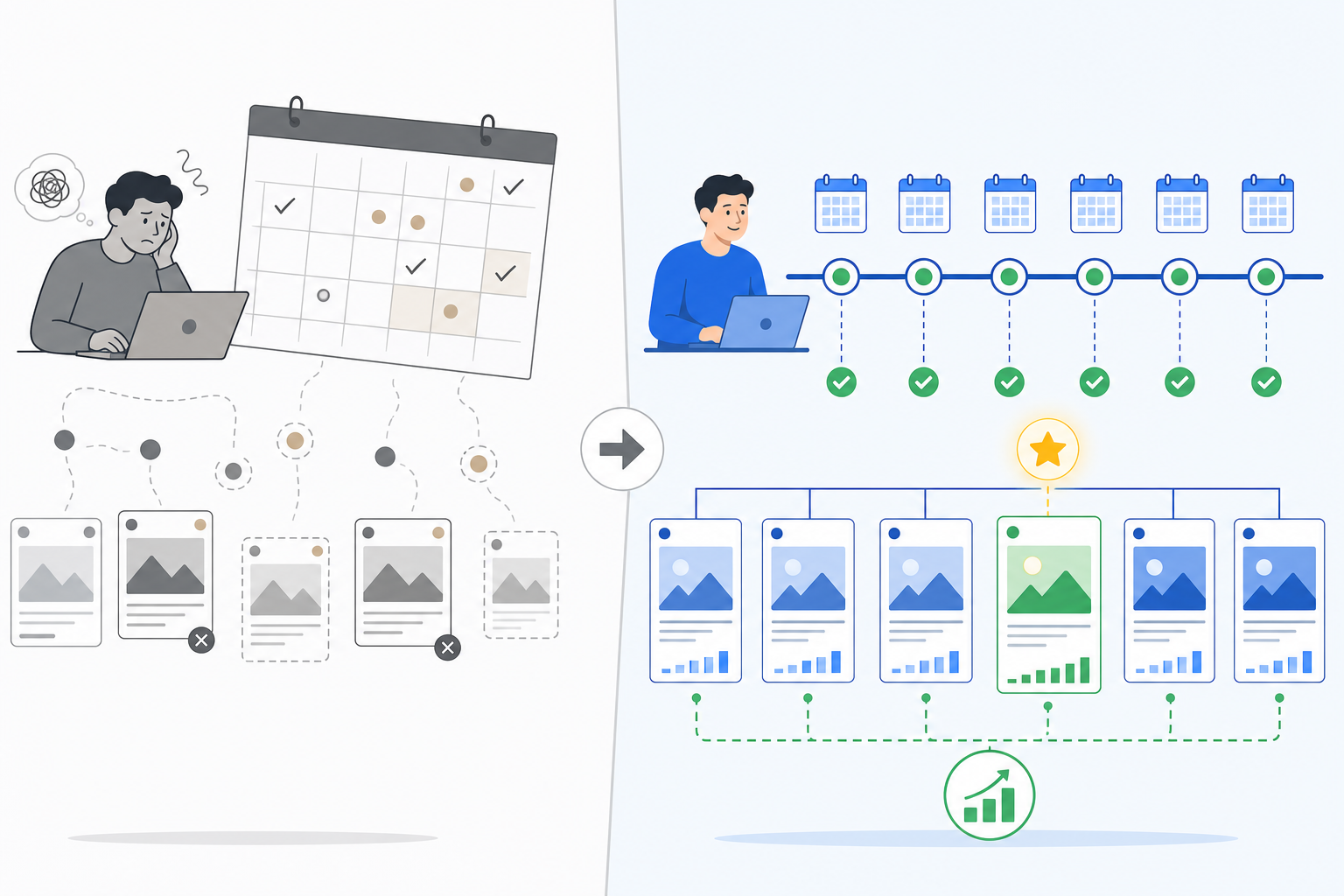
This is where many competitive ad monitoring processes quietly fall apart: manual checks are easy to do once and difficult to do consistently. Someone opens the Meta Ad Library, scrolls through a competitor’s active ads, takes a screenshot, and moves on. Then three weeks pass before anyone checks again, usually because a client or executive asks, “Have you seen what [competitor] is running?”
The problem is not effort; it is memory. The signal you need—“this ad has now run unchanged for four weeks”—only becomes visible when you compare week-over-week snapshots. A single glance tells you what is running today. It does not tell you whether the ad was there last week or whether three new variations have appeared around it.
Without a running record, longevity and creative multiplication are almost invisible.
A Simple Competitor Ad Monitoring Spreadsheet
You can build a useful tracking system with the following fields:
- Advertiser or Page name
- Platform: Meta, Google, TikTok, or LinkedIn
- Ad ID or permalink
- First-seen date
- Last-seen date, updated weekly
- Hook or headline
- Offer or price point
- Format: video, static, or carousel
- Landing page URL
- Variation family, using a short label to link related creatives, such as “serum-bundle-Q1”
- Country or targeting information, where visible
- Status: new, continuing, stopped, or escalated
A Simple Scoring Model for Ad Intelligence
Use one point for each of the following:
- Live for three or more weeks with largely unchanged creative
- Three or more creatives in the same variation family
- Presence on two or more platforms simultaneously
Use the score to prioritise attention rather than estimate performance:
- 0–1 points: Monitor. Keep tracking the ad but do not assume it is a winner.
- 2 points: Discuss. Raise it at the next marketing or strategy check-in.
- 3 points: Investigate this week. Review the landing page, offer, pricing, and likely positioning before deciding on a response.
This is not a performance estimate. It is a practical way to decide where limited attention should go first.
A Weekly 20-Minute Monitoring Checklist
For most marketing teams, a weekly check is a reasonable starting point:
- Choose three to five priority competitors.
- Check each relevant ad library on the same day every week.
- Add new ads and mark stopped ads in the tracking log.
- Group related creatives by hook, offer, and visual concept.
- Recalculate the signal score.
- Flag any competitor ad that has moved into “investigate”.
The process is manual, but it works when the cadence is consistent.
Using an Ad Spy Tool to Automate Monitoring
Keeping a log manually across several competitors and four platforms is possible, but the habit can erode during busy periods. This is the specific gap an ad spy tool such as Rival Ads is designed to address: it collects competitor ad data weekly across Meta, Google, TikTok, and LinkedIn, then surfaces what is new, what has stopped, and what is still running alongside an AI-generated summary.
The point is not that automation makes the manual approach invalid. It automates the same workflow described above and makes week-over-week changes easier to identify. If you prefer to manage the process in a spreadsheet, the tracking schema above will take you most of the way.
Turning Competitor Ad Signals Into Action
Spotting signals only matters if you act on them. The following process incorporates the scoring model above.
-
Set a baseline. Log each priority competitor’s core ads today, including the hook, offer, format, landing page, and platform. You need a starting point before you can identify changes.
-
Watch for the three-week mark. An ad that remains live and largely unchanged after three weeks earns a point and your attention, but not necessarily an immediate response.
-
Check for creative multiplication. Three to five variations of the same core message provide a second point and stronger evidence that the competitor is optimising around the concept.
-
Cross-reference platforms. The same offer appearing on two or more channels at once provides a third point and is often the hardest signal to explain away as coincidence.
-
Score before responding. Zero or one point means keep monitoring. Two points means raise the ad at your next strategy check-in. Three points means investigate properly this week by reviewing the landing page, pricing, offer, audience, and positioning.
-
Choose a response. You might match the general angle with your own point of differentiation, shift creative testing towards a gap the competitor is not addressing, or hold steady because their message does not threaten your positioning.
-
Keep the process sustainable. Weekly monitoring, manual or automated, helps you catch patterns while there is still room to act rather than months later, when the ad has already influenced the competitive landscape.
This is the core idea behind using an ad spy tool effectively: it is not about copying a competitor’s creative. It is about reading public behaviour closely enough to understand their strategy before the rest of the market catches up.
Frequently Asked Questions About Competitor Ad Monitoring
How Do I Know If a Competitor’s Ad Is Scaling?
Look for an ad that has stayed live for three or more weeks without major changes, alongside several creative variations built around the same core message. If it is also appearing on more than one platform at the same time, that is a reasonably strong indication that the competitor has moved from testing to scaling budget behind it.
It is still an inference from public behaviour rather than confirmed performance data. Score the ad against the other signals before deciding to act.
What Metrics Are Visible in Public Ad Libraries?
The Meta Ad Library shows how long a specific ad has been active and lets you browse an advertiser’s creative set manually, but it does not show spend or performance for standard commercial ads. Google’s Ads Transparency Center shows ad copy and advertiser presence but not consistent duration data. TikTok Creative Center surfaces trending and top content rather than a complete advertiser archive.
None of these tools substitutes for campaign data. Matching the “same” creative concept across platforms also usually requires manual comparison of the hook, offer, and visuals rather than an automated match.
How Often Should I Check for New Competitor Ads?
Weekly is a practical frequency for most marketing teams. Daily checks are usually unnecessary for identifying scaling patterns, while monthly checks may cause you to miss the early window. A four- to six-week head start is precisely what effective competitor ad monitoring is designed to uncover.
Can I Predict a Winning Ad Before It Becomes Obvious?
Not with certainty, but you can identify likely candidates. Longevity, creative multiplication, and cross-platform presence are early indicators that a competitor believes an ad is working and is investing accordingly.
They do not reveal actual ROAS, and each signal has plausible alternative explanations when viewed alone. Treat the framework as a way to identify where a competitor is probably placing its bets, not as a tool for forecasting outcomes with certainty.
The Takeaway: Monitor Signals, Not Just Ads
The operating principle is simple: log competitor activity weekly, require at least two aligned signals before taking an ad seriously, and look for three before taking action. Always sanity-check the landing page and offer before responding.
Competitor ad monitoring is not about finding a magic signal that guarantees you are right. It is about noticing patterns early enough that you still have choices—whether that means counter-positioning, adjusting your own creative testing, or deliberately holding your ground.
Public ad libraries were never designed to show spend or ROAS. But when you check them consistently and assess signals together rather than in isolation, they provide something genuinely useful: an early view of where competitors are placing their bets, often weeks before the pattern becomes obvious to everyone else.