
7 Ways Ad Monitoring Helps Agencies Win More Client Pitches
Learn how competitor ad audits help agencies win client pitches, impress prospects with actionable insight, and turn research into new business.
Chris Edington
13 min read
7 ways ad monitoring helps agencies win client pitches
The fastest way to win client pitches is to walk in already knowing more about a prospect's market than they do. Ad monitoring tools like Rival Ads let agencies pull a competitor ad audit, covering creatives, copy, platform mix, and how long ads have been running, in minutes rather than days. That means pitches can open with specific insight instead of generic promises. Prospects notice the difference immediately, and in my experience it's often the deciding factor between you and an agency that only talks strategy in the abstract.
I've sat through enough new business pitches, on both sides of the table, to recognise the pattern. An agency walks in, runs through a slick deck of case studies, talks about its 'proven process', and finishes with a capabilities overview that could apply to literally any brand in any category. Prospects are polite. They nod. Then they go with whoever showed them something they didn't already know.
That's the gap competitive ad intelligence fills. Before getting into the seven tactics, though, it's worth being honest about what this kind of data can and can't tell you. Overselling it in a pitch is a quick way to lose credibility if a sharp client pushes back.
What public ad data shows in a competitive pitch
Tools that monitor ad libraries are genuinely useful, but they have limits worth understanding before you build a pitch around them. They can reliably show you which ads are currently live, how creative and copy have changed over time, which platforms a competitor is active on, and roughly how long a given ad has been running. What they generally can't tell you with confidence is exact spend, real performance (clicks, conversions, ROAS), or definitive proof that an ad was pulled because it 'failed'. An ad disappearing might mean it underperformed, or it might just as easily mean the campaign ended, the offer expired, or the budget moved elsewhere.
So throughout this piece, when I talk about ads 'scaling' or 'fatiguing', I mean that based on observed creative volume and longevity. It's a reasonable hypothesis worth raising with a client, not a certainty you should present as fact. Framed that way, this data still gives you a real edge in a pitch, as long as you're honest about what it actually is.
A simple pre-pitch workflow for agencies
Before getting into the seven tactics in detail, here's the basic process I'd follow 24–48 hours before any pitch:
- Pick 3–5 relevant competitors: not every brand in the category, just the ones the prospect actually benchmarks themselves against.
- Pull current and recent ads across the platforms that matter for that category (Meta and Google for most UK consumer brands, LinkedIn for B2B).
- Code what you find by platform, message angle, offer type, and creative format, so patterns are easy to spot rather than buried in screenshots.
- Turn it into three pitch slides: what's being run, what's missing, and what you'd test first. Keep it visual, screenshots of real ads land far better than bullet points describing them.
Keep this checklist handy. It's the backbone of every tactic below and gives your team a repeatable way to use competitor research to win new business.
1. Open the pitch with a competitive audit
Most agency pitches start the same way: 'here's who we are, here's what we've done, here's our process.' It's not wrong, exactly, it's just forgettable. Prospects have sat through a dozen versions of this exact opening, and by slide four they're already mentally comparing you to the last three agencies they met.
Flip it. Open with: 'Here's what your top three competitors are currently running on Meta and Google.' That one sentence changes the entire tone of the room. You're not talking about your agency anymore, you're talking about their market, their rivals, and their opportunity. It signals you've done homework specific to them, not pulled a template off the shelf.
This is where ad monitoring tools earn their keep. Rival Ads, for example, is built to detect a competitor's presence across Meta, Google Ads, TikTok, and LinkedIn from just a website URL, then surface their currently active ads, creative, copy, and landing pages included. I've put together a competitive snapshot for a pitch in well under half an hour this way, for a mid-sized retail client, which used to take most of an afternoon of manually scrolling through ad libraries screenshot by screenshot.
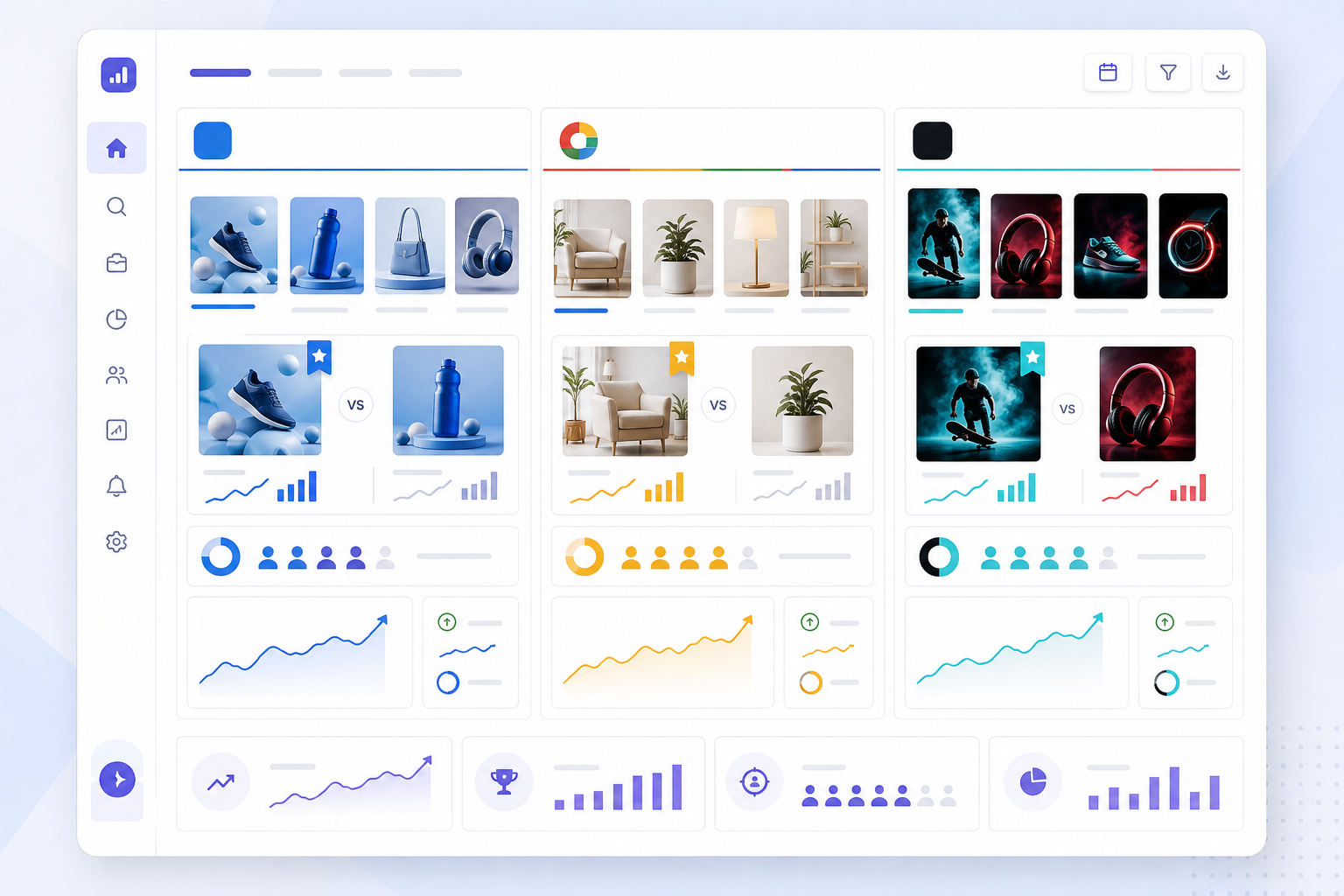
The prospects I've seen respond best are the ones who lean forward the moment they see their actual competitors' ads on screen. It's tangible, it's current, and it separates you from agencies still pitching in the abstract.
2. Show gaps the client isn't exploiting
Once you've got the audit, the next move is spotting what competitors aren't doing. Every category has blind spots, and pointing them out is one of the more persuasive things you can do in a pitch. It reframes the conversation from 'here's what we'll do for you' to 'here's an opportunity on the table, and we can go get it.'
A few things worth checking for:
- Ignored platforms: if you're pitching a B2B client and nobody in their category is running LinkedIn ads, that's worth flagging, though it's still a hypothesis until you've checked whether the audience and budget actually make it viable.
- Untested messaging angles: are all competitors leaning on price, while nobody's talking about service or speed?
- Underused creative formats: if the whole category is static image ads and nobody's doing UGC-style video or carousels, that's a gap you could test first.
- Offer structures: are competitors all running the same discount mechanic, leaving room for a different kind of hook?
The key word there is test: a gap in the market isn't automatically an opportunity until you've checked it fits the client's audience, margins, and operational reality. But framing these as 'here's where we'd start testing, and why' does two useful things in a pitch. It shows strategic thinking beyond execution, and it creates a sense of momentum, because gaps like this rarely stay open forever.
3. Benchmark the client against category leaders
Clients rarely have an accurate sense of how their advertising stacks up against the leaders in their space. They know their own numbers. They don't usually know, in any detail, what the top two or three competitors are actually doing week to week.
This is where a simple benchmark table earns its place in the pitch deck. The table below is an illustrative example, not real data from any specific account. When you build your own, base it on a defined observation window (say, the past four weeks) and be upfront with the client that ad volume is a proxy for activity, not a confirmed measure of budget or results.
| Metric (illustrative, 4-week window) | Client | Competitor A | Competitor B |
|---|---|---|---|
| New creative variations observed | Low | Moderate | High |
| Platforms active | Meta only | Meta, Google, TikTok | Meta, Google, LinkedIn |
| Dominant copy angle | Feature-led | Benefit-led, urgency | Social proof-driven |
| Offer structure | Flat discount | Bundled offer | Free trial |
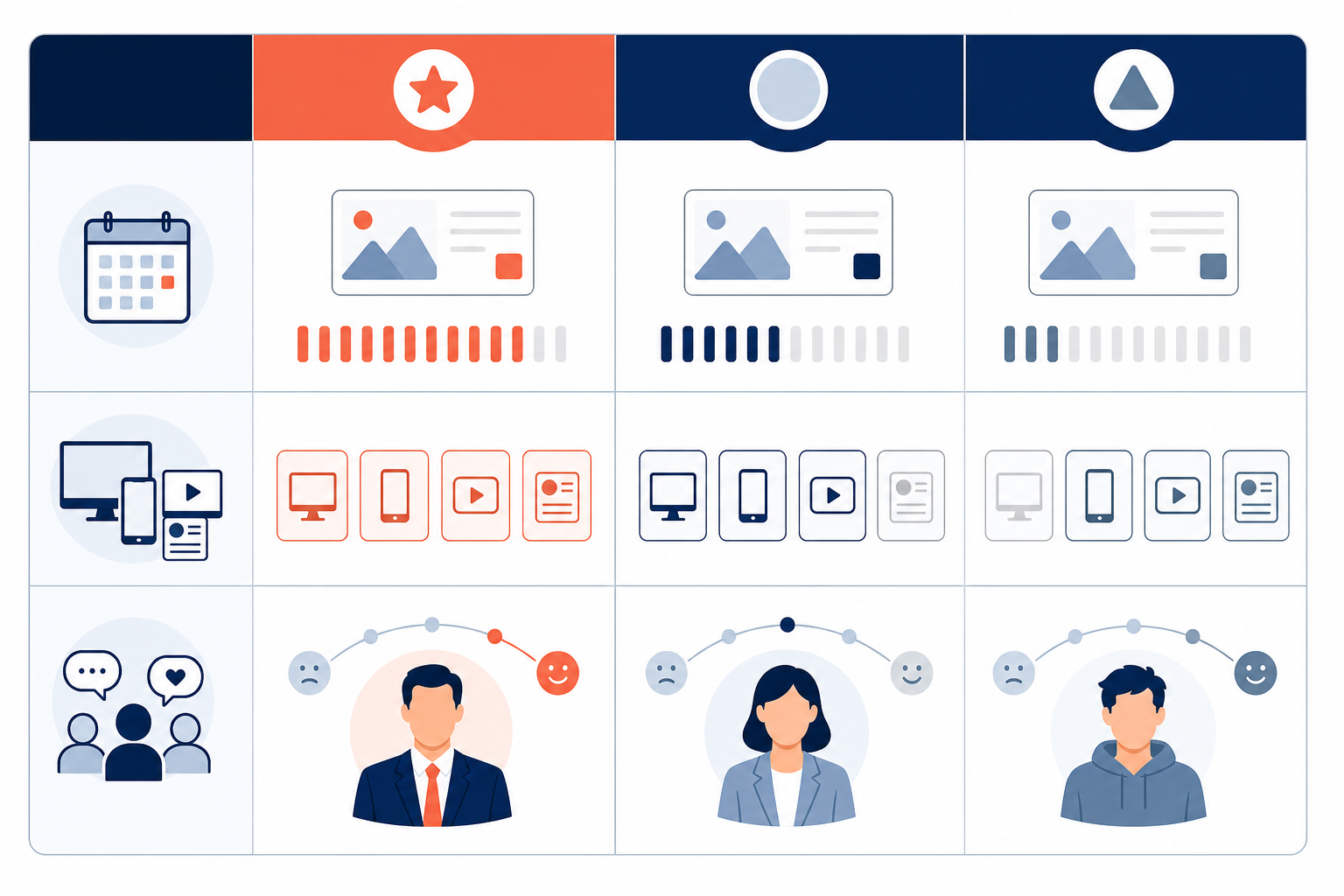
This kind of table does a lot of quiet persuasion, even with cautious, directional figures. It helps justify budget conversations without you having to say 'we think you should spend more', the table nudges the client there itself. 'Here's what activity in this category actually looks like right now' lands better coming from a visual than from opinion. It also repositions your agency from execution vendor to strategic advisor, which matters when a client is deciding who gets a seat at the table for bigger decisions down the line.
4. Use AI insights to look sharp fast, but check them
Here's the honest problem with competitor research: doing it properly takes time most agencies don't have before a pitch. Manually trawling through weeks of ad history and working out what it all means strategically is hours of work, and most new business teams are juggling several pitches at once.
This is where AI analysis layered on top of ad monitoring data can actually save time. Rival Ads, for instance, uses AI analysis (built on Claude) to summarise week-over-week changes, flagging ads that have appeared more frequently or disappeared, and offering a plain-English read on what that might signal strategically. Instead of staring at a spreadsheet of ad variations trying to spot patterns yourself, you get a draft strategic narrative to work from.
The important caveat: treat AI output as a strong first draft, not gospel. Spot-check the underlying ads it's referencing before you put a claim in front of a client. AI summaries can misread context or overstate certainty, and you're the one who has to defend the slide if a prospect asks a follow-up question. Once you've verified it, though, this matters a lot for smaller agencies without a dedicated analyst. It means a two- or three-person new business team can show up with insight that reads like it came from a senior strategist, without needing to employ one full-time.
5. Track creative longevity to identify timing opportunities
One of the more underrated pitch tactics is timing: not just showing what competitors are doing, but suggesting when might be the right moment for the prospect to act.
Week-over-week ad changes are useful here, within reason. If a competitor's ad has been running unchanged for months and then suddenly disappears, that's worth noting as a possible sign of fatigue, though it could just as easily mean the campaign budget or season ended. Equally, if a competitor is running a growing number of creative variations on the same theme, that's a reasonable signal they're leaning into something that's working, even if you can't see the exact numbers behind it.

Both signals are useful pitch material, framed as hypotheses rather than facts. If a competitor's longest-running ad has just been pulled, you can say: 'This might be a good moment to step up activity, their main campaign has just stopped, and there could be an opening.' If a competitor is clearly expanding their creative output, you can flag it as a category shift worth watching, and worth testing a response to sooner rather than later.
This kind of observation does something subtler too: it shows you're not working off a one-off snapshot pulled together the night before the pitch. It demonstrates ongoing market awareness, the kind that only comes from actually monitoring the space continuously, and it gives the prospect a reason to decide sooner rather than 'go away and think about it,' which, let's be honest, is where a lot of pitches quietly die.
6. Prove ongoing value with weekly competitive reporting
Here's something I think a lot of agencies miss: clients often expect the insight to dry up the moment the contract is signed. They've seen it before: agency wows them in the pitch, then onboarding happens, and suddenly it's all status updates and media reports with none of the sharpness that won the business in the first place.
Address this directly in the pitch. Show them what an actual weekly digest looks like once they're onboard. A good one covers five things: new competitor ads that launched, ads that were removed, messaging or offer changes, platform shifts, and what each of those might mean for the client's own strategy. This isn't hypothetical; it's the deliverable they'd be receiving every week as a client, so showing a real example (anonymised, if needed) builds trust fast.
This reframes the entire retainer conversation. You're not just selling media management or campaign execution, you're selling continuous competitive awareness that keeps their team sharp on the market every week, not just at kickoff. It's a much easier retainer to justify when the client can see, concretely, that the value doesn't stop after week one.
7. Whitelabel ad monitoring as your own competitive edge
This last one is more about positioning than tactics, but it matters just as much. If you're going to build competitor ad intelligence into your pitch process, present it as part of your own methodology, not a bolted-on third-party tool you're marking up.
Rival Ads offers whitelabel options on its higher plans, letting agencies present the ad monitoring and analysis process under their own brand, so clients experience it as 'the way we work' rather than 'a subscription you're paying extra for.' One honesty point worth building into how you position this: whitelabelling the delivery is fine, but it's worth being transparent internally (and with clients, if asked) that the underlying data comes from a third-party platform. That's standard practice across the industry, plenty of agency tools work this way, but presenting someone else's software as entirely proprietary research, without ever disclosing the source if asked directly, is the kind of thing that can damage trust if it ever comes up.
This approach is particularly useful for smaller or mid-size UK agencies going up against bigger shops with in-house analyst teams and the budgets to match. You don't need a department to deliver this kind of competitive edge, you need the right tool, branded consistently, built into how you win and run accounts. Pricing for tools like this typically starts in the tens of pounds per month on entry-level plans (check current pricing directly with the vendor, as it changes), which makes it a low-risk addition even when you're pitching smaller accounts where margins are tighter.
How to use ad monitoring to win more client pitches
None of these seven tactics require a huge research team or weeks of prep. That's really the point. Ad monitoring tools exist to compress what used to be days of manual ad library digging into a process that takes under an hour, and to layer useful, if appropriately caveated, strategic analysis on top of the raw data.
Before your next pitch, try this short checklist: pick 3–5 real competitors, pull their current ads across the platforms that matter, code what you find by message and format, build three slides around gaps and timing, and be honest about what's observed versus what's inferred. Agencies winning more pitches right now aren't necessarily the ones with the biggest case study libraries. They're the ones walking in already speaking the prospect's language, their competitors, their market gaps, their timing opportunities, before the prospect has even finished explaining their business.
If you want to see what a competitive audit looks like before you build one into your own pitch deck, it's worth running a free trial or sample report on a prospect you're already preparing for. Seeing your own next pitch's competitors laid out tends to make the value click faster than any explanation can.
FAQ: Using competitive research to win new clients
How can competitive research help win new clients?
It shifts the conversation from generic capability statements to specific, provable observations about the prospect's own market. When you can show what their competitors are currently running on Meta, Google, TikTok, or LinkedIn, and offer a grounded view on what it might mean, prospects see you as already thinking like a partner, not a vendor still trying to win the account. It's not a guarantee, but it's a consistent differentiator.
What should a competitive audit include for a pitch?
At minimum: the client's top 3–5 competitors' current live ads across relevant platforms, a comparison of messaging and offer strategy, any obvious gaps or underused platforms, and a cautious point of view on what seems to be gaining or losing traction based on observed activity. Tools like Rival Ads can assemble the raw material for this quickly, but it still needs a human pass to sanity-check and frame the findings before they go in front of a client.
How do agencies impress prospects quickly without a big research team?
Tools that automate data gathering are the biggest lever. Rival Ads surfaces active ads and layers AI-generated analysis on top, so even a solo pitch lead can walk in with a strong first draft of senior-level insight. The remaining work, verifying claims, picking the right competitors, and framing findings honestly, still falls to the person pitching, and that's exactly the part that makes it credible rather than gimmicky.