A CMO's Guide to Competitive Ad Intelligence, No Manual Grind
A practical guide to CMO competitive intelligence: learn why ad visibility matters, how to automate competitor research, and use insights in quarterly
Chris Edington
16 min read
CMO Competitive Intelligence: A Guide to Competitive Ad Monitoring Without the Manual Grind
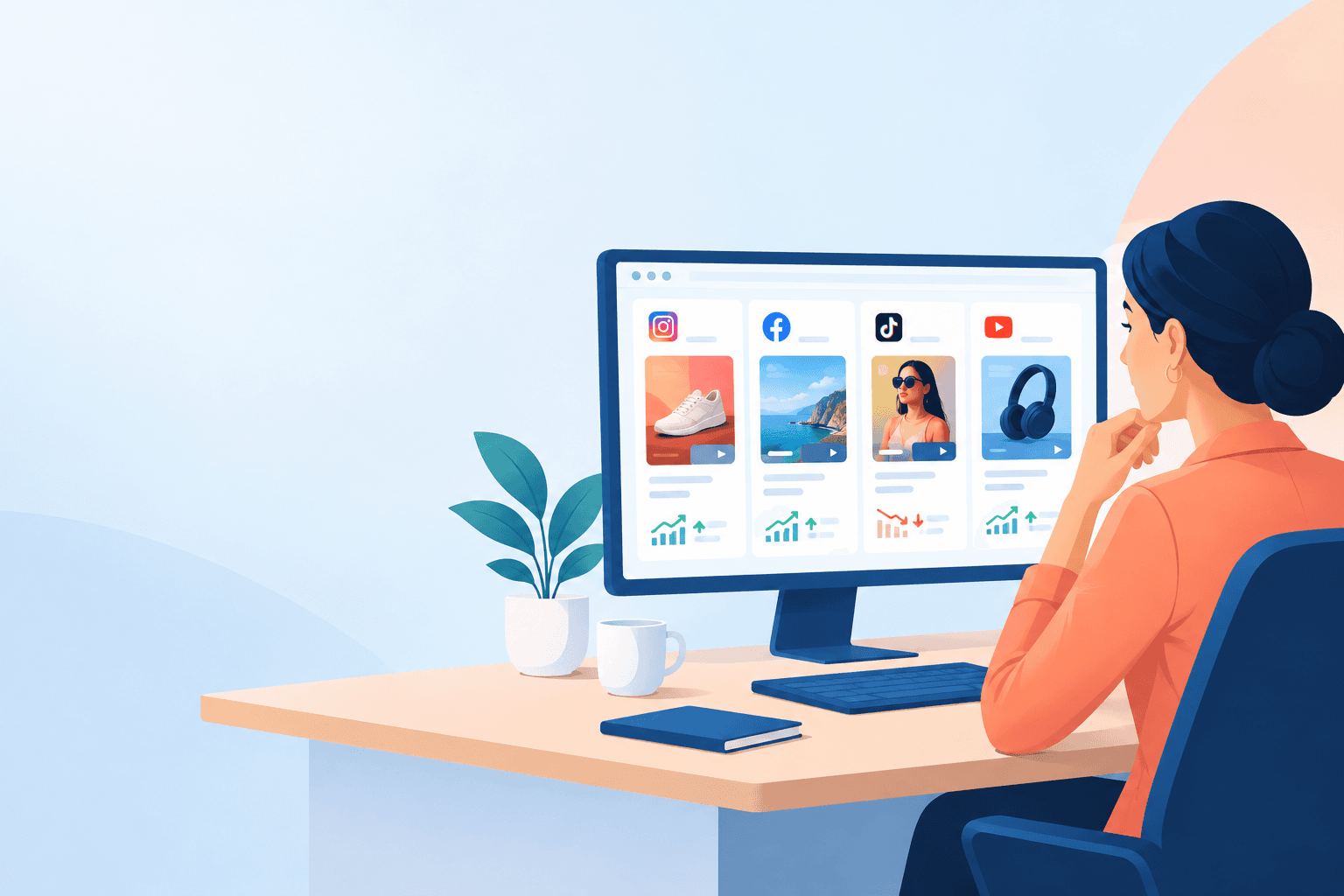
Competitor ads are a public signal of how your rivals position themselves, who they're talking to and which channels they're active in. They don't reveal budgets or results, but a change in them is a good prompt for strategic questions. For a CMO, the useful part is turning those signals into decisions. I'd automate the collection and first-pass analysis, so your team spends its time deciding rather than taking screenshots. Tools like Rival Ads check Meta, Google, TikTok and LinkedIn weekly without needing access to any ad account, and summarise what changed so you can fold it into quarterly planning.
That's the short version. The rest of this guide covers why competitor ad visibility matters at leadership level, what ads can and can't tell you, how to avoid the manual research trap, and how to make it part of your planning rhythm without adding headcount.
Why Competitive Ad Visibility Matters for CMO Competitive Intelligence 👀
Here's a composite story, one I've seen versions of many times. A founder is midway through a quarter, confident that their positioning (fast, affordable, built for small teams) is differentiated. Then a sales call goes sideways. The prospect keeps mentioning 'enterprise-grade security' and 'compliance', language nobody on the team uses. It turns out a main rival rewrote its ad copy and landing pages around a completely different buyer. The ads had been live for weeks. Nobody noticed, because nobody was looking.
That's the core argument for paying attention. Ads are a public record of what competitors have chosen to say to the market: positioning, offers and audiences, tested in the wild rather than in a slide deck. A few reasons that matters:
- Persistence is a clue. What a competitor keeps running versus quietly stops may hint at what's working for them. That's an inference, not proof, and you need to check it against other evidence.
- Ads can show up before announcements. New product angles, pricing pushes, geographic expansion and fresh audience segments sometimes appear in creative before they reach a press release.
- It's a CMO-level input. It can inform positioning, channel mix and board conversations, not just creative tweaks.
The size of the market makes this more pressing. The IAB and PwC reported US internet advertising revenue of roughly $258.6 billion in 2024, up around 15% on the year before, with social media advertising at about $88.7 billion. That's US data, so treat it as context rather than a UK benchmark. The direction is still clear: more competitors are putting more money into digital channels, and the picture changes quickly. Gartner's 2024 CMO Spend Survey put average marketing budgets at 7.7% of company revenue. With that much of the P&L at stake, wanting a systematic view of what the other side is doing seems fair.
What UK CMOs should know about public ad libraries
If you're selling in the UK, your competitors are often market-specific. Offers, pricing language and promotions can differ between the UK and elsewhere, and the same brand may run quite different ads in each market. Public tools help, but they only show part of the picture:
- The Meta Ad Library mostly shows currently active ads for ordinary commercial campaigns, so it isn't a full history.
- Google's Ads Transparency Center lets you search verified advertisers and see where and when ads ran, but coverage and fields vary by ad and market. Not finding a company there doesn't prove it isn't advertising.
- The EU's Digital Services Act ad transparency rules don't automatically apply to UK-only activity, so don't assume the same disclosure depth.
The practical lesson is to record the market and date for every observation.
What Competitor Ads Can Tell You, and What They Can't
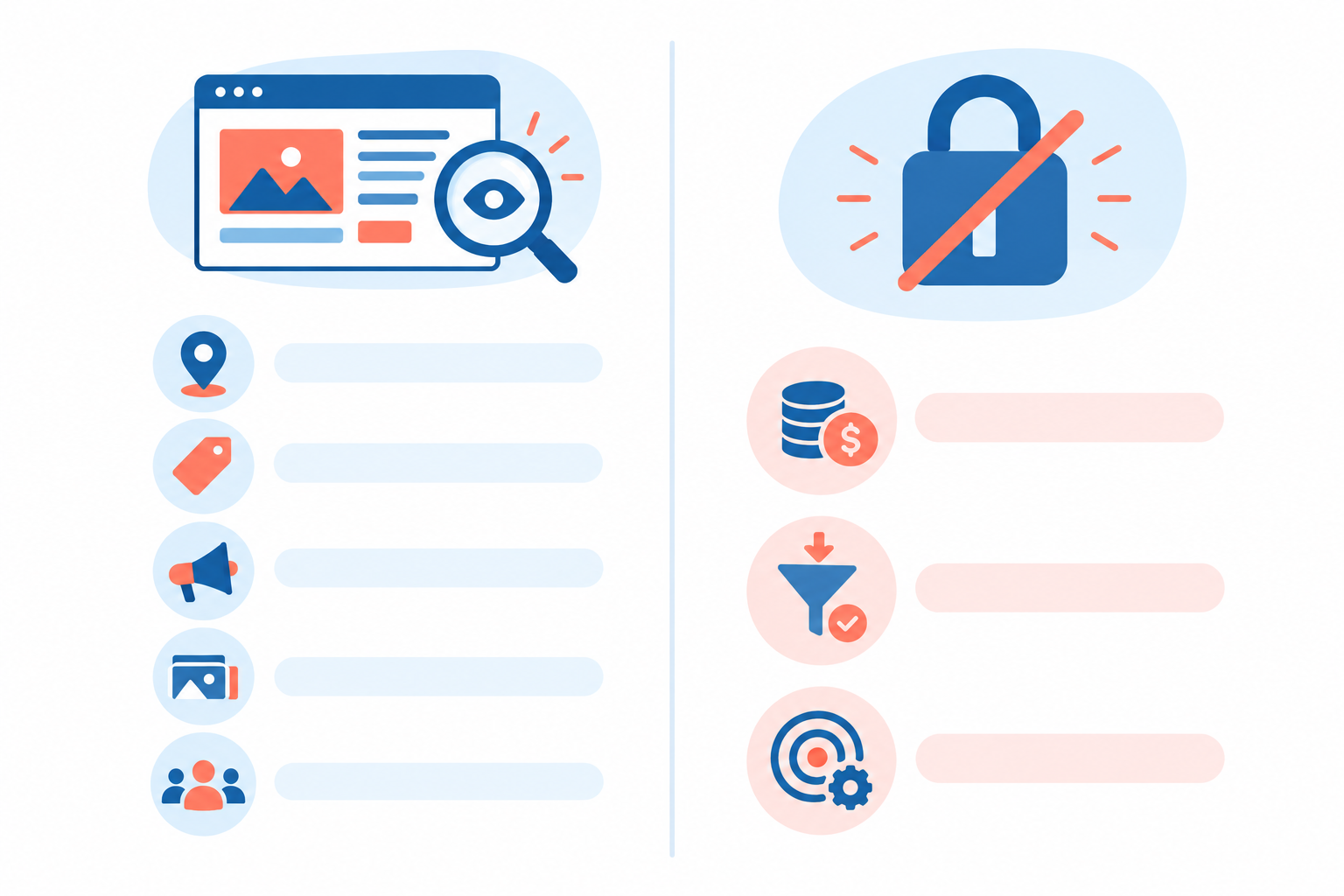
I want to be straight about this, because it's where competitive intelligence tends to go wrong. Ads are direct evidence of what a brand chose to publish. They are not evidence that an ad performed well, that the message drove sales, or how much was spent. With that in mind, here's what you can reasonably read from them:
- Positioning and messaging. The claims, proof points and tone competitors lead with. Are they selling on price, speed, trust or outcomes?
- Offer and pricing signals. Free trials, discounts, bundles and urgency tactics. If a rival pushes the same free-trial offer for several weeks, it's part of their visible messaging, but that doesn't tell you whether it converts.
- Channel activity. Where they're showing up across Meta, Google Ads, TikTok and LinkedIn. A sudden LinkedIn presence from a brand that was Meta-only is worth a conversation, though it doesn't tell you how much they're investing.
- Creative themes. Formats, hooks, UGC versus polished production, and how they change over time.
- Audience clues. Who the copy and landing pages seem to be speaking to, whether that's job titles in LinkedIn ads or slang in TikTok creative.
The limits of competitor ad tracking
Ads don't reveal spend, conversion rates, return on ad spend or targeting settings. Public ad libraries generally don't show reliable impressions or business outcomes either. So how long an ad has run, or how many variations exist, hints at activity but doesn't measure budget or success. Treat everything you see as a hypothesis to test.
Say you compare a brand's UK and US ads and spot different claims or promotions. That might reflect localisation, regulation, product availability or timing, and the ad alone can't tell you which. The sensible move is to log the market and date, then check your interpretation with local research and your sales team.
Tip: Before you act on any ad observation, pair it with your own performance data. A single ad is a weak basis for changing positioning or budget. A pattern, backed by your own numbers, is much stronger.
The Manual Research Trap 🕳️
Most teams start the same way. Someone, often a marketing manager with a hundred other things to do, checks the Meta Ad Library, then Google's transparency centre, then TikTok, then LinkedIn, and pastes screenshots into a deck. It feels productive. Done occasionally, it's fine. As your ongoing system, it's a trap.
Why manual competitor ad tracking breaks down
Manual tracking is inconsistent, platform-by-platform, and depends on one person remembering to do it. When that person goes on holiday or gets pulled onto a launch, the habit tends to quietly die. The hidden costs add up. Senior hours go on screenshots instead of strategy. Snapshots are out of date the moment they land in the deck. Changes get missed because nobody checks between big campaigns. And once an ad is switched off, there's often no record of it, especially on platforms that mainly show what's live right now.
The real killer is that a snapshot tells you what's live today, but not what changed, and the change is the part that hints at strategy. A rival launching a new angle, pausing an old one and doubling down on a third is a story. A folder of screenshots isn't.
It's tempting to fix this by hiring another analyst or buying yet another ad spy tool. Without a process, that usually just moves the problem. You've got another login, another export, and still nobody who owns the 'so what'.
Are you spending too much time on manual research?
- Research only happens before big campaigns or pitches
- Nobody clearly owns it
- Insights live in someone's inbox or a slide nobody opens again
- You can't say what a competitor was running three months ago
- Leadership hears about competitor moves from sales, not marketing
If you ticked two or more, you're in good company. I see this pattern a lot, and it's fixable.
How to Get Competitive Insights Without More Headcount
You don't need a bigger team. You need a smaller scope, a repeatable process and automation where it counts. Here's the approach I'd recommend.
- Pick a focused competitor set. Choose your direct rivals, a couple of adjacent players and one aspirational brand. Three to five is plenty. Watching the whole market just creates noise nobody reads.
- Start simple. A shared sheet, the public ad libraries and a fortnightly calendar slot make a perfectly respectable first version. You'll find out whether the habit sticks before you spend anything.
- Automate collection when manual effort stalls. Look for monitoring that works from a competitor's website alone, with no ad account connections or access requests. That removes the biggest source of friction.
- Track change, not snapshots. Look at week-over-week differences: which ads are new, which have stopped and which are still running. That's where the strategy shows up.
- Get help with the 'so what', but check it. AI-assisted summaries can save time on first-pass interpretation. A human who knows your market should still sanity-check them.
- Deliver it where leaders will actually read it. That means a dashboard for the team and a short weekly email digest for the exec level. If it needs a login to be useful, it won't get read.
- Assign ownership. Give each person a slice of competitors so nothing falls through the cracks.
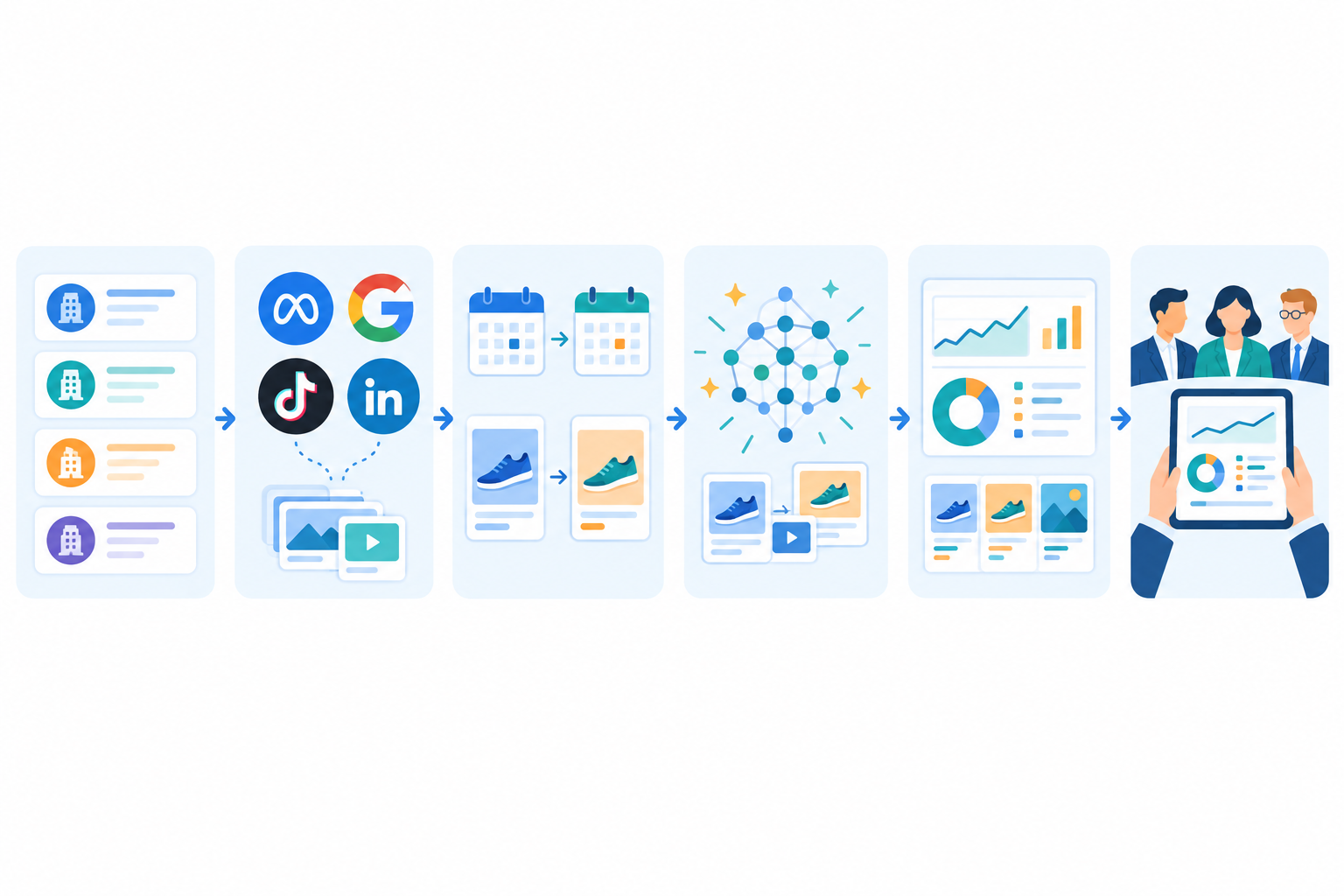
One example: how Rival Ads approaches competitor monitoring
Full disclosure: this is the workflow we built Rival Ads around, so take this as one implementation rather than the only option. You give it a competitor's website, and it detects their presence across Meta, Google Ads, TikTok and LinkedIn, then checks for active ads weekly (not in real time). It stores creatives, copy and links so you can look back after an ad is switched off. It flags what's new, stopped or continuing, and generates an AI analysis (powered by Claude) of the changes. Results arrive in a dashboard and a weekly email digest, with team roles for assigning competitors. Plans start at $29/month at the time of writing and scale with the number of competitors, so check current pricing.
A few honest caveats. Coverage depends on what each platform makes publicly available, so no tool, ours included, can promise a complete record of every ad. The archive only goes back to when monitoring started. And the AI analysis is a starting point for your judgement, not a replacement for it. Agencies can also use the whitelabel option to resell the same intelligence under their own brand.
Manual vs Automated Competitor Ad Monitoring: A Quick Comparison
Here's how the two approaches tend to compare in practice. These are tendencies, not guarantees, and they vary by tool and by team.
| Manual research | Automated ad monitoring | |
|---|---|---|
| Setup time | Quick to start; the process often gets rebuilt each time | A short one-off setup (add competitor websites), plus time to check it suits you |
| Platform coverage | Whatever someone has time to check | Multiple platforms together, but coverage varies by tool and by what platforms expose |
| Frequency | Ad hoc, usually before big campaigns | Scheduled, such as weekly |
| Historical archive | Depends on saved screenshots | Builds from the day monitoring starts; may not capture everything |
| Change detection | Spotted by eye, if at all | Usually built in (new, stopped, continuing) |
| Strategic interpretation | Whatever the analyst has time to write | Automated first-pass summary; still needs human review |
| Ongoing effort | Can take hours a week, often senior time | Lower, but reviewing and acting still takes time |
| Cost profile | Low software cost, higher hidden cost in hours | Subscription cost (Rival Ads starts from $29/month) |
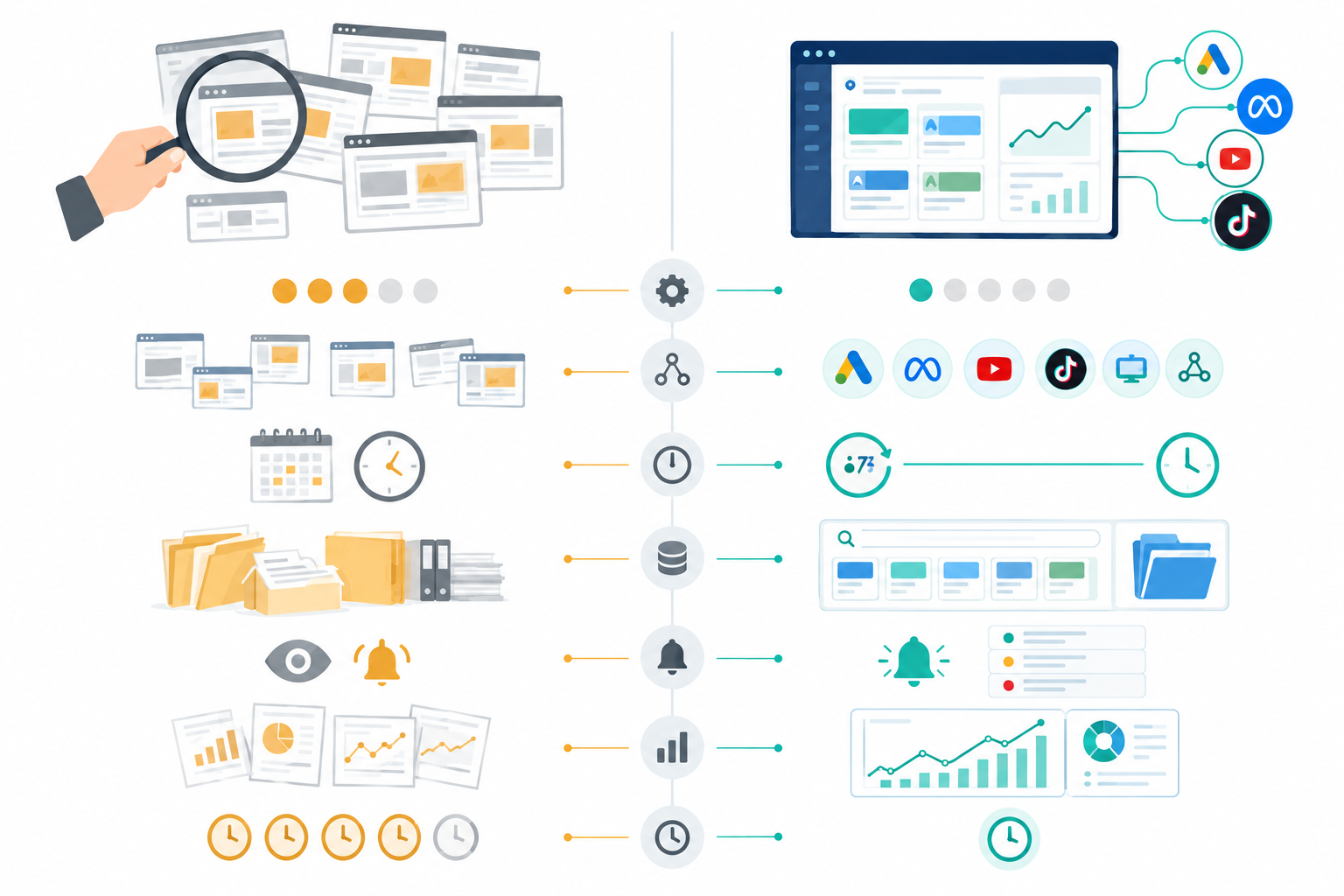
Manual research is still the better choice in some situations. A deep dive on one competitor or one campaign, a check on a niche platform a tool doesn't cover, or a quick look before a pitch are all good uses of your time in the ad libraries. Recurring monitoring across several rivals is where manual effort tends to fall over. On cost, I'd keep it simple: compare the subscription with what a few hours of senior time per week actually costs you.
What Good Competitive Intelligence Reporting Looks Like for Leaders 📊
Collecting ads is the easy part. Turning them into something a leadership team will act on is where competitive intelligence earns its keep. Here's what I'd aim for:
- Lead with the headline. Three to five moves that matter this month, not a gallery of every ad.
- Show what changed: new campaigns, stopped campaigns and what's still running.
- Interpret, don't just report. What might this tell us about their positioning, and what should we do (or deliberately not do)?
- Connect it to business decisions like messaging tests, budget shifts, launch timing and sales enablement.
- Keep a consistent format. Trends are easier to spot when the layout doesn't change.
- Include a short watch list of two or three things to monitor next.
- Share it beyond marketing. Sales, product and the leadership team all benefit.
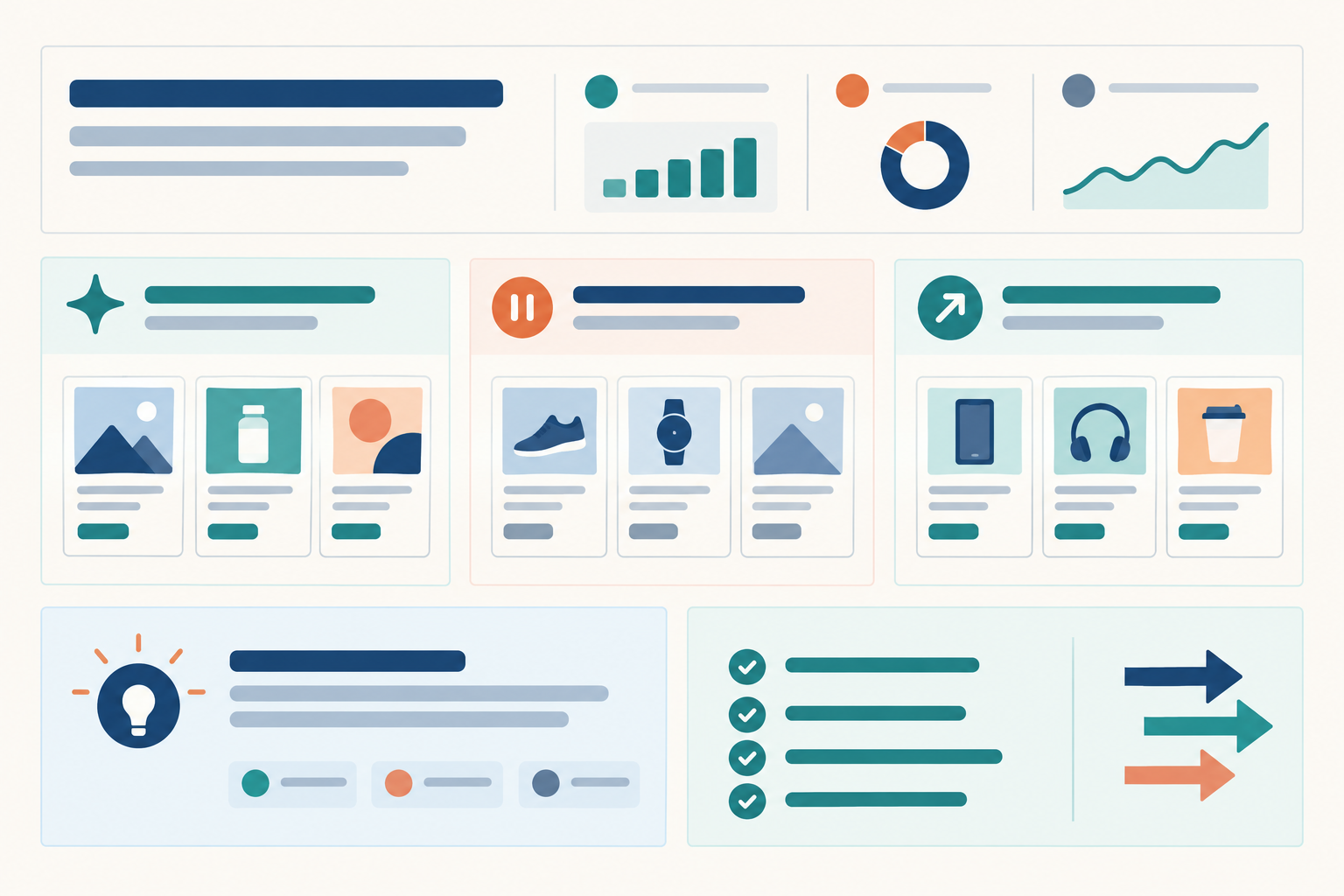
A one-page monthly competitor ad brief
Here's a structure a CMO could take straight into a leadership meeting:
- Headline moves (3 to 5 bullets). The biggest shifts across competitors, in plain English.
- New / stopped / continuing. A simple view per competitor, with one example creative each.
- What it suggests. Two or three sentences on positioning, offers and channel emphasis, with a confidence note (one ad versus a clear pattern).
- Our response. Test, ignore or watch, with an owner and a date.
- Watch list. What we'll check next month.
A worked example (illustrative)
Here's how one line of that brief might look. The scenario is hypothetical, but the format is real.
- Evidence: Over six weeks, a UK rival added several new LinkedIn ads focused on security and compliance, and its landing page now leads with an 'enterprise' headline. It previously only ran Meta ads about price.
- Confidence: Medium. It's a pattern across multiple ads and the landing page, but we can't see spend or results.
- Interpretation: They may be moving upmarket. Our sales team has also heard compliance questions in recent calls.
- Action: Ask sales to log compliance objections for four weeks, and test one proof-led message about our own security credentials. Review at the mid-quarter checkpoint.
I like the confidence note. It keeps the team honest about the difference between a hunch and a trend, and it stops the room from over-reading a single ad.
How to Fit Competitive Intelligence Into Quarterly Planning 🗓️
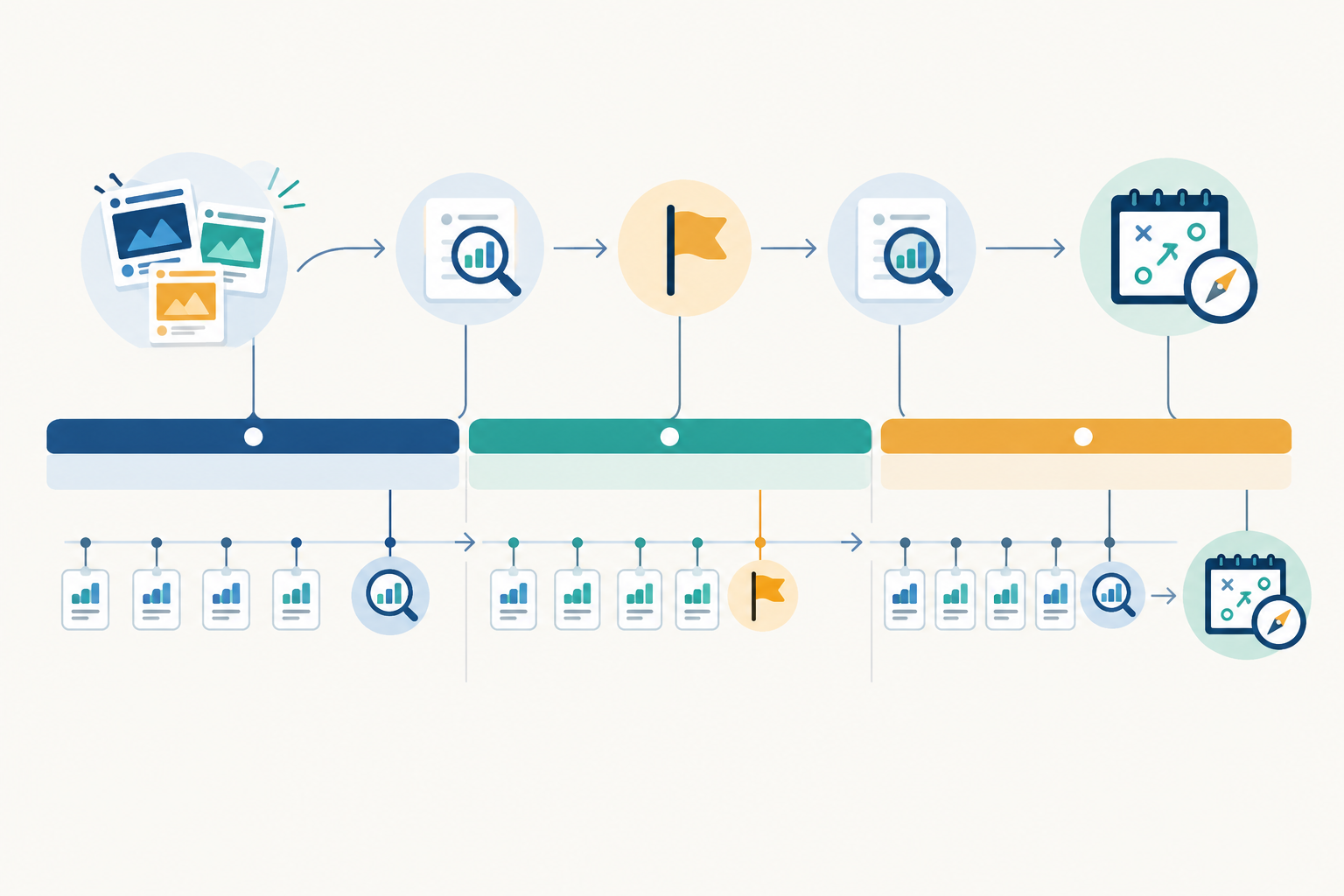
The best intelligence process is the one that slots into rituals you already have. Here's a quarter-long rhythm that works.
- Start of quarter: look back. Review the last 12 weeks of competitor ad records to spot messaging shifts, new angles and channels where rivals appear to be leaning in.
- Planning sessions: challenge assumptions. Use the findings to test your thinking on positioning, differentiation and channel mix.
- Set hypotheses. Turn observations into testable ideas, like 'Rival X is pushing price, so we'll test proof and outcomes.' That's the difference between learning from competitors and copying them.
- Mid-quarter checkpoint. Use the weekly digests to catch sudden changes and adjust, rather than waiting for next quarter.
- End of quarter: review. Look at what rivals stopped or continued, and what your own tests taught you.
- Fold it into existing rituals, like board updates, QBRs and sales kickoffs, rather than inventing new meetings.
Keep competitive intelligence reporting light
The formula is one owner, one weekly digest and one monthly summary. If you're a small founder-led team, there's a stripped-back version: a 30-minute monthly review. Skim the highlights, pick one competitor move to respond to, and note one thing to watch. That alone puts you ahead of many teams your size.
Common Pitfalls to Avoid in Competitor Ad Tracking
- Copying competitors. Use their moves to sharpen your own differentiation, not to mirror it. If everyone converges on the same message, nobody wins.
- Over-reading a single ad. Look for patterns and longevity. One ad can be a test, a mistake or a one-off.
- Tracking too many competitors. More names means more noise and more ignored reports. Start small.
- Ignoring where your buyers are. If you sell B2B, LinkedIn ads matter. If you're chasing younger audiences, TikTok probably does. Don't just watch the channel you're most comfortable with.
- Treating it as a one-off project. The value compounds when it's a habit, because the record and the trend lines get richer every week.
- Forgetting compliance and ethics. Stick to publicly available ad data, and keep your own claims and comparisons substantiated and in line with UK advertising rules such as the ASA's CAP Code.
Getting Started With CMO Competitive Intelligence This Week
You don't need a big programme to begin. Here's a simple plan for the next few days:
- Pick your top three to five competitors and note their ad library pages.
- Choose one owner and one weekly slot, even if it's just 20 minutes.
- Book a recurring 30-minute monthly review, and add a competitor slot to your next quarterly planning session.
- If manual checking starts to slip, that's your cue to try an automated tool, Rival Ads or otherwise.
The goal is simple: fewer hours collecting, more time deciding. 🎯
FAQ: CMO Competitive Intelligence and Ad Tracking
Why should CMOs care about competitor ad tracking?
Competitor ads are a public signal of how rivals position themselves, what offers they push and which channels they use. For a CMO, that can inform positioning, channel mix and messaging tests, and it reduces the risk of being surprised by a strategy shift. Ads don't show spend or performance, so treat what you see as hypotheses.
How do I get competitive insights without hiring more people?
Narrow the scope to three to five competitors, give one person ownership, and automate whatever you can, such as weekly collection and change detection. Keep the human time for review and decisions.
Do I need access to my competitors' ad accounts?
No. Ad data comes from publicly available sources, and a tool like Rival Ads only needs a competitor's website. Public data has limits, though, so coverage will never be perfectly complete.
Is the Meta Ad Library enough on its own?
It's a good starting point, but it covers one platform and mainly shows currently active ads rather than a history of changes. If you need Google, TikTok and LinkedIn too, or want to track changes over time, you'll need to combine sources or use a monitoring tool.
How often should a CMO review competitor ad activity?
A weekly digest is enough to stay informed without creating noise, with a deeper monthly review and a look-back at quarterly planning. Most leaders only need the headlines and the 'so what'.
How do I fit competitive intel into quarterly planning?
Review the previous 12 weeks at the start of the quarter, turn observations into testable hypotheses, check in mid-quarter using the weekly digests, and review what rivals stopped or continued at the end. Use meetings you already have rather than creating new ones.