How Startup Founders Use Competitor Ads to Sharpen Their Pitch: A Practical Guide
Learn how startup founders use competitor ads to spot market gaps, refine positioning and sharpen their pitch, with a lightweight weekly process that
Chris Edington
14 min read

How Startup Founders Use Competitor Ads to Sharpen Their Pitch
Competitor ads are one of the fastest, cheapest ways to see how your rivals position themselves. Every ad is a public experiment in messaging, audience and offer. Read the patterns (what competitors claim, who they target, what they keep running) and you can spot gaps to test, tighten your pitch and landing pages, and stop saying what everyone else already says. Good news if you're short on time: about 30–45 minutes a week is enough.
Below, I'll cover why competitor ad research is worth doing, what you can observe versus what you can only guess at, how to turn those observations into sharper positioning, and how to keep the habit lightweight.
Why startup founders should care about competitor ads 👀
Picture this. You're a day away from an investor meeting, or halfway through rewriting your homepage hero, and you open three competitor sites in adjacent tabs. Your headline promises 'faster, simpler, all-in-one'. So do theirs. All three of them. Suddenly your carefully crafted message looks like wallpaper.
That's why competitor ad research is worth your time. Ads are public, current and cost money to run. A stale 'About' page tells you what a company wanted to say two years ago. Live ads show what it is choosing to test or invest in right now. That isn't proof the message works, but it's a far fresher signal than a website nobody has touched since the last rebrand.
There's also a useful gap between brand voice and paid voice. Brand voice is what a company says to people who already like it. Paid messaging is what it says to strangers, which is a tougher test. Put the two side by side and you can see where a rival is confident, where it's hedging, and what it thinks it must say to win a click.
To be clear, this is a positioning exercise, not a copycat one. The goal is to understand what your competitors are saying well enough to say something different and true. It's also only one input. Competitor ads can show you how rivals are talking, but whether there's real market need is a question for customer interviews, sales calls and your own data. I think of ad research as the thing that gives you better questions to ask them.
Free competitor ad research tools are a good starting point
Before you pay for anything, try the free libraries: the Meta Ad Library, Google's Ads Transparency Center, the TikTok Commercial Content Library and the LinkedIn Ad Library. They're all genuinely useful, and for a small competitor set they may be all you ever need.
The catch is that each covers one platform, each has its own search quirks, and none gives you an easy view of what changed since last week. What's visible also varies by ad category and country, so check what you can actually see for the UK.
What competitor ad messaging reveals about market gaps
The main discipline in competitor ad analysis is separating what you can see from what you might guess. Ads show what a company chooses to emphasise, not what customers care about, and public libraries don't show spend or results. So for each signal below, I've split it into what you can observe, a weak hypothesis it might support, and a quick way to check it.
- The claims everyone makes.
- Observe: Several rivals lead with the same promise (speed, simplicity, 'all-in-one', 'AI-powered').
- Hypothesis: It may be table stakes that buyers have stopped noticing.
- Check: Ask recent customers what made them choose you. If nobody mentions it, drop it from your headline.
- The pain points they lead with, and the ones nobody mentions.
- Observe: Every ad hammers on saving time, and none mention implementation effort or reliability.
- Hypothesis: That silence might be an unmet need, or it might be a non-issue.
- Check: Ask three to five customers what nearly stopped them buying or what went wrong in the first month.
- Who they're targeting.
- Observe: Job titles or seniority implied in LinkedIn copy; tone, pacing and who's on screen in TikTok ads.
- Hypothesis: This is the customer a rival currently thinks is its best bet, which may be narrower than its website suggests.
- Check: Look at their case studies and customer reviews to see whether that audience really shows up.
- Offers and calls to action.
- Observe: The call to action in use, such as 'book a demo', 'start free trial' or 'download the guide'.
- Hypothesis: A weak one at best. A demo CTA doesn't reliably tell you price point or sales motion, and a trial CTA doesn't prove a product-led model.
- Check: Look at their pricing page, or ask prospects who've evaluated them how the buying process felt.
- Proof types.
- Observe: Logos, hard stats, testimonials, awards or head-to-head comparisons.
- Hypothesis: If nobody uses specific numbers, a well-sourced stat might stand out. If everyone uses logos, a detailed customer story might.
- Check: Test both formats in outreach and see which prompts more replies.
- Long-running versus short-lived ads.
- Observe: How long an ad has been listed and when it disappeared.
- Hypothesis: This is the weakest signal on the list. An ad might run for months because it works, or because nobody switched it off. Libraries don't show results either way.
- Check: Treat it only as a prompt to read that ad more closely, not as evidence of success.
A quick example of using competitor ads to find a market gap
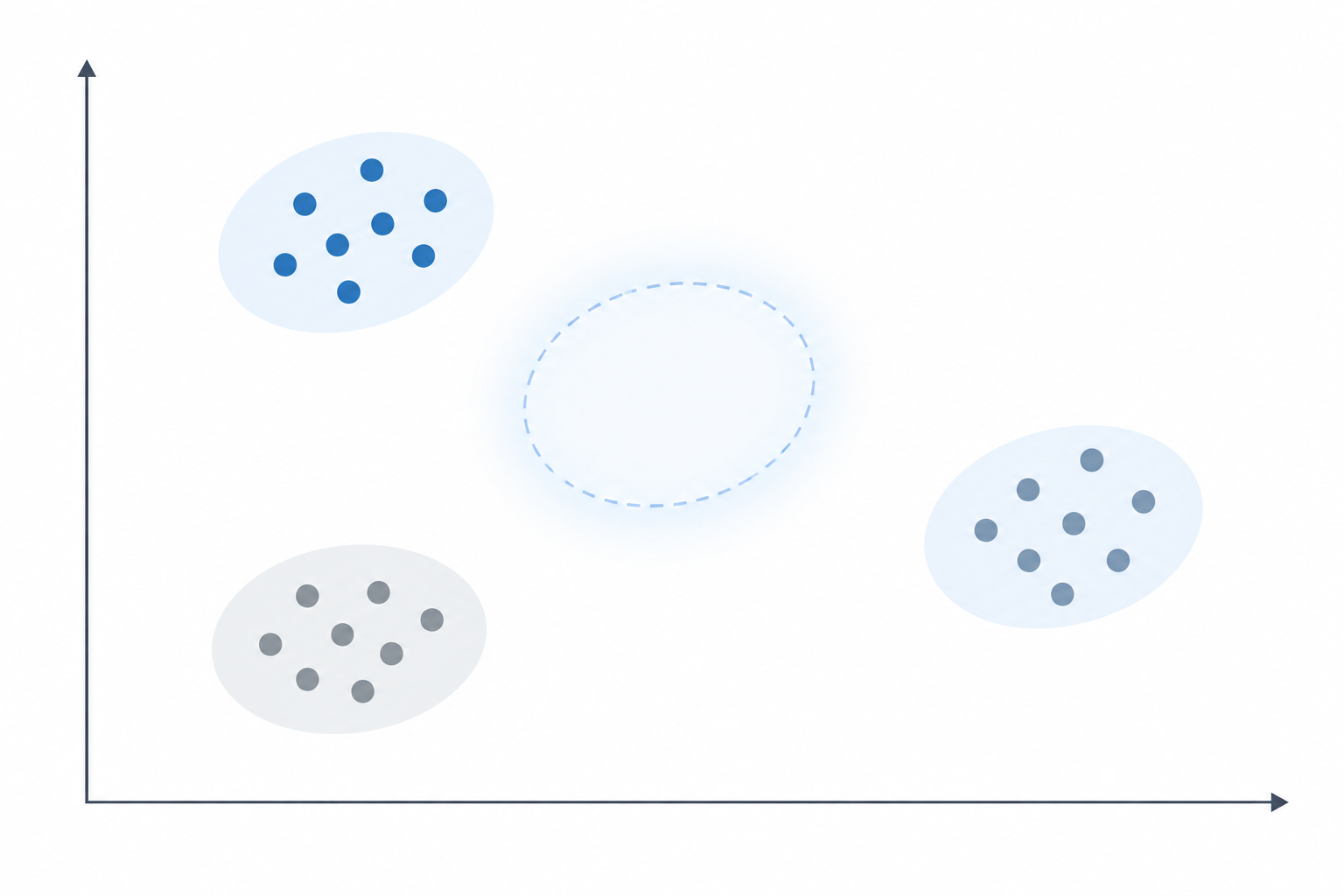
Here's a made-up but realistic scenario. A founder building project software reviews ads from five rivals and logs one observation: four of the five promise faster delivery, and almost none mention what goes wrong between teams.
That's a hypothesis, not a finding. So she books five customer calls and asks one open question: 'Tell me about the last time a project stalled. What happened?' Four of the five describe the same thing. Work stalls at handoffs, and nobody's sure who owns what.
Only then does she reframe her pitch around fewer handoff errors rather than raw speed. The ads pointed her to a possible gap, and the conversations showed it was real. Had the calls gone the other way, she'd have dropped the idea and lost an afternoon, not a quarter.
Marketing history has a similar example. Avis's long-running 'We Try Harder' campaign turned being number two into a service promise. It didn't come from ad analysis, but it's the same move: find what the category takes for granted, then offer a credible contrast.
What to look for in competitor ads: a founder's messaging checklist
Here's a framework you can paste into a doc and reuse. Work through one ad (or one cluster of similar ads) at a time.
| What to look at | What it tells you | How to use it in your pitch |
|---|---|---|
| Headline promise | The core outcome they believe buyers want most | If it matches everyone else's, reframe it and lead with a different outcome |
| Target persona | Who they seem to think their best customer is (title, company size, tone) | Find a segment they're ignoring, or speak more directly to one they address loosely |
| Primary pain point | The problem they think is urgent enough to stop the scroll | Name a sharper or less obvious problem that customers confirm in interviews |
| Proof and credibility | What they use to earn trust: logos, stats, testimonials, comparisons | Use a proof type nobody owns, and only claims you can substantiate |
| Offer and CTA | The next step they're asking for (trial, demo, audit, lead magnet) | Pick a lower-friction or more relevant next step for your buyer |
| Creative format | How they package the message (video, carousel, static, UGC style) | Notice saturated formats and test something that looks different |
| Landing page match | Whether the ad's promise carries through after the click | Make yours tighter; message mismatch is a common weakness |
How competitor ad messaging differs by platform
The same company often says different things in different places, so note the platform every time.
- LinkedIn ads: a good place to read B2B positioning, including the job titles and seniority implied in the copy and how formally they talk to buyers.
- Meta ads: brand and emotional hooks, which reveal the story a company wants associated with itself.
- Google Ads: the ad text and landing pages visible in the Transparency Center show how a rival words its promise to searchers. The tool doesn't reveal the keywords an advertiser bids on or its targeting settings, so don't infer those.
- TikTok ads: tone and audience cues, which show who a brand is trying to reach and how casual it's willing to be.
One tip for UK-based founders: record the date and country as well as the platform. Messaging, offers and even permitted claims can differ between markets.
How to sharpen your startup pitch with competitor ad insights
Collecting observations is the easy part. The value comes from changing something. Here's the sequence I'd follow.
- Map the common claims. List every promise you see across competitors, then mark the ones you'd have to drop to stand out. This is the uncomfortable bit, because some are probably on your homepage right now.
- Pick one or two hypotheses. Look for an audience, pain point or proof type nobody seems to own, and write each as a testable sentence. Chase five angles and you've just rebuilt the 'all-in-one' problem.
- Validate with customers. Ask five or so customers or prospects an open question about the problem (not 'would you like this?'). Keep a hypothesis only if you hear it unprompted from more than one person.
- Rewrite your one-line positioning statement. Test it against competitor headlines. If you could swap your line into their ad without anyone noticing, keep working.
- Update the assets that carry it. Your deck, homepage hero and landing pages should all reflect the sharper angle. Positioning only sticks when it's consistent.
- Run small tests. Try a few ad variations or outreach emails with the new message against the old one and compare replies, clicks and conversations. You're looking for direction, not statistical perfection.
- Revisit monthly. A gap that's open in March can be crowded by June.
A before-and-after startup pitch headline
Before: 'The faster, simpler way to manage your projects.'
After: 'Stop losing work between handoffs. Every task, one clear owner.'
The first line could belong to any of your competitors. The second commits to a specific problem and outcome. (It's illustrative, and only works if customer research and your product genuinely support it.)
A lightweight competitor research process for busy founders ⏱️
You don't need a research department. You need a habit you'll actually keep.
- Pick three to five direct competitors, not twenty. Depth beats breadth when you're short on time.
- Block a fixed 30–45 minute slot each week, plus a slightly longer monthly review. Put it in the calendar like any other meeting.
- Check what's new, what's stopped and what's still running. Change tells you more than a snapshot does.
- Log it in one shared doc. Use the same fields every time (see the sample below).
- Decide one change. One tweak to a headline, one new test, one question for your next customer call. Then move on.
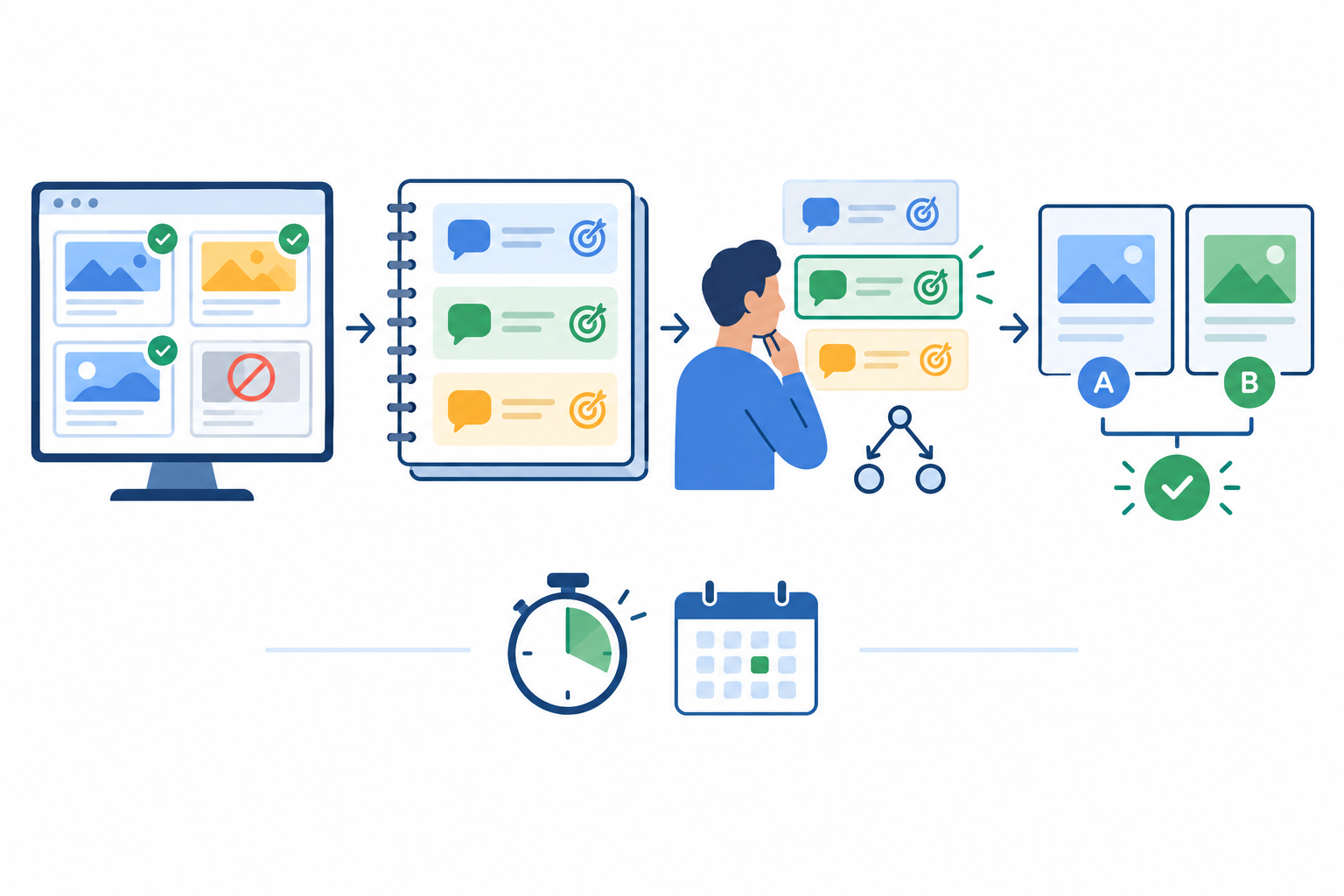
A sample competitor ad research log entry
Copy these fields into a doc or spreadsheet and add one row per ad or cluster of similar ads. The entry below is invented for illustration.
| Field | Example entry |
|---|---|
| Competitor | Rival A (fictional project-management tool) |
| Platform | |
| Date and country seen | 12 May, UK |
| Observed message | Headline: 'Ship projects twice as fast.' CTA: 'Book a demo'. Proof: three customer logos |
| Status | New this week |
| Hypothesis | Speed is the lead promise for the whole category; nobody addresses handoffs |
| Customer evidence needed | Do customers describe stalled handoffs as a bigger problem than slow delivery? |
| Next action | Add one handoff question to Thursday's customer call; draft an alternative hero line |
If a row has no next action, ask yourself why you wrote it down.
Common competitor ad research mistakes to avoid
- Copying the ad instead of learning the strategy. Ask why the ad says what it says and who it's for, then build your own version of the insight, not their words.
- Treating observations as conclusions. Anything you infer from an ad (confidence, price, sales motion, performance) stays a hypothesis until a customer or your own data backs it up.
- Over-researching and under-acting. The output should be a decision, not a beautiful spreadsheet.
- Ignoring smaller or adjacent competitors. Scrappier players often test bolder messaging because they have less to lose, and their experiments can hint at where the category is heading.
- Forgetting UK context. If you advertise in the UK, check the ASA and the CAP Code before borrowing any claim or tone. Comparative claims, for instance, should be verifiable and must not mislead or unfairly discredit a competitor. Be careful about using competitor names in ad copy too, as platforms such as Google have their own trademark policies. And watch the language, because American phrasing can feel off to a British audience.
Optional: automating competitor ad tracking
I'll be upfront: doing this by hand gets tedious. You jump between four ad libraries with different search quirks and no memory of last week, and that's where many people quietly give up. If that sounds familiar, there are tools that help, including one we built.
Full disclosure: Rival Ads is our product, so weigh this accordingly. It collects ads that Meta, Google, TikTok and LinkedIn make publicly visible for the competitors you add, and shows what's new, stopped or still active week to week. Those are observable statuses only, not spend, reach or performance. It also generates an AI summary of changes, which you should read as a set of hypotheses to test. Coverage depends on what each platform's public library exposes, so it varies by platform and country.
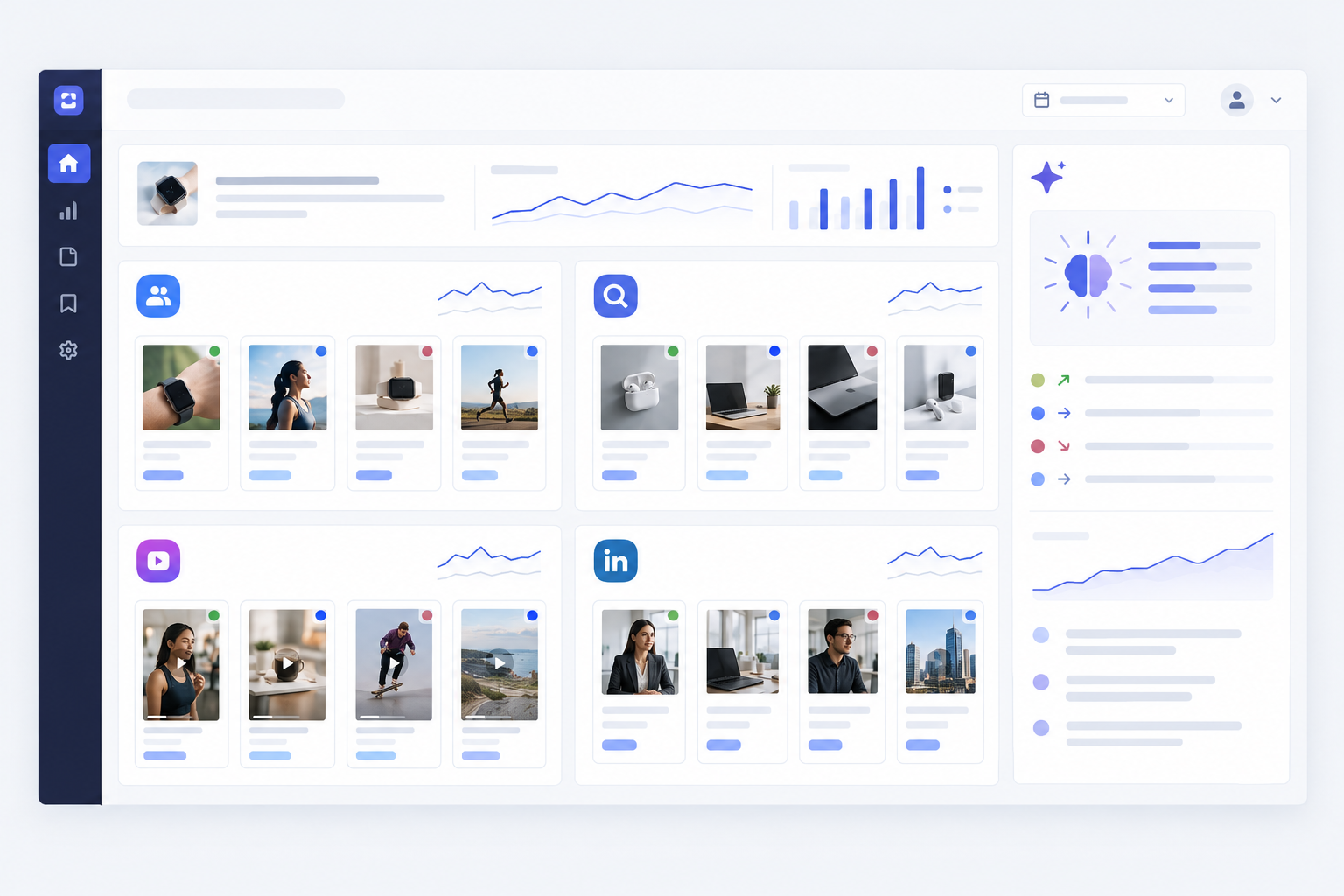
How does it compare with the free libraries? The libraries cost nothing and are the primary source, but you search one platform at a time and compare weeks yourself. A tool saves that legwork, but it costs money and can only show what those same libraries make public. If you're tracking three competitors, start free. If you're tracking ten across four platforms, the time saving may be worth paying for. Check the pricing page for current plans (they started at $29 a month, billed in US dollars, at the time of writing) and whether UK VAT applies to your account.
Putting competitor ad research into practice this week
You don't need an elaborate research project, just a small habit that ends in a change. Here's what I'd suggest:
- Pick three to five rivals and spend 30 minutes with the checklist above, logging what you see.
- Write one hypothesis and ask a few customers an open question to test it.
- Rewrite the one homepage or deck line that sounds most like everyone else's.
Start with the free ad libraries today. Within an hour you'll know how crowded your message really is.
Frequently asked questions about competitor ads and startup pitches
How can competitor ads help refine my startup's pitch?
They show the claims, audiences and offers your rivals are choosing to invest in. That helps you spot crowded messaging to avoid and possible gaps to test. Validate those with customers first, then bring the sharper angle into your deck, homepage and ads.
What should founders look for in rival messaging?
Focus on the headline promise, the pain point they lead with, who they target, the proof they use, and the offer or call to action. Note what you can directly see, then write down what you suspect and how you'd check it.
How much time should founders spend on competitive research?
For most early-stage teams, 30–45 minutes a week on three to five competitors is a sensible starting point, with a deeper review monthly. Automated monitoring can cut the manual checking by surfacing what's new or stopped.
Is it legal to look at competitors' ads?
Viewing ads that platforms make public, and learning from a rival's positioning, is generally fine. Reproducing their creative, wording, imagery or trademarks is a different matter, and the risk depends on the material and context. In the UK, the ASA guidance is a good starting point, and for a specific case it's worth taking legal advice.
Can I see how well a competitor's ads are performing?
Not directly. Public libraries don't show spend, reach or conversions. How long an ad has been listed or how many variations exist might prompt a closer look, but neither is proof of performance.