
How AI Is Changing the Way Marketers Analyze Competitor Strategy
See how ad intelligence helps media buyers spot competitor ad patterns, test cycles and messaging shifts—without replacing human judgment.
Chris Edington
11 min read
How AI Is Changing Ad Intelligence for Competitor Ads (Without Replacing Media Buyers)
Ad intelligence, the practice of systematically collecting, organising and interpreting competitor advertising signals, is finally catching up with how much media buyers actually need it. Instead of scrolling through the Meta Ad Library at 11pm on a Sunday, media buyers are increasingly leaning on tools that can spot creative fatigue, testing cycles and possible budget shifts across hundreds of competitor ads in seconds.
Here's the important bit: AI isn't replacing the media buyer's job. It's catching the signals. You're still the one who brings the context, the client history and the judgement calls needed to act on what it finds.
I've spent enough time watching media buyers work, and doing it myself, to know that competitive research has always been one of those tasks everyone agrees is important and almost nobody has time to do properly. AI is finally changing that equation, not by doing the thinking for you, but by doing the grunt work so you can get straight to the thinking.
The Old Way: Tracking Competitor Ads with Screenshots and Spreadsheets
If you've tracked competitor ads for more than a few months, you know the drill. You open Meta Ad Library, search the competitor's page, scroll through their active ads, and try to remember what was there last week. Then you do the same for Google's Ads Transparency Center. If you're thorough, you check TikTok's Creative Center too, and maybe LinkedIn's ad library if the competitor runs B2B campaigns.
Each of these libraries shows you something slightly different, and it's worth knowing the limits before you rely on them. Meta and TikTok show active ads reasonably well but don't always retain historical creative once a campaign stops running. Google's Ads Transparency Center is comprehensive for search and display but light on creative detail. None of them show you spend, targeting or performance, just presence. That's an important difference that gets lost when you're piecing together a picture of competitor activity from manual scrolling.
Then comes the really tedious part: screenshotting creatives, pasting them into a spreadsheet or a Notion doc, and trying to eyeball patterns across dozens of competitors and even more ad variants. Did they launch something new? Is that headline different from last week's? Wasn't there a video ad here before? You're relying on memory and vibes, which is a shaky foundation for strategic decisions.
This approach has a few problems that no amount of diligence fixes:
- It misses timing signals. A competitor pausing an ad on Tuesday and relaunching a near-identical version on Thursday tells you something about their testing cadence, but only if you're checking daily, which nobody is.
- It doesn't scale for agencies. If you're managing competitive research across ten client accounts, each with five to ten competitors, manual tracking turns into a part-time job on top of your actual job.
- It's inconsistent. Different team members notice different things. What one person flags as significant, another scrolls past.
The hidden cost here isn't just the hours lost, it's the opportunity cost of those hours. Every minute spent collecting screenshots is a minute not spent interpreting what competitors are doing and translating that into your own strategy. This is the gap ad intelligence tools were built to close.
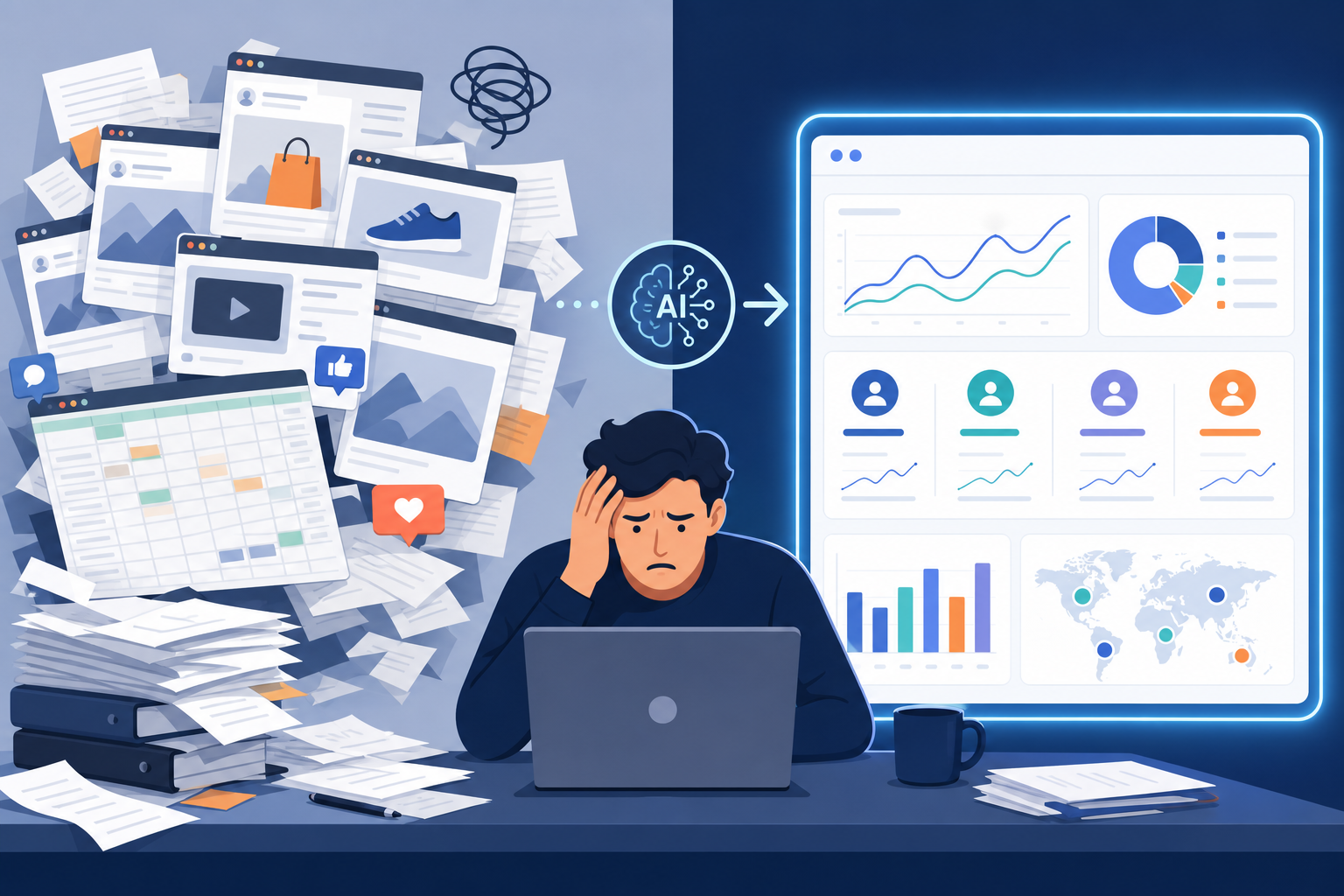 Alt text: A media buyer manually tracking competitor ads across multiple browser tabs and spreadsheets, illustrating the time cost of screenshot-based research.
What AI Catches in Competitor Ads That Humans Miss
This is where things get genuinely useful, though it's worth being precise about what's actually being observed versus what's being inferred. Good ad intelligence platforms build week-over-week diffs of what's publicly visible, then apply AI to interpret those diffs the way an experienced media buyer would, just faster, and across a wider dataset than any one person could hold in their head. What they can't do is see inside a competitor's ad account, so anything about spend or strategy is an educated read, not a fact.
Here's what that actually looks like in practice:
- Week-over-week diffs, not just ad lists. Instead of "here are the ads this competitor is running," you get "here's what's new, what's stopped, and what's still running since last week." That distinction changes how you prioritise your attention.
- Testing structure recognition. AI can spot when a competitor is running the same offer with five different hooks, a classic creative testing pattern that's easy to miss looking at ads one at a time but obvious when they're laid out together.
- Cross-platform correlation. If a competitor is pushing the same campaign concept on Meta, TikTok and LinkedIn at once, that's worth flagging as a possible coordinated push. It could also just be a scheduling coincidence, so it's worth treating as a hypothesis rather than confirmed strategy.
- Subtle messaging shifts. A change from "Save 20% today" to "Trusted by 10,000 businesses" isn't just a fresh ad. It can signal a pivot from promotional to trust-building messaging. AI trained to read copy changes catches this kind of shift even when the visual creative looks almost identical.
- Possible scaling signals, with real limits. By tracking ad volume, creative persistence and frequency changes over time, AI can flag when a competitor is likely increasing spend. But volume can also reflect heavier testing, automated creative variants, or just incomplete data from the ad library itself. Treat this as a proxy, never as confirmed budget information, since nobody outside a competitor's own team actually has their real figures.
This is the core value of a proper ad intelligence tool. It doesn't just archive competitor ads, it actively surfaces the patterns a sharp media buyer would want flagged, across every competitor you're tracking at once, while leaving the final call to you.
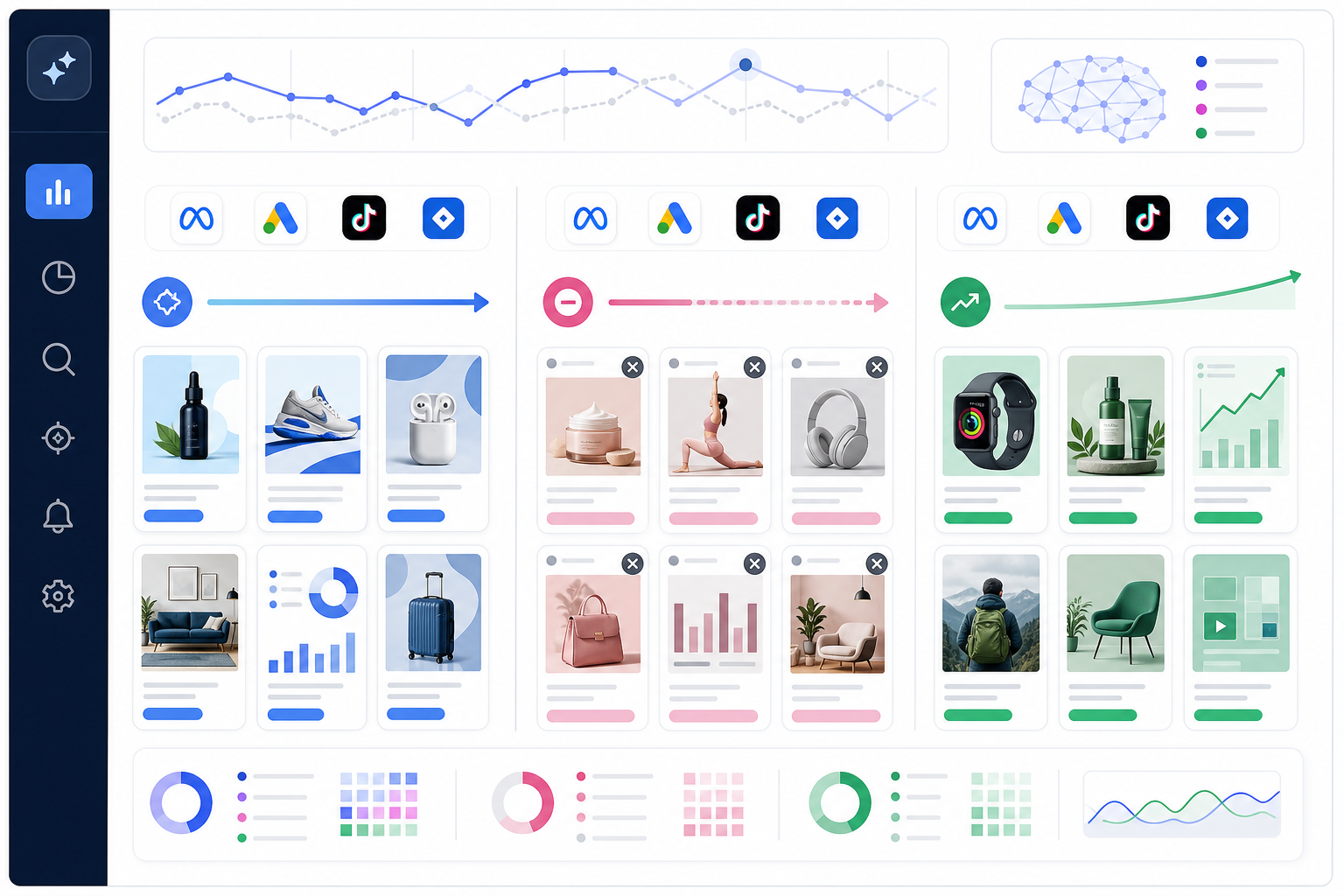 Alt text: Infographic illustrating a week-over-week competitor ad diff, showing new, stopped and scaling creatives across Meta, Google, TikTok and LinkedIn.
A Hypothetical AI Strategic Read of Competitor Advertising
To be upfront: what follows is a constructed scenario, not a documented case study, but it's the kind of pattern that shows up regularly when monitoring competitor ads with a tool like Rival Ads. It's useful because it shows how the same raw observation can support more than one interpretation.
Say a competitor launches 12 new creatives in a single week across Meta and TikTok. A quick manual scroll might register this as "they're doing a lot of testing right now" and move on. An AI-generated analysis working from structured week-over-week data might read it differently, but it should present that reading as one plausible explanation among a few, not a certainty.
| Observation | Possible interpretation | Confidence | Human check needed |
|---|---|---|---|
| All 12 creatives share a visual theme (countdown clock, seasonal palette) | Coordinated seasonal push rather than scattered testing | Medium | Check if the theme persists next week or disappears |
| Copy shifts from "discover," "introducing" to "shop now," "only 48 hours left" | Move from brand awareness to conversion-focused messaging | Medium-high | Compare against known sales calendar or past seasonal behaviour |
| Volume spike across two platforms simultaneously | Possible increased spend or budget reallocation | Low-medium | Cannot confirm without account access; watch for volume sustained over 2+ weeks |
That table matters more than the narrative gloss on top of it. It tells you the competitor has possibly moved from a top-of-funnel phase into a harder sales push, which might mean they're clearing seasonal stock, testing a new promotional calendar, or reacting to a slow sales period. It could just as easily be a short-lived test that gets pulled in a week. The honest answer is you don't know yet, which is exactly why the validation column exists.
Piecing this together manually would mean cross-referencing 12 ads, noting visual similarities, tracking copy tone over several weeks, and correlating timing across two platforms. That's genuinely hours of work for a human analyst, and a lot of that nuance would probably get missed entirely in a quick weekly scroll, especially across multiple competitors. The value of AI here isn't certainty, it's speed to a well-organised hypothesis.
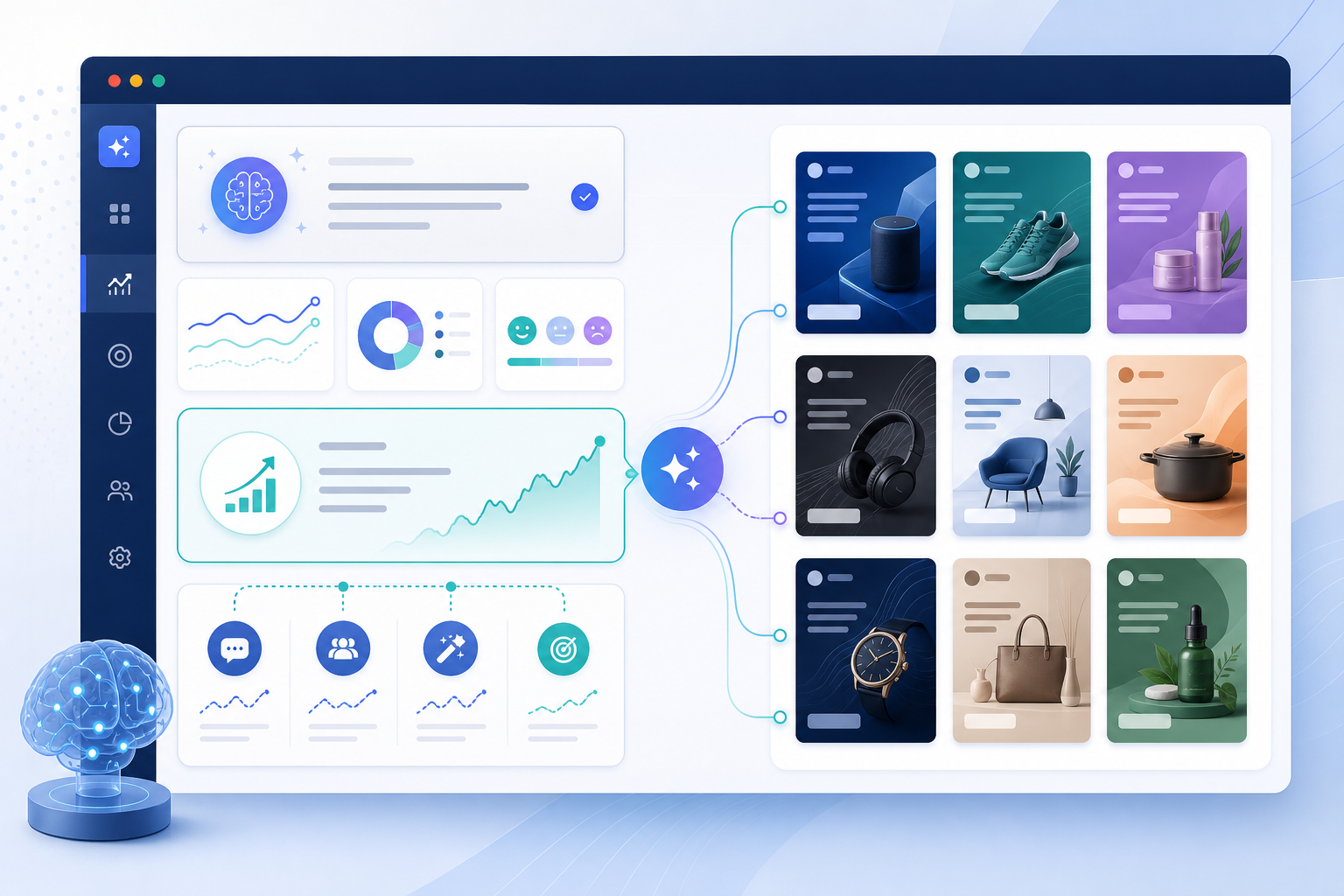 Alt text: Dashboard mockup showing AI-generated strategic analysis alongside competitor ad creatives, highlighting a detected shift from awareness to conversion messaging.
Where Human Judgment Still Matters in Ad Intelligence
Here's the part I want to be really clear about: none of this makes the media buyer redundant. If anything, it raises the bar for what good strategic thinking looks like, because the grunt-work excuse disappears. AI's blind spots fall into three broad areas.
Context. AI doesn't know your client's history, budget constraints or risk tolerance. Maybe you tried a similar seasonal push last year and it flopped for reasons specific to your brand. A competitor scaling aggressively might warrant a matching response, or it might not, depending on what your client can actually afford.
Validation. AI can't always tell a genuine scale-up from a failed test about to get killed. A burst of ad volume can look like momentum when it's actually a competitor throwing variants at the wall before pulling the plug on the whole campaign. Reading between those lines takes experience with how that particular market or competitor typically behaves, which is exactly why the validation step in the table above matters more than the initial flag.
Action. AI can't write your media plan for you, and it can't tell you what's worth reacting to. Not every competitor move deserves a response. Say an AI flag suggests a rival is scaling a discount campaign hard. Reacting instantly by slashing your own prices without checking margin impact, or whether the pattern holds for more than a week, is exactly the kind of bad strategic reaction good judgement is meant to prevent.
Think of AI here as an incredibly fast, tireless research assistant who never misses a beat but has zero context about your business. That's genuinely valuable. It just isn't the whole job.
How AI Changes Your Weekly Competitor Ad Intelligence Workflow
So how does this actually change how you spend your Monday mornings? Here's a workflow that reflects how I think most media buying teams, UK agencies included, should be approaching this now.
- Start with an AI-generated digest instead of a blank spreadsheet. Let the tool surface what changed across your tracked competitors before you open a single tab yourself.
- Use the diff view to prioritise. Skip past competitors who didn't move this week and spend your limited time on the ones showing genuine change.
- Read the AI strategic analysis first, then dig into the raw creatives. Let the AI framing guide your thinking, then verify anything flagged as significant with your own eyes. This is where your judgement adds real value.
- Check whether the pattern persists. Before treating any single week's flag as meaningful, see if it holds for a second reporting period. One week of volume spikes could be noise; two or three weeks is a trend worth acting on.
- Bring AI-flagged patterns into stand-ups and client reports as talking points, not final verdicts. Frame them as "here's what we're seeing and here's what we think it means," not gospel.
- Set up competitor assignments across your team. If you're managing this at agency scale, make sure roles are clear so nobody's duplicating monitoring on the same three competitors while others go untracked. This matters as much around UK-specific retail moments, Black Friday, Boxing Day, the January sales, as at any other time of year, since that's when competitor testing tends to spike.
A quick note on tools: this is the workflow Rival Ads is built around. It doesn't need ad account access. You point it at a competitor's website, it detects their ad presence across Meta, Google, TikTok and LinkedIn, and delivers weekly diffs plus AI analysis to your dashboard or inbox. Agencies can run it under their own brand via the whitelabel option. Whichever tool you use, the principle above matters more than the product: let AI handle the scanning, and keep the interpretation and the final call with your team.
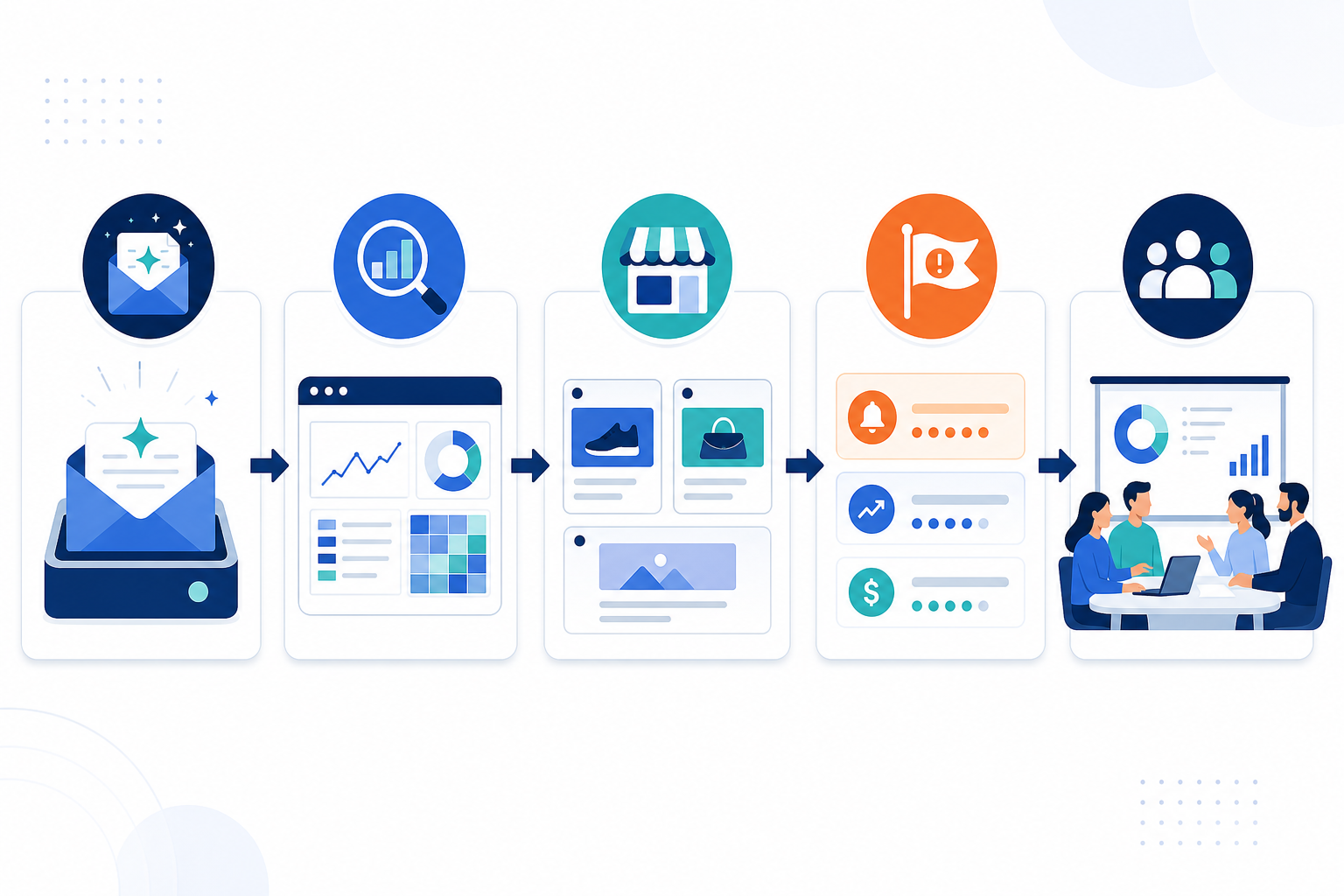 Alt text: Flowchart of a weekly media buyer workflow, from AI digest email through prioritisation, validation and team review of flagged competitor moves.
Frequently Asked Questions About AI, Ad Intelligence and Competitor Ads
Can AI really analyse competitor ad strategy?
Yes, to a meaningful degree. AI can process hundreds of ad variants, spot testing patterns, and flag changes in messaging or apparent spend far faster than a human scrolling through ad libraries. What it can't do is understand your specific business context or make the final call on strategy. It's also working from public ad-library data, which shows presence and creative, not confirmed budgets or targeting, so treat its reads as informed hypotheses rather than facts.
How accurate are AI-generated ad insights?
Accuracy depends heavily on data quality and how the AI is prompted. Tools that feed the AI structured week-over-week data, what's new, paused, or scaling, produce more grounded analysis than asking a general-purpose AI to guess from raw screenshots. Even then, treat the output as a strong hypothesis to verify, not a settled conclusion, particularly for anything implying budget or spend changes.
Will AI replace media buyers' competitive research?
Unlikely, and not in the way people fear. AI removes the tedious data-gathering part of competitive research, freeing up media buyers to spend their time on interpretation and strategy. The buyers who thrive will be the ones who use AI to work faster and validate its flags with real market knowledge, rather than the ones who ignore it or expect it to make decisions for them. Rival Ads is one option built for this kind of grounded, structured analysis, but the underlying skill, knowing what to check before acting, is what actually separates good competitive research from noise.