
Competitive Positioning 101: What Competitor Ads Reveal About Their Strategy
Learn how Competitive Positioning 101: What Competitor Ads Reveal helps founders read live ad copy, spot market gaps, and build sharper messaging.
Chris Edington
14 min read

The core lesson of Competitive Positioning 101: What Competitor Ads Reveal is simple: competitor ads are one of the most useful signals of competitive positioning you'll find—because unlike a website or pitch deck, ads are what a company is currently willing to spend real money to say. By studying headline language, audience targeting cues, visual tone, and what's scaling versus what's been paused, you can build a strong working theory of a competitor's strategy without ever sitting in their boardroom.
But here's the important caveat before we go any further: ads reveal a competitor's current hypotheses and investment priorities—not guaranteed winners, and definitely not their complete strategy. An ad library shows you creative and duration. It doesn't show you spend, conversion rate, profitability, or whether the campaign is actually hitting its targets. Treat everything in this guide as a strong signal worth investigating, not proof on its own.
I've spent time digging through competitor ads across Meta, Google, TikTok, and LinkedIn while building out positioning work for early-stage teams, and the pattern that keeps showing up is this: ads move faster than any other public artefact a company produces. A website can sit untouched for a year. An ad account gets adjusted constantly. That gap is exactly what makes competitive positioning analysis through ads so useful for founders and CMOs—including UK teams working with tighter budgets and smaller teams than their US counterparts—who need directional insight fast and can't afford to guess.
This is Competitive Positioning 101—a practical, appropriately cautious guide to reading what competitors appear to be telling the market, based on what they're currently paying to say.
Competitive Positioning 101: What Competitor Ads Reveal About Positioning
Websites get updated occasionally, often after an internal debate, a rebrand, or a new hire who finally convinces leadership the homepage copy is stale. Ads change far more often—sometimes weekly, sometimes daily—based on budget cycles, seasonal pushes, and testing plans.
Here's where I want to correct something I've seen stated too confidently elsewhere, including in earlier versions of this piece: a company running the same ad for three weeks straight is not proof that the message is converting brilliantly. It might mean that. It might also mean the campaign is a low-priority retargeting sequence, a brand-awareness spend that isn't measured on direct response, a contractual placement they can't easily pull, or simply a low-budget test that nobody's gotten around to reviewing. Sustained activity is evidence of continued investment and attention—that's genuinely useful to know—but it isn't evidence of profitability or strategic certainty. The honest framing is: the longer an ad runs, the more likely it's earning its budget, but you can't say that with certainty from the outside.
Compare that to static assets like an About page or a pitch deck, which often lag behind real strategy shifts by months. I've seen UK software companies whose website still talks about "enterprise-grade security" while their live ads have quietly pivoted to speed and simplicity messaging aimed at small business owners. That doesn't prove the pivot is working—but it does tell you where they're currently placing their bets, which is valuable on its own.
Ads also show you a competitor's current best guess about their own audience. They're not just telling you what they think their product does well—they're telling you who they believe will respond to that message right now. That's positioning and audience targeting bundled into one signal, refreshed far more often than anything on their website.
If you're trying to understand a competitor's current strategic direction—not the polished version from their careers page—their live ad activity is one of the most useful (if imperfect) sources you have.
How to Read Competitor Ad Value Propositions in Headlines
Once you start looking at competitor ads with intent, the headline is where you should focus first. Companies know they have a split second to grab attention, so the sharpest differentiation almost always lives in the first 5-7 words.
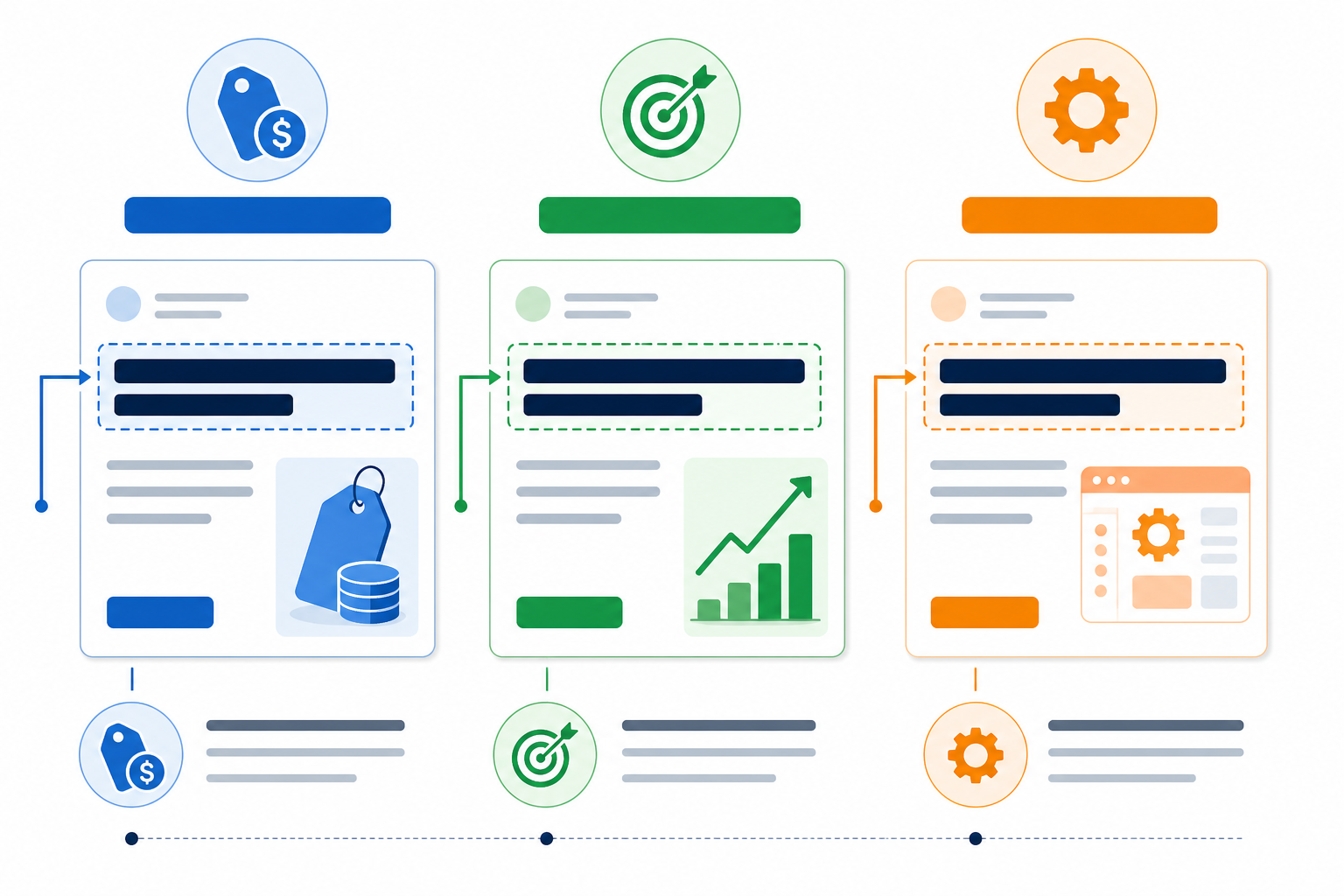
Most headlines fall into a handful of recognisable patterns. Here's a slightly wider set than the classic three, because in practice you'll see all of these show up:
- Price-led headlines ("Save 40% on your first year") suggest a cost positioning strategy—competing on value-for-money, often to win price-sensitive buyers or undercut an established player.
- Outcome-led headlines ("Launch in days, not months") suggest a speed or simplicity angle. This is common among challenger brands trying to make an incumbent look slow by comparison.
- Feature-led headlines suggest the company is still competing on capability rather than brand. If specs or integrations dominate the headline, they may not have found a stronger emotional hook yet—or they're targeting a technical buyer who genuinely cares about the details.
- Trust-led headlines ("Trusted by 12,000+ finance teams") suggest they're leaning on social proof to reduce perceived risk, usually because the category has been burned by unreliable vendors before.
- Risk-reduction headlines ("No credit card required" or "Cancel anytime") suggest they're addressing friction or scepticism at the point of decision, often in a crowded or commoditised market.
- Status-led headlines ("The tool top marketing teams switch to") suggest they're selling identity and aspiration as much as function—common once a category matures and functional differences shrink.
- Category-creation headlines ("The first AI-native CRM built for...") suggest they're trying to avoid being compared directly to existing players by naming a new space entirely.
Repeated phrases across multiple ads are a strong tell, even with the caveats above. If the same three or four words show up across different formats and platforms, that's very likely their core message rather than a one-off test—short-lived tests tend to get killed quickly, while core messages get repeated deliberately.
A simple way to apply this: keep a running note (a spreadsheet works fine) logging each competitor's headline, the category it falls into, and the date you spotted it. After a few weeks, patterns and shifts become obvious. If a competitor starts with feature-led copy and gradually moves toward outcome-led language, that's a real-time view of their positioning strategy evolving—and you're watching it happen before their website catches up.
How to Spot Target Audience Clues in Competitor Ad Creative
Headlines tell you the "what." The rest of the ad copy and creative gives clues about the "who"—though these are genuinely clues, not confirmed facts, so treat them as hypotheses to validate rather than conclusions to act on immediately.
A few things worth watching for:
- Job titles or industry jargon in the copy may indicate exactly who they're trying to reach. If an ad opens with "Hey, Ops Managers," that's a fairly direct signal about their target buyer.
- Pain points mentioned in the first line may show what problem they believe matters most to buyers. This is a window into their assumptions about the market—assumptions worth validating or challenging against your own customer conversations, not accepting at face value.
- Platform choice offers a clue, not a verdict. LinkedIn ads often suggest a focus on B2B decision-makers, but they can also just reflect cheap inventory in a quiet auction period. TikTok ads may suggest a younger or more consumer-oriented push, but they can equally reflect an experimental test budget or a creator-partnership deal. If a competitor you thought was purely enterprise-focused suddenly appears on TikTok, it's worth investigating—but don't assume it means their entire strategy has shifted.
- Testimonial or case study ads may reveal which customer segment they're proudest of, or simply which customer agreed to be featured. If every testimonial features a fintech company, that's a reasonable hint about where they see traction—corroborate it by checking their careers page for role postings in that sector, or their case study library for volume.
- Pricing mentions (or their deliberate absence) hint at audience, but aren't conclusive. No price on the ad often means "talk to sales," which commonly signals an enterprise motion—though some SMB-focused companies also hide pricing simply because their model is usage-based and hard to summarise in an ad.
Putting these clues together, and checking them against other public signals like job postings, review sites (G2, Capterra, Trustpilot), and LinkedIn employee headcount, gives you a reasonably accurate picture of a competitor's likely target customer—without needing access to their internal marketing docs.
How Tone and Visuals Signal Brand Positioning Strategy
Copy tells you a lot, but tone and visuals fill in more of the story. This is the part of competitive positioning analysis that's easy to skim past, and also the part where it's easiest to over-interpret—so I'll flag the exceptions alongside the patterns.

A few patterns tend to hold up reasonably often, with real exceptions worth knowing:
Playful, meme-style creative often signals a challenger brand trying to disrupt an incumbent—if you can't out-resource the market leader, you can out-personality them. But plenty of well-funded, market-leading consumer brands use humour deliberately to stay culturally relevant, so don't assume playful tone always means small or new.
Polished, corporate visuals often signal a company protecting an established position, using clean stock photography and safe language to reinforce trust with buyers who already know the brand. The exception: some enterprise software companies deliberately use humour and irreverence in ads specifically to differentiate from a sea of identical "polished" competitors—so a corporate-looking incumbent using memes may be signalling a fresh positioning push, not confusion.
Bold colour and motion-heavy video ads on TikTok or Meta often suggest a growth-stage push for top-of-funnel awareness rather than immediate conversion. That said, some direct-response performance marketers use exactly this style purely because it performs well in the algorithm—not because they're chasing brand awareness at all.
Text-heavy, data-driven ads on LinkedIn often suggest a considered, high-value B2B sale, since few buyers commit to a £50,000 software contract from a flashy 15-second video. The counterexample: some consumer fintech and insurance brands run dense, stat-heavy LinkedIn creative purely to recruit talent or build category credibility, not to sell directly.
A subtler, more reliable signal: consistency (or inconsistency) in visual branding across platforms tends to reflect marketing maturity. If a competitor's LinkedIn, Meta, and TikTok ads look like they came from three different companies, that often points to a fragmented team or an agency working without a unified brief. If everything feels cohesive, you're likely facing a more disciplined marketing operation—though even mature teams occasionally run rough tests that break the pattern.
How to Compare Positioning Across Multiple Competitors
Looking at one competitor's ads is useful. Looking at several side by side is where real strategic clarity starts to emerge, because positioning only means something in relation to what everyone else in the category is saying.
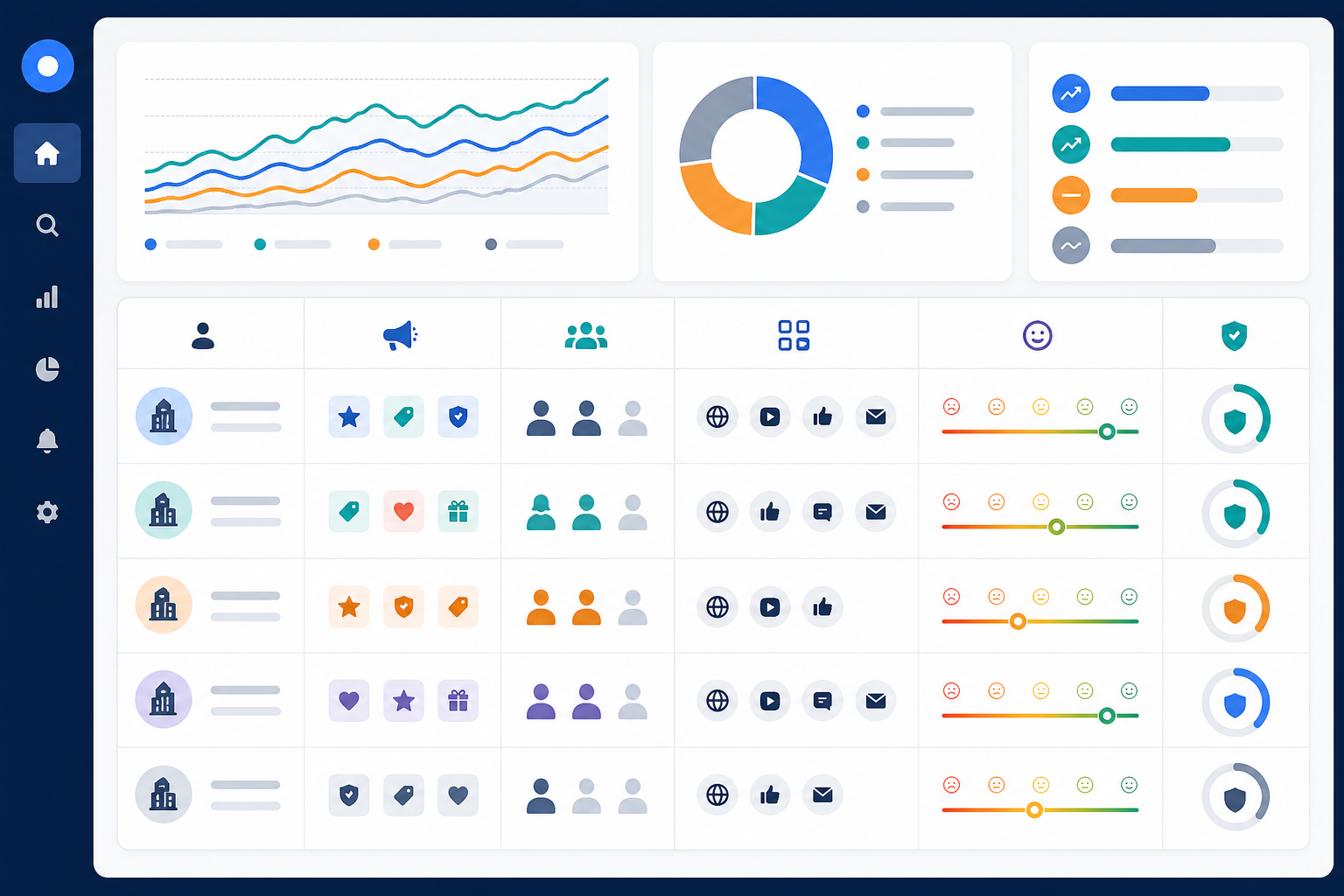
Here's a worked example using three fictional UK SaaS competitors, so you can see the framework in action rather than just a list of column headers:
| Competitor | Headline theme | Apparent audience | Pain point led with | Proof used | Platform mix | Funnel stage (best guess) | Confidence | Open questions |
|---|---|---|---|---|---|---|---|---|
| Competitor A | Outcome-led ("Go live in 48 hours") | SMB operations teams | Slow onboarding | Customer logos, no stats | Meta, Google | Mid-funnel, conversion-focused | Medium | Is "48 hours" verified or aspirational? |
| Competitor B | Trust-led ("Trusted by 4,000+ UK teams") | Mid-market finance buyers | Compliance risk | Case study, ICO-referenced language | LinkedIn only | Bottom-funnel, considered sale | High | Why LinkedIn exclusively—budget or buyer habit? |
| Competitor C | Price-led ("From £19/month") | Freelancers, micro-businesses | Cost of existing tools | None shown | TikTok, Meta | Top-of-funnel, awareness | Low | Is this a genuine push or a short test? |
Walking through one row: Competitor B's LinkedIn-only, trust-led approach with compliance messaging and a specific customer count suggests they're chasing considered, risk-averse mid-market buyers—plausibly UK financial services teams, given the regulatory language. I'd rate this medium-to-high confidence because the signals reinforce each other (platform, tone, proof all point the same direction), but I'd still check their case studies page and any G2 reviews before treating this as settled. That's the discipline worth applying to every row: state the observation, state your confidence level, and name what you'd need to check to be more certain.
Once you've mapped a handful of competitors this way, a few things tend to jump out:
- Who's scaling versus testing. Competitors running the same ad for weeks appear more committed to that message, though as covered earlier, that's a signal of investment, not confirmed proof of performance. Competitors constantly swapping creative are more likely still testing.
- Whitespace. If every competitor in your category leans on speed and simplicity, and nobody's talking about reliability or support quality, that's a potential open lane worth exploring.
- Overlap. Where multiple competitors are saying nearly the same thing, that's a crowded message. Repeating it just adds you to the noise instead of helping you stand out.
Building this grid manually means checking Meta's Ad Library, Google's Ads Transparency Center, TikTok's Creative Center, and LinkedIn's ad activity separately for every competitor, every week—which is manageable for two or three companies but becomes tedious fast once you're tracking a real competitive set. This is the exact gap a tool like Rival Ads is built to close: it's a platform I've used for exactly this kind of tracking, and it pulls ad activity from these platforms on a recurring basis so the comparison grid above is easier to maintain without four separate manual checks each week. I'd still recommend spot-checking anything strategically important directly in the source ad library, since no third-party tool fully replaces that.
How to Turn Competitor Ad Analysis Into a Messaging Advantage
All this analysis is only useful if it changes what you actually do. Here's a practical sequence for turning competitor ad intelligence into your own positioning advantage:
- Identify the 2-3 positioning angles your top competitors all lean on. If everyone's shouting about speed, write that down. If most are price-led, note that too.
- Decide whether you want to compete head-on or claim a different angle entirely. Sometimes the smartest move is contrast, not competition—especially if the dominant angle feels crowded.
- Test a headline that directly contrasts with the dominant competitor message. If everyone's saying "fast," try leading with "thorough" or "built to last." Let your own data—not assumption—tell you which resonates.
- Watch how competitors react, but treat it as a secondary signal, not proof. If a competitor adjusts their ads shortly after you launch new positioning, that's mildly interesting and worth noting. It is not confirmation that your angle is working. The real validation is in your own numbers: improved click-through rate, better lead quality, more qualified conversations, or direct feedback from sales calls. Competitor reactions can just as easily reflect unrelated internal changes on their end.
- Set up ongoing tracking so this isn't a one-off exercise. Competitive positioning shifts constantly. Treating it as continuous input into your marketing strategy—rather than a quarterly research project—is what separates reactive teams from ones that consistently stay ahead.
This is really the heart of good ad intelligence: it's not about copying what works for someone else, and it's not about treating every observation as certain. It's about building a reasonably accurate, appropriately humble picture of the landscape so you can choose your own lane deliberately, rather than by accident.
FAQ: Competitive Positioning Analysis Through Ads
How can I figure out a competitor's positioning just from their ads?
Start with headlines—the first line of an ad usually contains their core value proposition. Then look at who they appear to be speaking to (job titles, pain points, platform choice) and how long they've been running a given message. Ads that have stayed live for weeks without major changes are a reasonable signal of continued investment, but not confirmed proof of performance—ad libraries don't show you spend, conversion rate, or profitability, so treat duration as one input among several, not the final word.
What messaging clues should I look for in competitor copy?
Focus on three things: the value proposition in the headline (price, speed, trust, or feature-led), the pain point mentioned first (a hint at their assumed buyer priority), and repeated phrases across multiple ads (a stronger indicator of their real positioning than any single ad). Testimonials and case studies also hint at which customer type they're proudest to showcase, though it's worth checking whether that's their broadest segment or just their most flattering one.
How do I compare positioning across several competitors at once?
Manually, this means checking each competitor's ad library on Meta, Google, TikTok, and LinkedIn separately every week, then logging headline theme, audience signals, platform mix, and tone into a shared grid like the worked example above. This is workable for a handful of competitors but gets unmanageable once you're tracking a full competitive set. Tools such as Rival Ads can help automate the pulling and organising of that data, though I'd still recommend verifying anything strategically important directly against the source ad library rather than relying on any single tool as the final word.
What are the biggest risks of over-interpreting competitor ads?
The main risk is mistaking a signal for a fact. An ad running for weeks might reflect a winning message—or a low-priority retargeting sequence nobody's reviewed. A platform choice might reflect deliberate audience targeting—or simply cheap ad inventory that week. Always pair ad analysis with other sources (job postings, reviews, case studies, pricing pages) before making a strategic decision based on what you've seen in someone else's ad account.