
How to Build a Creative Testing Roadmap from Competitor Ad Data (Without Just Copying Everyone Else)
Learn a repeatable process for turning competitor ad research into a structured creative testing roadmap—from categorizing angles to building a 4-week
Chris Edington
15 min read
How to build a creative testing roadmap using competitor ad data (without copying everyone else)
If you've ever spent an afternoon scrolling through a competitor's Meta ad library, you know the feeling: forty tabs open, a dozen screenshots saved, and... then what? Most performance marketers I talk to have a folder somewhere called "competitor swipe file" that hasn't been touched in three months. The research happens. The application doesn't.
Here's the fix. A creative testing roadmap built from competitor ad data works best when you treat competitor ads as a signal source, not a script. The process breaks down into four steps: categorise the angles competitors are running, map those angles to your own audience and offer, prioritise based on signal strength, then slot the strongest candidates into a 4-week test calendar with clear hypotheses, not copies. The rest of this post walks through exactly how to do each step, including where competitor signal can mislead you, and how to avoid the copycat trap that makes so many "competitor-inspired" campaigns fall flat.
Why competitor ad data should feed your creative testing roadmap, not replace it
There's a real difference between ad spying as a hobby and ad intelligence as a strategic input. Spying is passive: you watch, you screenshot, you feel vaguely informed. Ad intelligence is active: you're pulling structured signal out of what competitors are doing and feeding it into decisions you're actually going to make this quarter.
Here's the important caveat, and it's one a lot of guides skip: competitor ads show you what's being tested in the market, not what's proven to convert. Public ad libraries (Meta's included) don't show you spend, profitability, conversion rate, or which audience segment is actually responding. A UK insurance brand running the same ad for six weeks might be winning on that creative, or they might be running a brand-awareness mandate with a fixed quarterly budget that has nothing to do with performance. You genuinely can't tell from the outside. Treat every competitor signal as a hypothesis worth investigating with your own data, never as a guarantee.
That's why your roadmap still needs to be anchored in your own audience data, your own offer structure, and your own brand voice. Competitor ad data is one input among several. It sits alongside your historical performance data, your customer research, and whatever qualitative insight you've got from sales calls or support tickets. Think of it like weather data for a farmer: knowing it rained heavily two towns over doesn't tell you what to plant. It tells you conditions are shifting, and it's worth paying attention to your own soil.
Step 1: Categorising competitor ad angles
Before you can prioritise anything, you need a consistent way to sort what you're seeing. Without categories, competitor research just turns into a pile of disconnected screenshots. Here's a system that works well, with quick definitions so your team tags things consistently:
- Sort by angle type. Most ads fall into a handful of buckets: pain-point led (names a specific frustration), social proof (reviews, testimonials, user counts), offer/discount (price or promotion led), aspirational (lifestyle or identity focused), educational (explains a concept or process), or comparison (positions against an alternative). Tag every ad you log with one, occasionally two, of these.
- Separate by platform. Angles that perform well on TikTok often flop on LinkedIn, and vice versa. A punchy pain-point hook works differently in a 15-second UGC video than in a static LinkedIn carousel aimed at a procurement manager. Track Meta, Google, TikTok, and LinkedIn separately rather than lumping everything into one list.
- Log format alongside angle. Angle and format tend to perform as a pair. A social proof angle delivered as a UGC testimonial video behaves very differently from the same angle delivered as a static graphic with a quote overlay. Note both, using a simple tag format like: social proof | UGC video | Meta | retargeting | Competitor A.
- Use week-over-week data to spot age. An angle that just appeared this week is a different kind of signal to one that's been running steadily for two months, though as we'll cover in Step 3, "running for a while" is a clue, not proof. If you're using an ad monitoring tool, a diff view (what's new, what's continuing, what's stopped) does a lot of this tracking for you automatically.
- Tag by competitor. You want to know if a single competitor owns a particular angle, or if it's showing up market-wide. That distinction matters a lot for prioritisation, which we'll get to shortly.
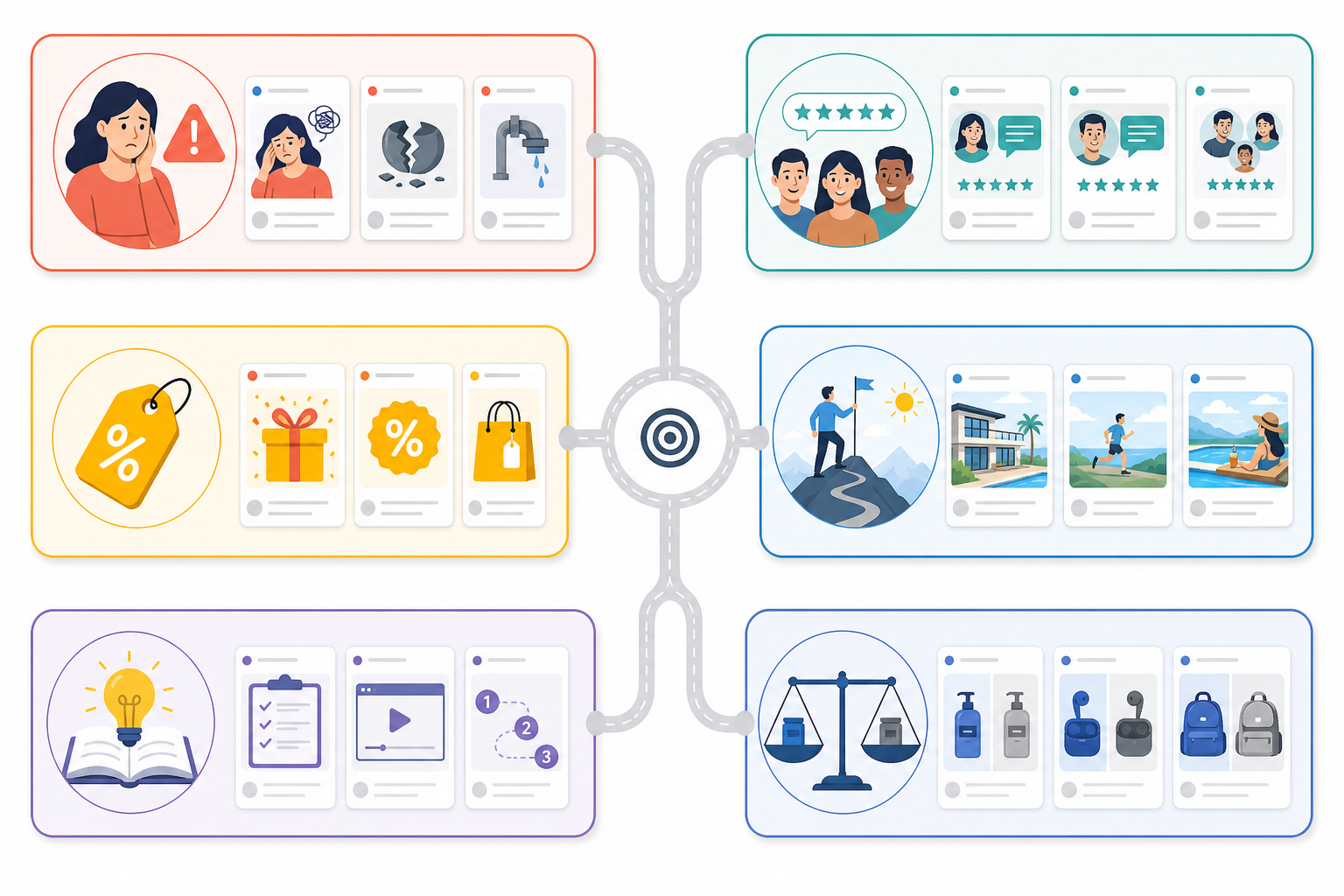
This step feels a bit like admin, I know. But it's the difference between "I saw a cool ad" and "three competitors are independently testing an aspirational angle around convenience, and it's been live for a month." One of those is useful. The other is trivia.
Step 2: Mapping competitor ad angles to your own audience and offer
Once you've got angles categorised, the next job is filtering out the ones that don't actually apply to you. This is the step people skip most often, and it's the one that causes copycat campaigns to underperform.
Run every shortlisted angle through this four-question checklist before it earns a slot on your roadmap:
- Audience pain: Does this angle address a pain point our audience genuinely has, described in language they'd actually use, or is it specific to the competitor's own positioning and customer base?
- Offer proof: Do we have the proof points (data, reviews, case studies) needed to back this angle up credibly, or would we be making a claim we can't yet substantiate?
- Funnel stage: Is this angle built for cold audiences or warm ones? An angle a competitor is running for retargeting (one that assumes prior familiarity with the brand) can completely flop as a cold-audience hook, meaning the first ad someone sees, with no existing trust to lean on. Check which funnel stage you're seeing the ad in before you borrow it.
- Brand credibility: Does our current level of trust and social proof support this angle, or does it rely on authority we haven't earned yet?
A competitor selling to enterprise buyers might run an angle about compliance and risk reduction. If you're selling to solo founders or small UK businesses, that angle simply doesn't map. No amount of clever copywriting will make it relevant.
And this is the part I'd underline twice: reframe the angle in your own brand voice and value proposition rather than lifting the language directly. If a competitor's pain-point hook is "Tired of losing hours to manual reporting?", don't just swap in your product name. Ask what pain point your customers describe in their own words, then write the hook from that. The angle category can be borrowed. The specific execution shouldn't be.
Step 3: Prioritising creative tests by competitor signal strength
Now you've got a shortlist of angles that are both interesting and relevant to your audience. You still can't test everything at once, so you need a way to rank them, and this needs to be more than a gut feeling.
A quick but necessary caveat first: none of the signals below prove an ad is profitable. Public ad libraries don't expose spend, audience size, placement, or attribution data. Longevity and repetition are proxies for "this ad has continued strategic value to the advertiser," which might mean it's converting well, but might also mean it's running against a fixed brand-awareness budget, testing a new market, or simply hasn't been reviewed yet. Use the scoring model below to prioritise what's worth testing, then validate every result against your own account data once it's live.
A simple 10-point scoring model:
- Longevity (0–3): 1 week = 0, 2–3 weeks = 1, 4–6 weeks = 2, 6+ weeks = 3. Ads that run longer are more likely to have continued strategic value, but confirm nothing about profitability on their own.
- Repeated variations (0–2): Same angle appearing across multiple formats or hooks from one competitor scores higher. It suggests the angle is core to their strategy rather than a one-off test.
- Cross-competitor adoption (0–2): Two or three competitors independently testing a similar angle around the same time is a stronger market signal than any single advertiser's behaviour. It may point to a shifting objection, a seasonal trigger, or a shared audience insight.
- Audience relevance (0–2): How well the angle passed your Step 2 checklist.
- Offer fit (0–1): Whether you currently have the proof points to execute it credibly.
Worked example:
| Observed pattern | Inferred angle | Score | Hypothesis | New execution | Primary metric | Decision threshold |
|---|---|---|---|---|---|---|
| Three UK SaaS competitors running "save X hours a week" messaging for 5+ weeks, in both static and video formats | Pain-point: time saved on manual admin | Longevity 2 + Repeated 2 + Cross-competitor 2 + Audience 2 + Offer 1 = 9/10 | Our audience (finance managers at SMEs) responds better to a specific time figure than a vague promise | Original customer-story video citing our own case study data, not the competitor's framing | CPA vs. account average, hook rate | Kill if CPA is 50%+ above account average after minimum spend is reached; scale if CPA is at or below average |
A few notes on what "scale signal" actually tells you: new variations of an angle appearing regularly is an indirect proxy for continued investment, not confirmed evidence of budget scale. Third-party monitoring tools can show you creative changes, but they generally can't show you spend. Treat it as one input in the score, not a standalone green light.
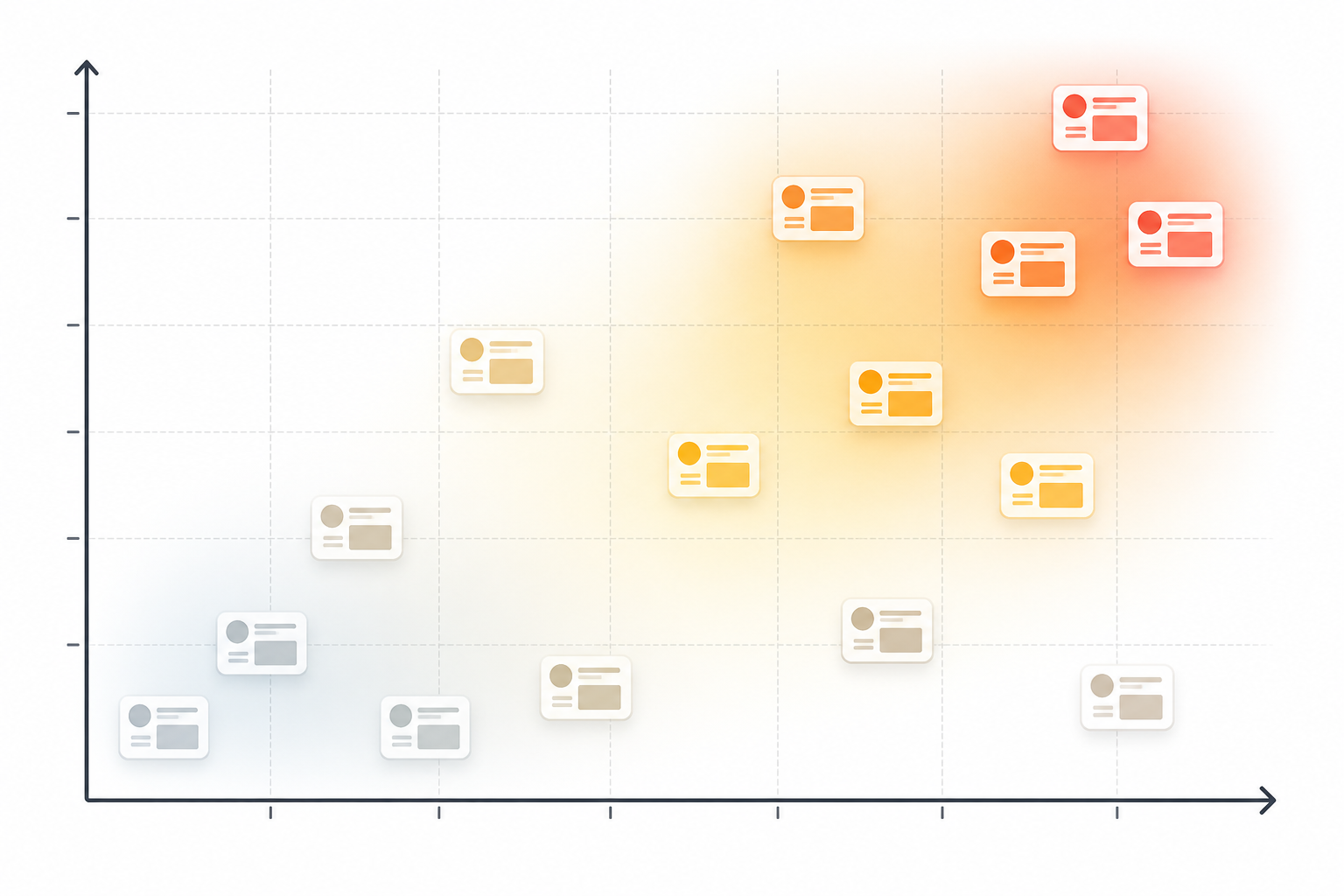
If you're doing this manually, it means checking back on the same competitor ad libraries every week and noting what's still running. It's doable, but slow. That's exactly why weekly monitoring matters more than a one-time audit. A single glance at a competitor's Google Ads or Meta ad library tells you very little on its own. Tracking it over several weeks, alongside your own scoring model, tells you a lot more.
Step 4: Building a 4-week creative testing calendar
With your prioritised angles in hand, it's time to put them on a calendar. A rolling 4-week structure works well because it's long enough to get a reasonable read on performance but short enough that you're not locked into a stale plan. Before you launch anything, though, set a few ground rules so "testing" doesn't turn into changing five things at once and guessing why performance moved.
A quick testing protocol:
- One variable at a time. Decide upfront whether you're testing the angle, the format, the hook, or the offer. Changing all four against a control makes it impossible to know what actually drove the result.
- Set a control. Keep your current best-performing creative running as a baseline so you have something to compare against.
- Respect the platform's learning phase. Meta, for example, generally recommends around 50 conversion events per week per ad set before performance data is reliable. Pulling a test earlier than that means you're reacting to noise, not signal.
- Set a minimum spend or impression threshold before judging results. A rough guide: don't make a kill/scale decision until you've spent at least enough to generate 30–50 conversions (or, for low-volume/high-consideration offers, at least two weeks of consistent delivery at your normal budget).
- Track a primary metric and a guardrail metric. For example, CPA as primary and CTR or hook rate as a guardrail, so a cheap-but-irrelevant click doesn't get mistaken for a win.
Sample creative testing calendar:
| Week | Focus | Control | Variant | Primary metric | Decision point |
|---|---|---|---|---|---|
| 1 – Launch | Test top 2–3 highest-scoring angles as new creative, in your own voice and format | Current best performer | New angle-led creative | CTR, hook rate | Confirm delivery and learning phase started |
| 2 – Review | Check early signals once minimum spend/impressions are hit | Same | Same | CPA vs. account average | Kill only if threshold met AND CPA is 50%+ above average, or CTR is under half your account median |
| 3 – Iterate | For angles showing promise, test a format variation (e.g., static to video) | Winning variant from Week 2 | New format, same angle | CPA, conversion rate | Decide if the angle or the execution is doing the work |
| 4 – Consolidate | Retire flat performers, document results, pull next angles from tracking | — | — | — | Feed results into next cycle |
One habit that makes a huge difference: keep a simple log noting the source angle, your hypothesis, and the result. Something as basic as a spreadsheet row ("Angle: social proof / Source: Competitor X running since March / Hypothesis: our audience trusts peer reviews more than founder testimonials / Result: 22% lower CPA than control, based on 340 conversions over 3 weeks") compounds over time. Six months in, you'll have a genuine body of evidence about which angle types work for your brand specifically, rather than starting from zero every cycle.

Avoiding the competitor ad copycat trap
It's worth being blunt: copying a competitor's exact creative rarely works. That's less an ethics problem than a performance one. Your audience, your offer, and your level of brand trust are all different from theirs. A testimonial that feels authentic coming from a brand with three years of reviews behind it can feel hollow coming from a brand nobody's heard of.
There's also real risk in close replication of ad copy or visuals. Close imitation can create legal or platform risk depending on the specifics: brand confusion, IP disputes, and platform flags aren't hypothetical. If you're advertising to a UK audience, it's worth remembering that the ASA's CAP Code requires claims, testimonials, and comparative statements to be substantiated with your own evidence, not borrowed from a competitor's positioning. This isn't legal advice, but it's a good reason to keep your proof points your own.
Beyond the risk, copycat ads tend to underperform simply because they lack the specific proof points or positioning that made the original credible for that brand. A competitor's angle worked because of the context around it: their pricing, their customer base, their existing trust. Strip that context away and paste in your logo, and the angle loses the thing that made it work in the first place.
The better mental model: use competitor ads as a prompt for your own hypothesis, not a template to trace. "Inspired by the angle, built from your own data" beats "inspired by the creative" every time. It's about borrowing the question a competitor is answering, not their answer.
Competitor ad monitoring tools: what they can and cannot tell you
If you're tracking this across several competitors and platforms by hand, it gets tedious fast: checking ad libraries weekly, screenshotting changes, keeping your own diff log. Purpose-built monitoring tools (Rival Ads is one option among several) can automate the weekly tracking of creative, copy, and format changes across Meta, Google, TikTok, and LinkedIn, and flag angles that appear to be gaining repetition or longevity. Worth knowing: any tool like this is still working from public ad library data, so it can tell you what's continuing to run, not confirm what's actually converting. Whichever way you track it, the goal is the same: buy back time from manual research so you can spend it on building and testing your own original creative.
FAQ: Using competitor ad data for creative testing
How do I turn competitor ad research into actual tests?
Start by categorising the angles competitors are running (pain-point, social proof, offer-led, and so on), then check which of those angles genuinely apply to your own audience and funnel stage using a short relevance checklist. From there, score each angle on signal strength (longevity, repetition, and cross-competitor adoption) and slot the top candidates into a rolling 4-week test calendar with a defined control, one variable change, a minimum spend threshold, and your own creative execution.
What angles are worth testing versus ignoring?
Angles worth testing score well across several signals at once: they've run for multiple weeks, appear in more than one creative variation, and ideally show up independently across two or more competitors. Angles worth deprioritising are one-off ads that disappear quickly, though bear in mind this could mean they underperformed, or simply that the campaign budget or flight ended, since public ad libraries don't show you spend or results either way.
How much budget or sample size do I need before judging a test?
As a rough guide, wait until you've hit your platform's learning-phase threshold (Meta typically suggests around 50 conversions per week per ad set) and accumulated at least 30–50 total conversions before making a kill or scale decision. For lower-volume or long-consideration offers, give it a minimum of two full weeks at your normal budget rather than judging off a few days of noisy data.
What if two competitors are sending contradictory signals?
Treat it as a sign to test small rather than commit big. If one competitor is scaling a discount-led angle while another is pulling back on the same theme, that usually means the market is split rather than settled. Run both as low-budget tests against your own audience and let your data, not theirs, break the tie.
How do I avoid just copying competitors outright?
Focus on the underlying angle or pain point rather than the specific copy, visuals, or offer structure. Reframe it through your own brand voice, your own proof points, and (if you're advertising in the UK) claims you can actually substantiate under the ASA's CAP Code. Treat the competitor ad as the starting hypothesis rather than the finished creative, and you'll keep your testing original while still being informed by what's moving in the market.