
How Often Should You Check Your Competitors' Ads? (Spoiler: Not Daily)
Learn the ideal competitor ad monitoring frequency for DTC brands, including when weekly reviews beat real-time tracking and when to increase cadence.
Chris Edington
14 min read

Competitor Ad Monitoring Frequency: How Often Should You Check Competitor Ads?
 Alt text: Marketer reviewing a weekly competitor ad monitoring dashboard showing new, stopped and persistent adverts
If you've ever refreshed the Meta Ad Library three times before your morning coffee, here's the short version: for most DTC and eCommerce brands, weekly is the right competitor ad monitoring frequency. Twice-weekly earns its place during major promotional windows or known competitor launches. Daily or real-time checks are worth the effort only for genuinely time-sensitive categories—live pricing, flash sales and limited-stock drops.
That's the core decision rule. Everything below explains the reasoning, the exceptions and how to build an effective ad monitoring cadence without creating unnecessary work for your team.
Quick definitions, because these terms get used loosely: a weekly digest is one scheduled review of new, stopped and persistent ads. Twice-weekly is the same review run on two fixed days. Daily checks mean a manual or automated look every 24 hours. Real-time alerts mean you're notified the moment something changes, often within minutes. I'll use these terms consistently from here on.
One caveat before we start: a public ad library shows you what's live, when it appeared and roughly how long it's stayed up. It doesn't show you spend, targeting or conversion rates. So a "monitoring review" in this article means comparing what's new, what's stopped and what's still running—and treating anything beyond that as an educated guess, not a fact.
Is Real-Time Competitor Ad Tracking Necessary?
I get the appeal. Nobody wants to miss a competitor's flash sale or discover their viral ad has been running unchallenged for a week. That instinct isn't wrong—it's just misapplied most of the time.
Real-time or daily checks earn their keep when you're dealing with genuine time sensitivity: live pricing changes, limited-stock drops, app-store launches or 24–48-hour flash sales. If your category runs on that kind of velocity—fast fashion, trending gadgets or markets with real daily price wars—tighter monitoring isn't paranoia. It's operationally necessary, and weekly monitoring will genuinely miss things in these specific situations. I want to be clear about that rather than paper over it.
But for most DTC and eCommerce brands, checking multiple times a day mostly creates problems:
- Alert fatigue sets in. When every notification feels urgent, none of them actually are. You start scanning instead of analysing.
- Reactive decisions replace strategic ones. Someone spots a new ad at 9am and wants to "respond" by lunchtime—except that ad might not have any meaningful performance signal behind it yet.
- Noise gets mistaken for signal. A competitor might increase spend for 48 hours, test a weak creative or run a short-lived promotion that vanishes before it's confirmed as something worth reacting to.
Competitors don't usually pivot strategy overnight—they test over days, sometimes weeks. What looks urgent on Tuesday might just be one variant in a broader test that's paused by Thursday.
Why Weekly Ad Monitoring Usually Wins
Once you stop checking daily, you start seeing patterns instead of isolated snapshots. That's where useful ad intelligence lives—but it's worth being precise about what a weekly review can and can't actually tell you.
What a weekly comparison can show you directly from a public ad library:
- New ads that weren't there last week
- Stopped ads that have disappeared
- Persistent ads that are still running after seven-plus days
What it can't show you, no matter how long you stare at it: spend, targeting, conversion rate or profitability. So when I say an ad still running after two weeks is "a reasonable signal it's performing well enough to keep live," that's an inference built on persistence—not confirmed spend data. It's a clue worth prioritising, not proof of anything.
With that boundary in mind, here's why a weekly ad monitoring cadence tends to outperform more frequent checking for most brands:
- It roughly matches how ad platforms optimise. Delivery algorithms generally need days, not hours, to gather enough signal before performance starts to stabilise. Checking daily often means judging an ad before the platform itself has enough data to judge it.
- You get more signal and less noise. Instead of reacting to every new ad, you're reviewing a curated set of meaningful changes.
- It's sustainable. Weekly reviews slot into existing rhythms—Monday planning or Friday wrap-ups—without becoming an unpaid second job for whoever's watching the ad libraries.
This is part of why we built Rival Ads around a weekly digest rather than a constant live feed. It encourages teams to review settled change rather than scan for movement that hasn't finished happening yet. It's one approach among several—the logic matters more than the specific tool.
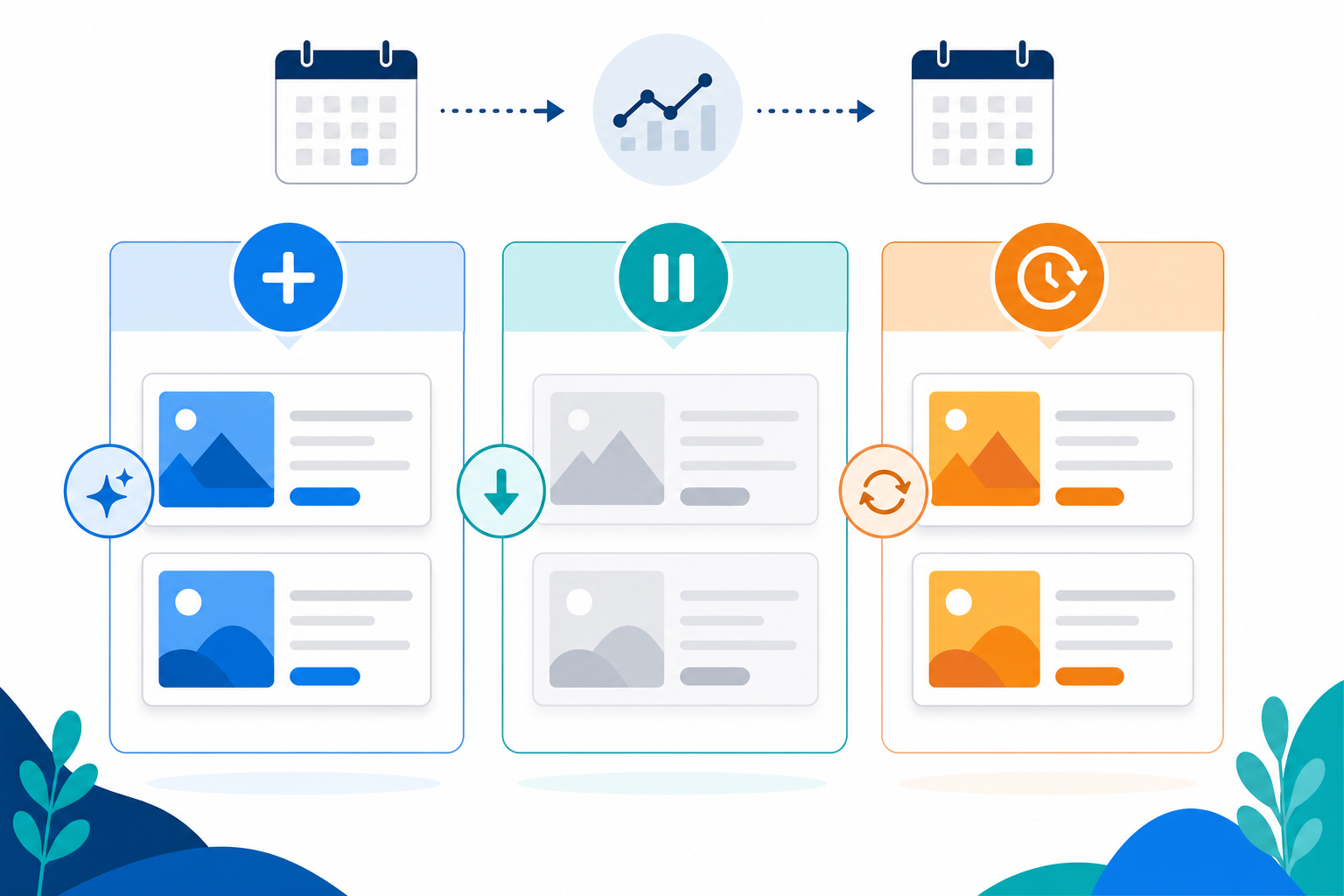 Alt text: Week-over-week competitor ad comparison chart showing new, stopped and persistent adverts
How Ad Testing Cycles Affect Competitor Ad Monitoring Frequency
Here's the mechanical reason weekly monitoring tends to make sense, with the caveat that exact timing varies quite a bit by advertiser.
As a rough heuristic, many advertisers need somewhere in the region of 3–7 days of live data before drawing meaningful conclusions—but treat that as a starting assumption, not a fixed law. It depends heavily on:
| Scenario | Typical spend/volume | Rough time to meaningful signal |
|---|---|---|
| High-spend, fast-converting (e.g. impulse-buy DTC) | High daily conversions | 2–3 days |
| Mid-spend, standard eCommerce | Moderate conversions | 5–7 days |
| Lower-spend or considered purchase | Low conversion volume | 1–2 weeks or longer |
These ranges are illustrative, not benchmarked against a specific dataset—use them as a mental model for why a snapshot on day one or two tells you very little.
Google's own guidance on campaign experiments recommends giving tests enough time and traffic to reach statistically useful results, rather than judging them after a day or two, though it doesn't specify one fixed number for every advertiser. Meta has historically described roughly 50 optimisation events within a rolling seven-day window as a useful benchmark for an ad set to exit its "learning phase"—the period where delivery is still being tuned.
Two things are worth being precise about: this is an advertiser-side benchmark for people managing their own campaigns, not something verifiable from outside; and it's about optimisation events, which could be conversions or other actions depending on campaign setup. It isn't a universal "50 conversions" rule. It's a useful mental model for why performance data takes time to settle—not a rule you can apply directly to a competitor's account from a public ad library.
So when you check a competitor's ads daily, there's a reasonable chance you're looking at something mid-test—not a confirmed winner or loser, just work in progress.
Here's a concrete illustration. Say a skincare brand launches three ad variations on a Monday. Check on Monday or Tuesday, and you're mostly watching a coin flip—there's rarely enough delivery data yet for a real pattern to emerge. By Wednesday, one variation might be pulling ahead, but it's still early days. By Thursday or Friday, in many cases, a clearer pattern shows up: two variations quietly stop running, and one keeps going into the following week.
If your monitoring day is Monday, you catch that outcome cleanly—one new ad, two stopped and one persistent. If you'd checked daily, you'd have spent four days watching an undecided test and possibly reacted to a version that was pulled by Thursday anyway. The exact days shift with spend and audience size, but the underlying logic—give it time before drawing conclusions—holds fairly broadly.
Weekly checks tend to sync better with these cycles. Instead of catching competitors mid-decision, you're more likely to see decisions they've already made.
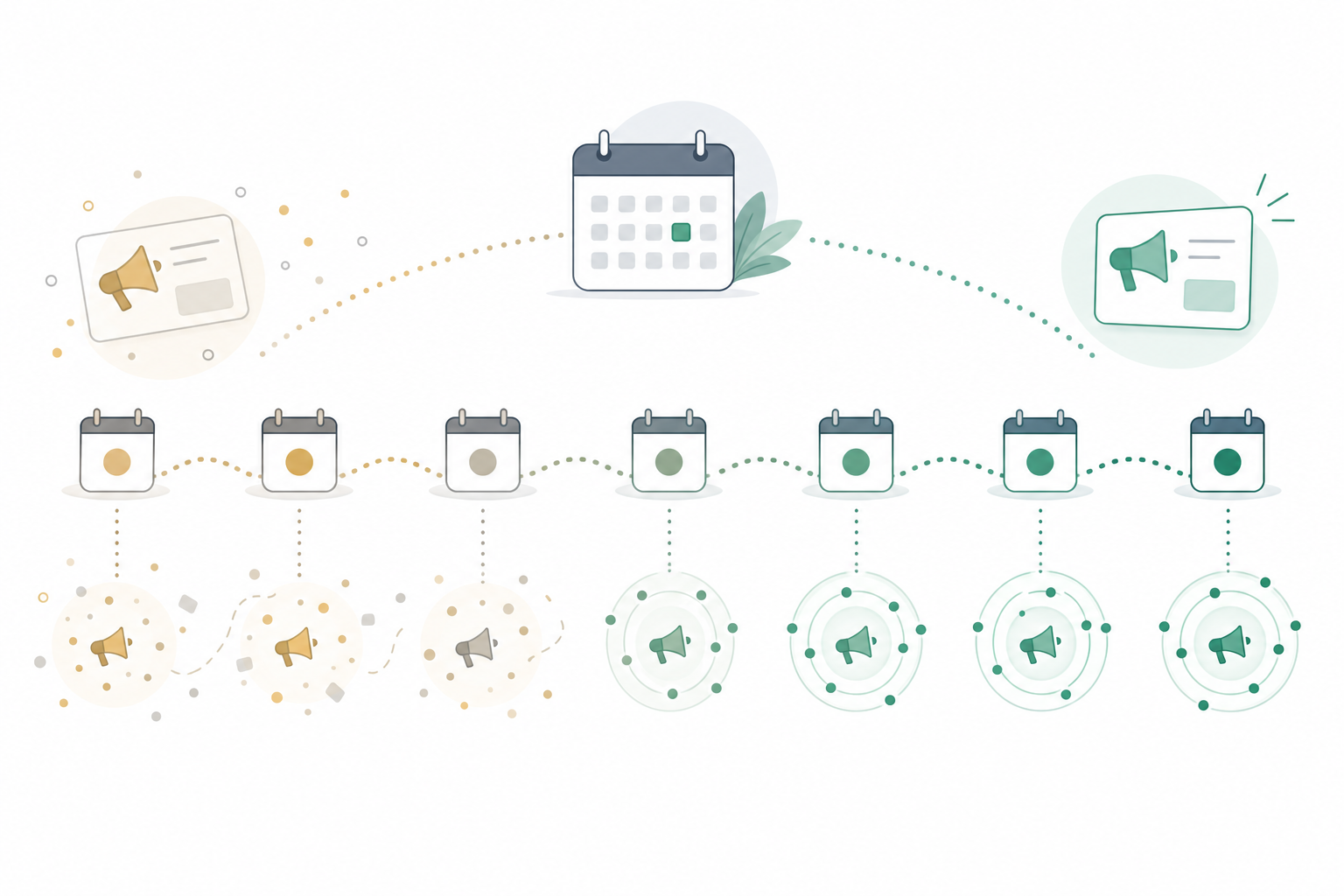 Alt text: Illustrative timeline showing how ad testing signal typically stabilises over roughly a week, with a note that exact timing varies by budget and objective
Competitor Ad Monitoring Cadence: A Practical Decision Framework
Rather than treating "weekly" as a fixed rule, think of monitoring frequency as a dial with a few clear settings.
| Cadence | Best for | What to monitor | Main limitation | Escalation trigger |
|---|---|---|---|---|
| Weekly (default) | Most DTC/eCommerce brands and steady-state periods | New ads, stopped ads and persistent ads | Can miss short-lived offers, price changes or campaigns that start and stop within seven days | A sudden cluster of new ads or a major offer change |
| Twice-weekly | Peak promotional windows and known competitor launches | Offer changes and creative volume shifts | Slightly more team time; risk of reacting mid-test | New landing pages, price drops or stock-out messaging |
| Daily/near real-time | Live pricing wars, flash sales, limited-stock drops and app launches | Price points, availability messaging and launch timing | High alert fatigue; reactive, low-confidence decisions | Immediate competitor price match or stock claim |
| Biweekly/monthly | B2B, considered-purchase categories and long sales cycles | Strategic shifts, messaging pivots and new campaigns | Might miss faster-moving seasonal competitors | A clear change in core value proposition or offer structure |
The key distinction worth holding onto is that creative discovery—spotting that a new ad exists—can happen on almost any cadence without much cost. Performance inference—deciding whether that ad is actually working—is where patience pays off, because you're relying on proxies such as runtime, repetition and offer persistence rather than data you don't have access to.
Match Your Ad Monitoring Cadence to the Promo Calendar
Weekly is your default, but it isn't fixed forever. For UK brands specifically, here's how I'd map cadence to the calendar:
- Regular weeks (most of the year): Weekly digest reviews. This is genuinely enough for the vast majority of the calendar.
- Black Friday to Cyber Monday: Increase to twice-weekly monitoring starting roughly three weeks before Black Friday and continuing through Cyber Monday. Budgets rise and testing cycles compress during this window, so more happens between reviews.
- Boxing Day and January sales: Stay at twice-weekly through the Boxing Day period, then keep at least a weekly check through early-to-mid January. Don't drop to monthly just because the big campaigns wrapped—UK retailers often run aggressive clearance sales that carry real competitive signal.
- Product launch windows: If you know a competitor has something coming, add two or three extra check-ins around that date. This is event-driven, not habitual.
- Quieter periods (typically February–March): Weekly, or even biweekly, is often plenty—although fashion and gifting brands may still see real activity around Valentine's Day and Mother's Day. Treat "quiet" as category-dependent rather than a blanket rule.
Category matters as much as the calendar. Fashion, mobile apps, gaming and seasonal retail move faster and might justify a tighter cadence year-round. B2B and considered-purchase categories, where sales cycles run longer, can often use deeper strategic reviews every two to four weeks, layered under a lighter weekly check for basic change detection.
How to Set Up a Sustainable Competitor Ad Monitoring Rhythm
Knowing the ideal cadence is one thing. Sticking to it—and turning what you see into decisions—is another. Here's the system that works well for most marketing teams, plus what the output should actually look like.
- Pick a fixed day each week. Monday morning is a natural fit—it lets you factor competitor moves into the week's planning before you're knee-deep in execution.
- Assign clear ownership. Ad monitoring that's "everyone's job" quietly becomes no one's job.
- Anchor the review around three questions: What's new? What's stopped? What's still running after a week or more?
- Log each finding with a confidence level, not just an observation. Note what you saw, how confident you are that it's meaningful (low, medium or high), what you'd do, who owns the action and by when.
- Lean on summarised digests rather than manual scrolling. Tools like Rival Ads deliver a weekly summary of new, stopped and ongoing ads, which cuts the time spent hunting through ad libraries manually. It's useful, but still a starting point for your own judgement rather than a final verdict.
- Set calendar reminders for known promotional dates. Temporarily increase cadence around Black Friday, Boxing Day or a launch, then drop back to weekly once the window closes.
- Resist checking ad libraries daily "just in case." Let your weekly review do the watching.
For a small set of five to ten competitors, this whole review should take about 20–30 minutes once you have a rhythm going—longer the first few times while you're building the habit. A useful weekly digest, whether you build it yourself or use a tool, should answer four things at a glance: which ads are new since last week, which have stopped, which have been running for two weeks or more, and whether any offer or price point has changed.
If your current process can't answer those four questions in under half an hour, that's the thing to fix before worrying about cadence.
 Alt text: Weekly competitor ad monitoring workflow showing scheduling, ownership, review questions and confidence logging
Frequently Asked Questions About Competitor Ad Monitoring Frequency
Is real-time competitor ad tracking necessary for eCommerce brands?
For most DTC and eCommerce brands, no—weekly monitoring captures the strategic patterns that matter, including new offers, creative direction and persistent ads, with far less noise. But it isn't a full substitute for real-time tracking everywhere.
Short-lived promotions, temporary price changes, stock-out claims and 24–48-hour flash sales can start and finish between weekly checks, and you'll simply miss them. If your category runs on that kind of velocity, layer in daily or real-time alerts specifically for pricing and availability, and keep weekly monitoring for everything else.
How often do competitors typically change their ads?
It varies by category and budget, so treat any figure here as a rough guide rather than a fixed rule. As a heuristic, many brands rotate creative every 1–2 weeks; fast-fashion and flash-sale brands often cycle faster, while considered-purchase categories such as skincare, supplements or home goods may keep a winning ad live for 2–4 weeks before testing new variations.
What's the ideal competitor ad monitoring frequency for eCommerce brands?
Weekly is a sensible baseline for most DTC and eCommerce teams because it roughly aligns with typical ad testing timelines and realistic team bandwidth. Increase to twice-weekly during major UK promotional windows such as Black Friday, Cyber Monday or Boxing Day, or around a known competitor launch.
Brands in high-velocity categories, or those tracking live pricing, may need daily checks. B2B and considered-purchase brands can often stretch to biweekly or monthly strategic reviews while maintaining a lighter weekly check for basic change detection.
Won't I miss something important if I only check weekly?
You'll rarely miss the moves that matter most for strategy—a new offer, an ad still running weeks later or a campaign that's clearly paused—since these tend to persist for days rather than hours. What you can genuinely miss are short-lived events: a 48-hour flash sale, a temporary price drop or a stock-out message that's resolved by the time you check.
If those matter for your category, that's exactly the case for adding targeted daily or real-time checks on pricing and availability specifically, rather than abandoning weekly review altogether.
How do I know if an ad I'm seeing is a winner or just still being tested?
You generally can't know for certain from a public ad library alone—it doesn't expose spend, conversions or profitability. What you can do is look for proxies: has the ad run for more than a week, has the offer stayed consistent and has it appeared across multiple placements?
The more of these signals line up, the more confident you can be in treating it as a meaningful data point rather than a mid-test snapshot.
How many competitors should I actually be monitoring?
Most teams get diminishing returns past eight to ten direct competitors. Beyond that, reviews take longer without adding much decision-useful signal. Start with the five brands you're most often compared to or lose customers to, then expand only if you find yourself consistently missing relevant moves.
A competitor's ad has disappeared—what does that actually mean?
On its own, not much. It could mean the campaign was paused for underperformance, the budget ran out, the promotional period ended or the competitor is mid-refresh with a new variant about to go live.
Log it as "stopped" with low-to-medium confidence, and only treat it as a meaningful strategic signal if several ads from the same campaign disappear at once or if nothing replaces them after a couple of weeks.
Here's the operating rule in three lines: default to weekly for creative and offer intelligence, move to twice-weekly around major UK promotional windows or known launches, and reserve daily or real-time checks specifically for live pricing, stock or flash-sale categories.
Log what you see with a confidence level and an owner, not just a screenshot. If you're starting from scratch, pick five competitors, set your Monday review and add temporary alerts only for the specific triggers that genuinely warrant them—not for everything, all the time.