
LinkedIn Ads Benchmarking: What B2B Competitors Are Testing Right Now
LinkedIn ads benchmarking: use ad intelligence to compare UK B2B competitors, creative, formats and messaging—and sharpen your LinkedIn ads strategy now
Chris Edington
12 min read
LinkedIn ads benchmarking means comparing your own hooks, formats, proof points and offers against what competitors are actually running, not what you assume they're running. It sounds obvious, but most B2B marketing teams I talk to have never done it properly for LinkedIn, even though it's one of the most important paid channels for B2B buyers in the UK and across Europe.
A quick note on how I put this together, because I think it matters for how much weight you give any of it: this is based on ongoing observation of active LinkedIn ad campaigns across SaaS, professional services and fintech (mostly UK and US advertisers) using LinkedIn's own Ad Library alongside a tracking tool I'll mention later. It's not a controlled study with a fixed sample size, and LinkedIn's Ad Library doesn't expose spend, impressions or conversion data. So treat the patterns below as directional signals worth checking against your own category, not settled facts.
With that caveat out of the way, the pattern I keep seeing across categories is a shift towards founder-led video, pain-point-first hooks instead of feature lists, and short carousel breakdowns that read more like organic LinkedIn posts than traditional ads. If your creative still looks like a static product screenshot with generic copy, there's a reasonable chance you're blending into a feed that's moved towards personality and proof. Benchmarking against what's actually live is a far better starting point than guessing.
Let's get into what seems to be working, what seems to be fading, and how to benchmark your own LinkedIn ads without needing a dedicated research team.
Why LinkedIn ads are underwatched (and why that matters)
Here's something I notice constantly: competitive intelligence effort at most marketing teams goes towards Meta and Google. LinkedIn often gets treated as an afterthought, despite being a genuinely strategic channel for B2B. In the UK, it consistently ranks among the top platforms B2B marketers say they use, even when budget conversations still default to Meta and Google first.
Part of the reason is practical: LinkedIn's own Ad Library, while useful for spotting what's currently live, is clunky for ongoing tracking. It shows you active ads, but it doesn't surface performance signals, doesn't make historical comparison easy, and requires checking competitors one by one. There's no diff view telling you what changed since last week. So teams check it once, perhaps during quarterly planning, then forget about it for months.
That gap is an opportunity, not just a problem. Because fewer teams watch LinkedIn closely, it's often where positioning overlaps are easiest to spot first. I've seen founders assume their messaging is genuinely distinct. Then they check three competitors and realise they're all saying some version of the same thing. If nobody's watching, nobody catches those overlaps early, and that's exactly the kind of blind spot ad intelligence is meant to close. Not so you can copy anyone, but because you can't differentiate against messaging you've never actually seen.
What are B2B competitors testing on LinkedIn right now?
Across the active LinkedIn campaigns I track (software, services and fintech), a handful of messaging patterns keep recurring. I want to be upfront that "keeps showing up" and "proven to convert" are different claims. What follows is what's live and, in several cases, has stayed live long enough to suggest it's earning its keep. Longevity is a signal, not proof. More on that shortly.
Pain-point-first hooks are replacing feature-first headlines. Instead of "Introducing our new dashboard," you're seeing "Stop losing deals to [specific cause]." This lines up with what LinkedIn's own B2B Institute has argued for several years: ads that map to a buyer's actual problem or business risk tend to outperform ones that open with a product description.
Founder-voice, first-person copy is appearing even from funded, mid-size companies. "I built this because..." used to feel like a scrappy startup device. Now it shows up in ads from companies well past the bootstrap stage, likely because it reads as more credible than a brand voice reciting a value proposition.
Category-creation language is on the rise. Rather than naming a direct competitor, brands are positioning against "the old way" of doing something: legacy tools, manual processes and outdated workflows. LinkedIn's B2B Institute describes this as category education, creating demand by naming a new problem or framework before asking anyone to evaluate a specific vendor.
Social proof is moving to the front of the ad, not sitting buried at the bottom. Logos, specific customer results and review scores increasingly appear in the headline or opening seconds of video. This tracks with the Edelman-LinkedIn B2B Thought Leadership Impact Report, which has found that a majority of B2B decision-makers say thought leadership and proof-based content builds more trust than traditional marketing materials. Buyers want evidence before they want a pitch.
Specificity in numbers is beating vague claims. "Saved 14 hours a week" reads as more credible than "save time," because a precise number implies it's backed by real data rather than marketing aspiration. I haven't seen controlled testing on this specific point. It's a pattern I'd treat as a strong hypothesis worth A/B testing yourself, not an established fact.
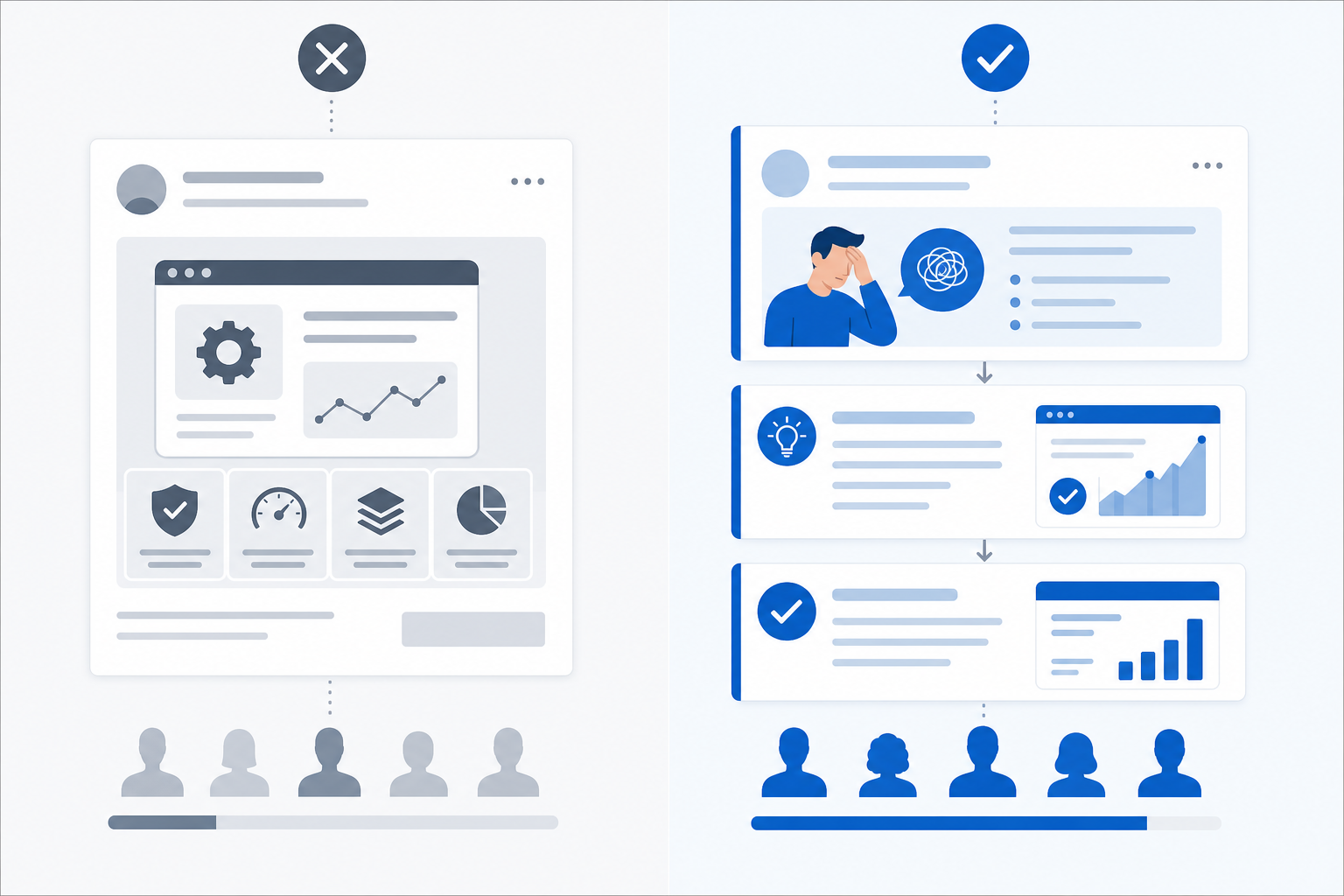 Conceptual illustration of the shift from feature-first to pain-point-first copy, based on observed patterns rather than a single data source.
Worth noting: none of these angles work because they're clever tricks. They work because B2B buyers are managing risk, reputation and internal consensus when they make purchase decisions, and messaging that acknowledges that human reality tends to land better than messaging that stays purely rational and product-focused.
LinkedIn ad format trends: video, carousel and text ads
Messaging angle is one axis of LinkedIn ads benchmarking. Format is the other. Comparing formats fairly means controlling for objective and funnel stage first: a brand-awareness video isn't a fair comparison against a bottom-funnel text ad optimised for lead generation. Here's roughly how the main LinkedIn ad formats stack up for different objectives, based on what I'm seeing across active campaigns:
| Format | Best for | Strengths | Watch-outs | Benchmark signal |
|---|---|---|---|---|
| Short talking-head video | Top-of-funnel attention, trust-building | Feels native to the feed; LinkedIn reports video ads are roughly five times more likely to prompt a comment than other formats (per LinkedIn's own marketing data) | Autoplay is silent, so on-screen text in the first few seconds carries the message | Still running after 3–4+ weeks; multiple variants of the same hook |
| Carousel | Narrative-driven consideration | Structured as problem → market shift → solution, reading like an organic post | Easy to default back into a feature-by-feature product tour | Slide sequence tells a story rather than listing features |
| Single-image text ad | Retargeting, direct offers (demo, trial) | Cheap to produce, easy to test multiple headlines | Can look generic if copy isn't sharp | Used consistently for bottom-funnel, tightly matched CTA |
| Document ads / native content | Soft-sell thought leadership | Shares a framework, checklist or finding before the pitch | Needs a genuinely useful asset, not a disguised brochure | Appears earlier in funnel sequence, product pitch held back |
What seems to be declining, based on the advertisers I track regularly, is heavily designed static graphics packed with dense feature lists. They haven't disappeared, but they're increasingly the exception rather than the rule in the accounts I follow. I'd treat that as an emerging trend to watch rather than a settled shift across all B2B.
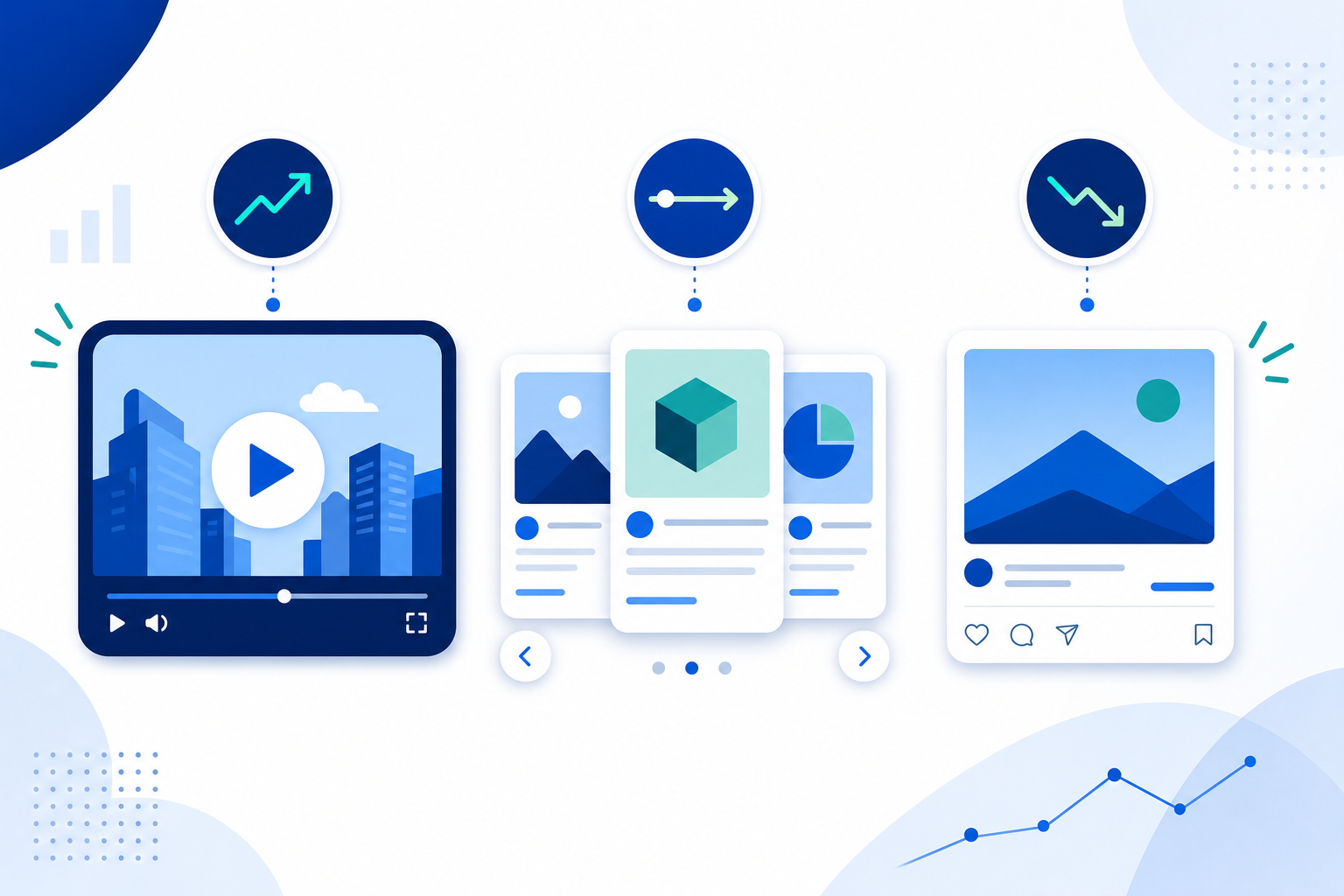 Conceptual summary of observed format shifts, not a statistically representative usage study.
What LinkedIn ads benchmarking means for your positioning
So what do you actually do with all this? A few things are worth thinking through.
If three or more competitors are testing a similar messaging angle, treat that as a practical heuristic worth investigating, not proof the market has "validated" it. It could mean buyers are responding to that framing. It could also mean everyone's copying the same category leader. Either way, it means you need a sharper, more specific version of your own angle rather than a word-for-word borrow, because borrowed messaging tends to read as borrowed. Buyers and competitors can usually tell.
Watch for messaging convergence specifically. When every competitor in your category starts sounding the same (same claims, same tone, same proof points), that's your opening. A crowded field of similar messaging is exactly when a distinctive, differentiated voice cuts through hardest.
And be careful how you read iteration speed. A competitor's ad that hasn't changed in four months next to another testing five new hooks a week does tell you something about who's actively optimising. But an unchanged ad isn't automatically a sign of neglect: it could be a deliberately evergreen campaign with a fixed budget, or a message so effective they've stopped touching it. Active duration in LinkedIn's Ad Library is a proxy for performance, not proof of it. Use it to prioritise what to investigate further, not as a final verdict.
How to benchmark LinkedIn ads against competitors without a full-time analyst
You don't need a dedicated competitive intelligence hire to do this properly. Here's a practical framework that works for most marketing teams, followed by a simple way to score what you find.
Step 1: Build your watch list. Pick 3–5 direct competitors and 1–2 aspirational ones outside your immediate category. The aspirational picks matter: companies known for strong B2B marketing outside your niche often surface angles and formats before they go mainstream in your specific space.
Step 2: Set a weekly review cadence. LinkedIn's creative refresh cycle tends to be slower than Meta or TikTok, so weekly is usually enough to catch meaningful shifts without drowning in noise.
Step 3: Capture what you see in a structured way, not just impressions. A simple tracking table works well:
| Competitor | Audience/funnel stage | Format | Hook | Proof point | Offer/CTA | First seen | Still live? | Variants seen | Your read |
|---|---|---|---|---|---|---|---|---|---|
| Example Co | Bottom-funnel, demo | Single-image text | "Stop losing deals to slow follow-up" | "14 hrs/week saved" | Book a demo | Wk 3 | Yes, 5 weeks | 2 | Pain-point hook, sharp and specific |
Then score each competitor's strongest ad on a simple 1–5 scale across five dimensions: distinctiveness (does it sound different from category norms?), proof (specific evidence vs. vague claims), pain-point clarity (does it open with a real buyer problem?), format fit (does the format match the funnel stage?), and strategic relevance (does it address something your own buyers actually care about?). This turns a vague "they seem to be doing well" into something you can actually compare week over week.
Step 4: Note what's continuing to scale versus what got pulled quickly, but remember this is a proxy, not proof, for the reasons above. Worth flagging, not worth reacting to as if it's a confirmed winning strategy.
A note on tools: doing this manually across LinkedIn, Meta, Google and TikTok competitor by competitor takes a lot of time. That's the gap tools like Rival Ads are built for: you enter a competitor's website and get their active ads across all four platforms, refreshed weekly, with an AI-generated summary of what's new, stopped or scaling. I mention it here as one option among several manual and paid approaches, not as a required step in the framework above.
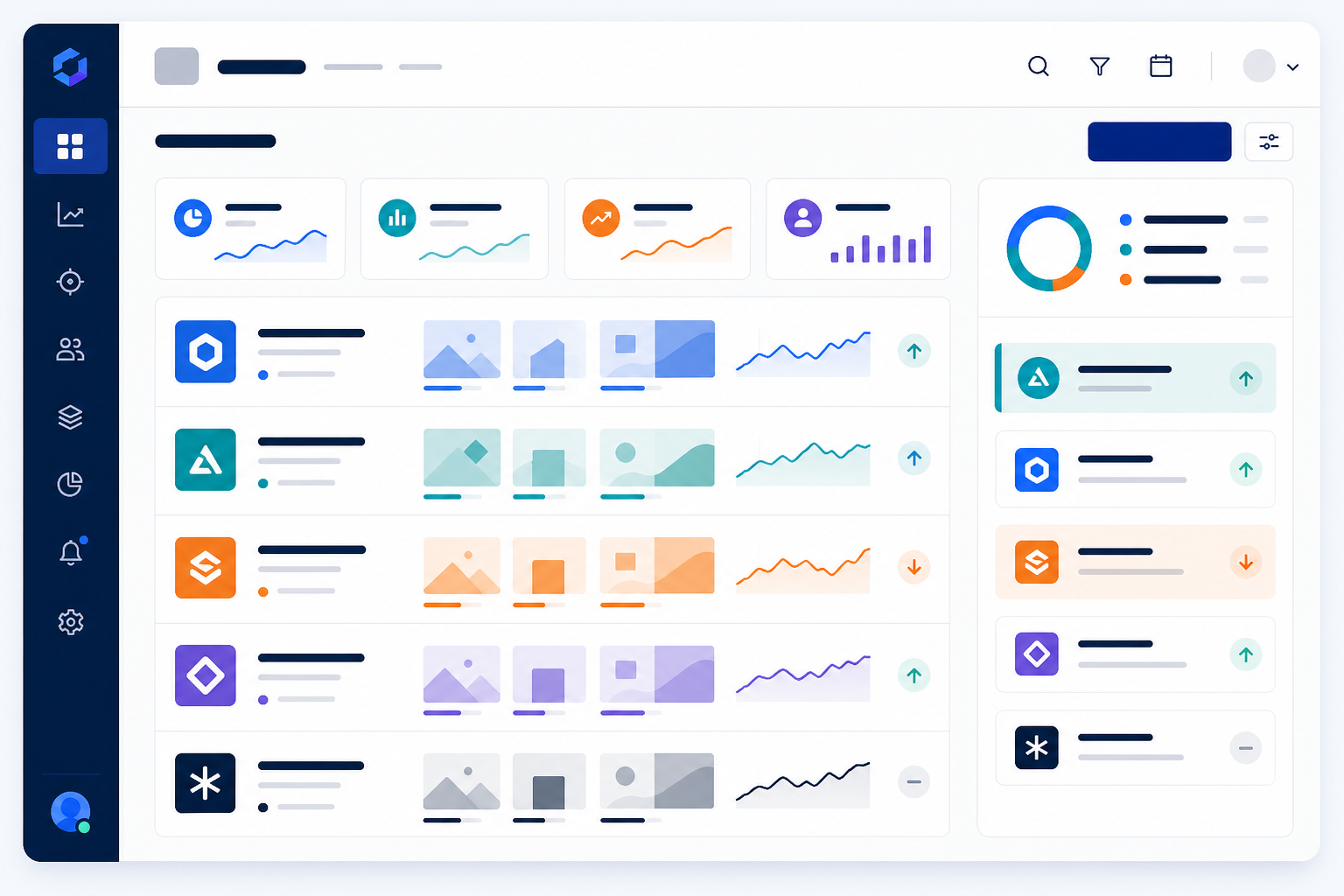 Conceptual mock-up of a weekly competitive digest interface, for illustration purposes.
Whichever approach you use, the habit matters more than the tool. Make the review a standing agenda item, not a one-off audit you run twice a year. Positioning shifts continuously; your visibility into it should too.
LinkedIn ads benchmarking FAQ
What is LinkedIn ads benchmarking? It's the structured comparison of your competitors' live LinkedIn ads, hooks, formats, proof points, offers and how long creative stays live, against your own, so you can judge whether your positioning still stands out or has quietly converged with everyone else's. It's different from general market research because it's based on what's actually running right now, not survey data or assumptions.
What are B2B competitors testing on LinkedIn right now? Based on ongoing observation across SaaS, services and fintech advertisers, the recurring patterns are pain-point-led hooks, founder-voice video and carousels structured as narratives rather than product tours. Heavily designed static ads with long feature lists appear to be declining in the accounts I track, though this is a directional pattern rather than an industry-wide statistic.
How do I benchmark my LinkedIn ads against competitors without a research team? Start with a watch list of 3–5 direct and 1–2 aspirational competitors, then log what you see weekly in a simple table covering format, hook, proof point, offer and whether the ad is still live. Score the strongest examples against your own on distinctiveness, proof, pain-point clarity, format fit and strategic relevance, that scoring step is what turns raw observation into a decision you can act on.
What LinkedIn ad formats perform best in B2B? There's no single format that wins universally. Performance depends heavily on funnel stage. Short, unpolished video tends to do well for top-of-funnel attention and starting conversations; carousels suit problem-to-solution storytelling; text ads remain a solid, low-cost option for retargeting and direct offers like demos. If you're comparing formats, compare like-for-like objectives, not raw engagement numbers across different funnel stages.
Does a LinkedIn ad still running mean it's performing well? Not necessarily. Active duration in LinkedIn's Ad Library is a useful proxy: ads that keep running usually aren't losing money for the advertiser. But it can also reflect an evergreen budget, low competition for that audience, or simply nobody revisiting the campaign. Treat a long-running ad as a prompt to investigate further, not as confirmed proof of strong performance.
Is it worth monitoring competitors who aren't direct rivals? Yes. Watching one or two companies outside your immediate category, particularly ones known for strong B2B marketing, often surfaces messaging and format ideas before they become mainstream in your specific niche, giving you a head start rather than a reaction.