
What Winning Ad Angles Look Like Across Meta, TikTok & Google (2026 Playbook)
See how winning ad angles shift across Meta, TikTok, and Google Ads. A UK marketer's guide to adapting one core message for each platform, with a test
Chris Edington
16 min read
Winning Ad Angles in 2026: How One Message Wins Differently on Meta, TikTok and Google
A practical, UK-focused breakdown of how a single customer motivation needs to be reshaped for Meta, TikTok and Google Search and Display — with a worked example, a testing framework, and honest caveats about what "scaling" evidence actually proves.
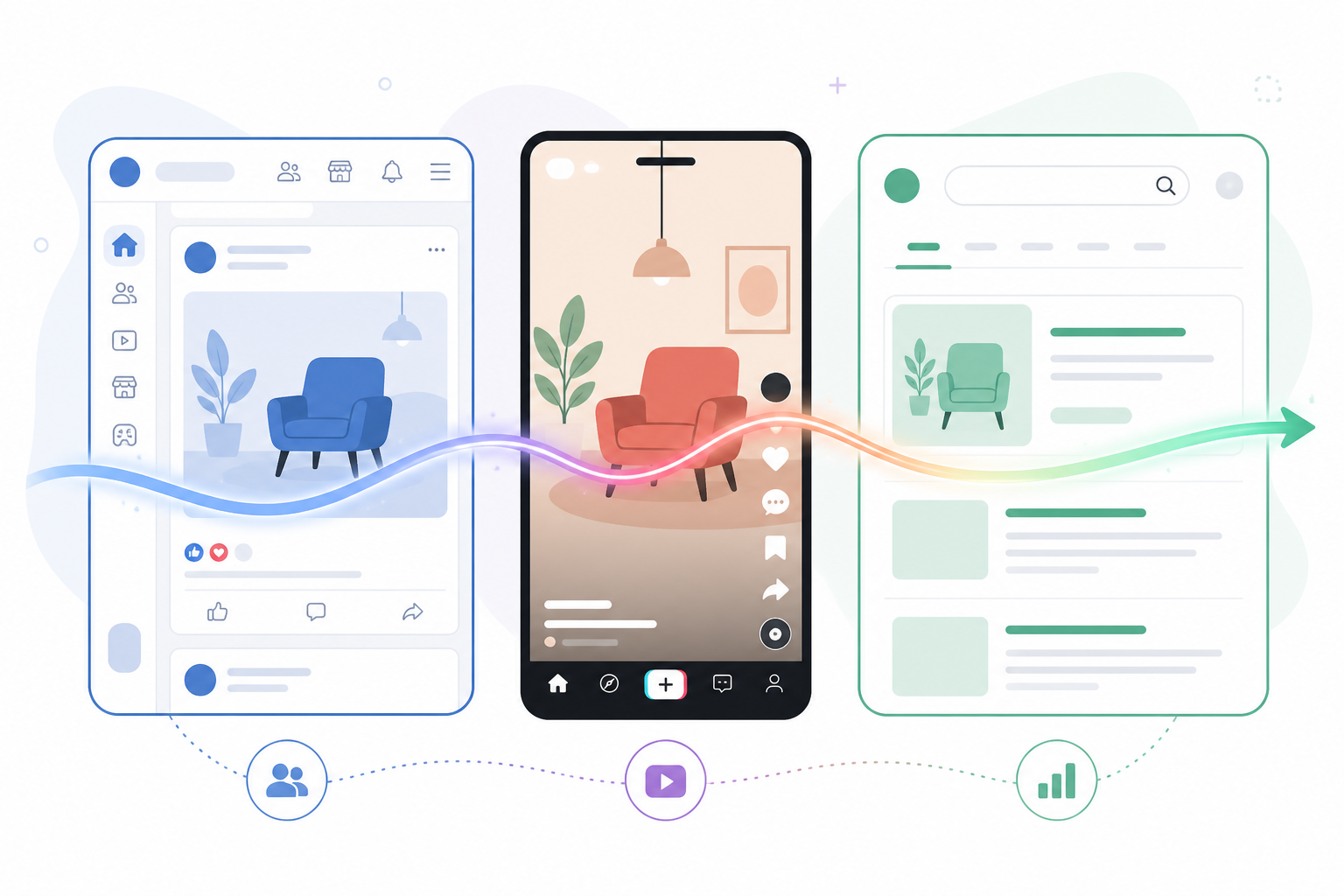
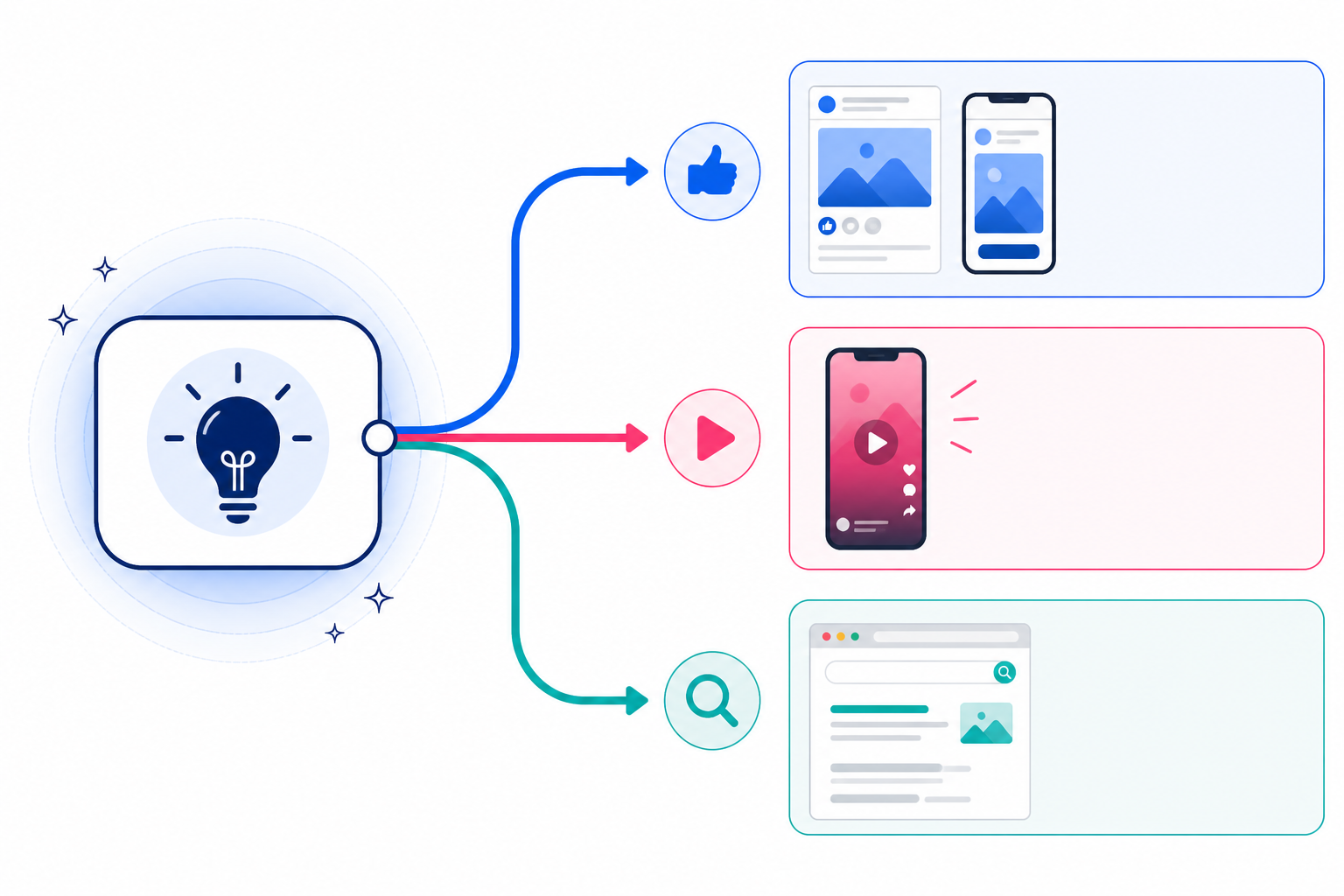
Here's a distinction most "winning ad angle" advice skips over: an angle isn't a video style, a carousel, or a trending sound. An angle is the customer motivation underneath the ad — price, convenience, risk reduction, trust, transformation, or identity. UGC video, founder-led clips, RSAs and static banners are formats. Trend-jacking and pattern interrupts are hooks. Testimonials and demonstrations are proof. Keep those four things separate and cross-platform testing gets a lot less confusing.
I look at competitor ad activity for a living, and the pattern I see most often among UK brands growing quickly isn't a bigger budget. It's a team that keeps one motivation constant — say, risk reduction — and lets the hook, format and proof change completely depending on whether they're on Meta, TikTok or Google. Below, I'll walk through what that looks like on each platform right now, with the caveats that matter, a worked example with real copy, and a testing framework that doesn't rely on vanity metrics to make decisions.
Why the same angle doesn't work everywhere
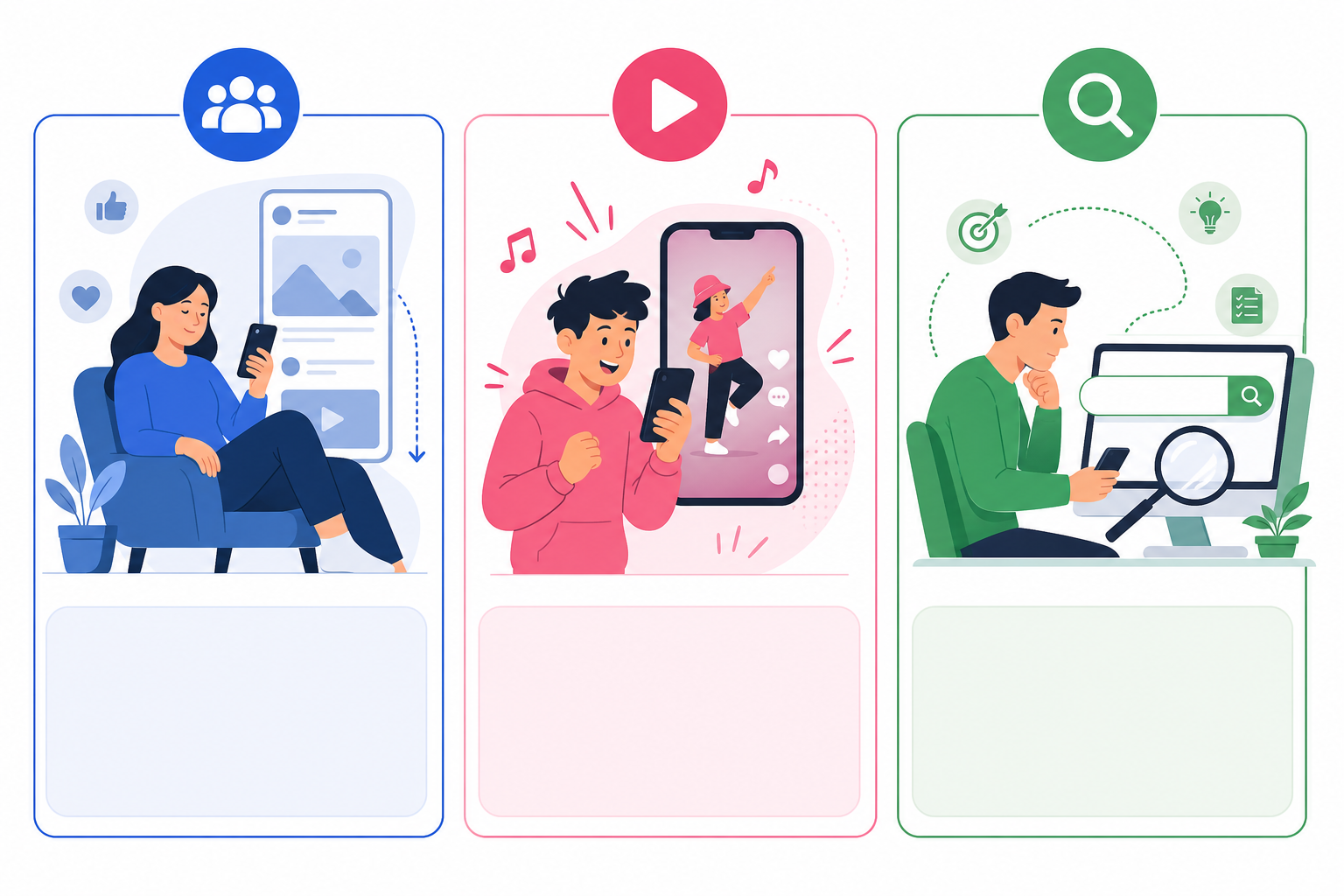
Marketers get this wrong constantly: they find a winning ad on one platform and assume the same execution will travel. It rarely does. The reason is audience context, not creative quality.
Using the framework above: on Meta, someone's scrolling, half-thinking about dinner, so the hook has to interrupt convincingly before the angle even gets heard. On TikTok, people are in entertainment mode, so anything that smells like a traditional ad gets skipped, no matter how good the underlying angle is. On Google, someone has typed a specific problem into a search bar. They're not being interrupted; they're actively comparing who solves it fastest. That's why proof and clarity matter more than hook here.
That difference in audience intent is the foundation of effective ad angles across platforms:
| Platform | Audience mindset | Best first format to test | Primary early signal |
|---|---|---|---|
| Meta | Passive scroll, low intent | UGC-style video or testimonial | Thumb-stop rate, 3-sec view rate |
| TikTok | Entertainment mode, low intent | Creator hook with native pacing | Watch time, comment volume |
| Google Search | Active intent, high urgency | Plain-text RSA headline | CTR on closely-matched queries, then conversion rate |
That mindset difference dictates format, and format dictates which proof mechanism lands. A native-feeling vertical video with a direct-to-camera hook makes sense on TikTok because it mimics organic content. The same approach on Google Search is largely wasted — nobody's watching a video when they've typed "same day boiler repair Manchester" and just wants to see who can help fastest. A punchy, benefit-led RSA headline that converts brilliantly on Search would likely get scrolled past on Meta, because a headline alone doesn't earn attention the way a story or a proof point does.
This is why copy-pasting a Meta winner straight into TikTok — or vice versa — usually flops. The angle underneath isn't wrong. The hook, format and proof are just mismatched to what the audience is doing in that exact moment.
What's scaling on Meta right now
A methodology note before this list, because it matters more than the list itself: I infer these patterns from creative frequency and duration in Meta's public ad library, cross-referenced against Meta's own published creative guidance — not from any brand's actual return on ad spend, which I can't see. A creative running for six weeks is a reasonable signal, but it can also reflect brand-awareness budget, an evergreen campaign, or just a gap in the creative pipeline. Treat everything below as worth testing, not as proven winners.
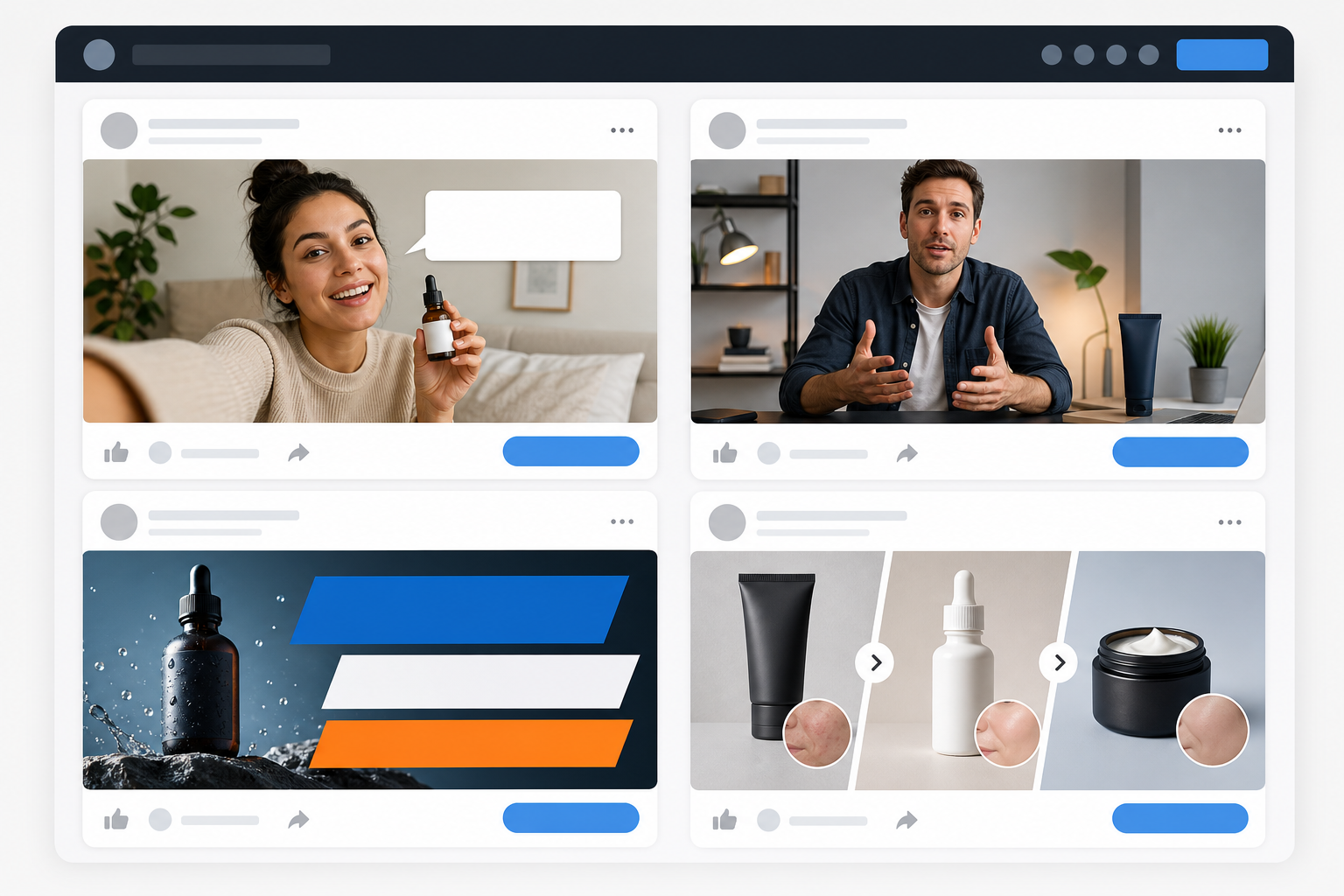
- Testimonial-format ads expressing a trust or risk-reduction angle show up more often than polished brand video in categories where trust is the main barrier — health, beauty, financial services. Meta's own creative guidance points the same way: a clear problem, an immediate visual demonstration, and social proof in a native-looking format rather than a glossy commercial.
- Bold text overlays and direct-to-camera hooks in the first two seconds are doing work that used to be handled by clever taglines. This is a hook technique, not an angle on its own.
- Founder-led framing tends to build credibility faster than product-only creative, particularly for newer brands without existing recognition.
- Carousel format used for a transformation angle — before-and-after storytelling — performs well in categories where transformation is the point of the purchase: home improvement, fitness, skincare.
One UK-specific note: if you're using testimonials, the Advertising Standards Authority (ASA) has clear rules on genuine versus incentivised reviews, and on health or efficacy claims made by "real customers." Check creative against CAP Code guidance before it scales, not after.
Meta's Advantage+ campaigns automate targeting and placement, but they still depend entirely on the advertiser feeding in genuinely different angles. Automation distributes a winning angle more efficiently once you've found one — it doesn't find the angle for you. Brands like The Farmer's Dog and Liquid I.V. have talked publicly about building creative systems around testing distinct motivations — convenience, transformation, trust, identity — rather than endlessly tweaking one hero video.
What's scaling on TikTok right now
TikTok's own Creative Codes research, published in 2023, found that 63% of top-performing ads communicate the key message within the first three seconds, and just over half of users said they found TikTok ads enjoyable rather than annoying. That research is a few years old now, and TikTok hasn't published a comparable update, so treat it as a foundational pattern that still shows up in what I see tracked today rather than current 2026 data. What follows are patterns worth testing, not universal rules — trend-jacking in particular depends heavily on category, audience age, and brand fit. A financial services brand riffing on a dance trend can land as tone-deaf rather than relatable.
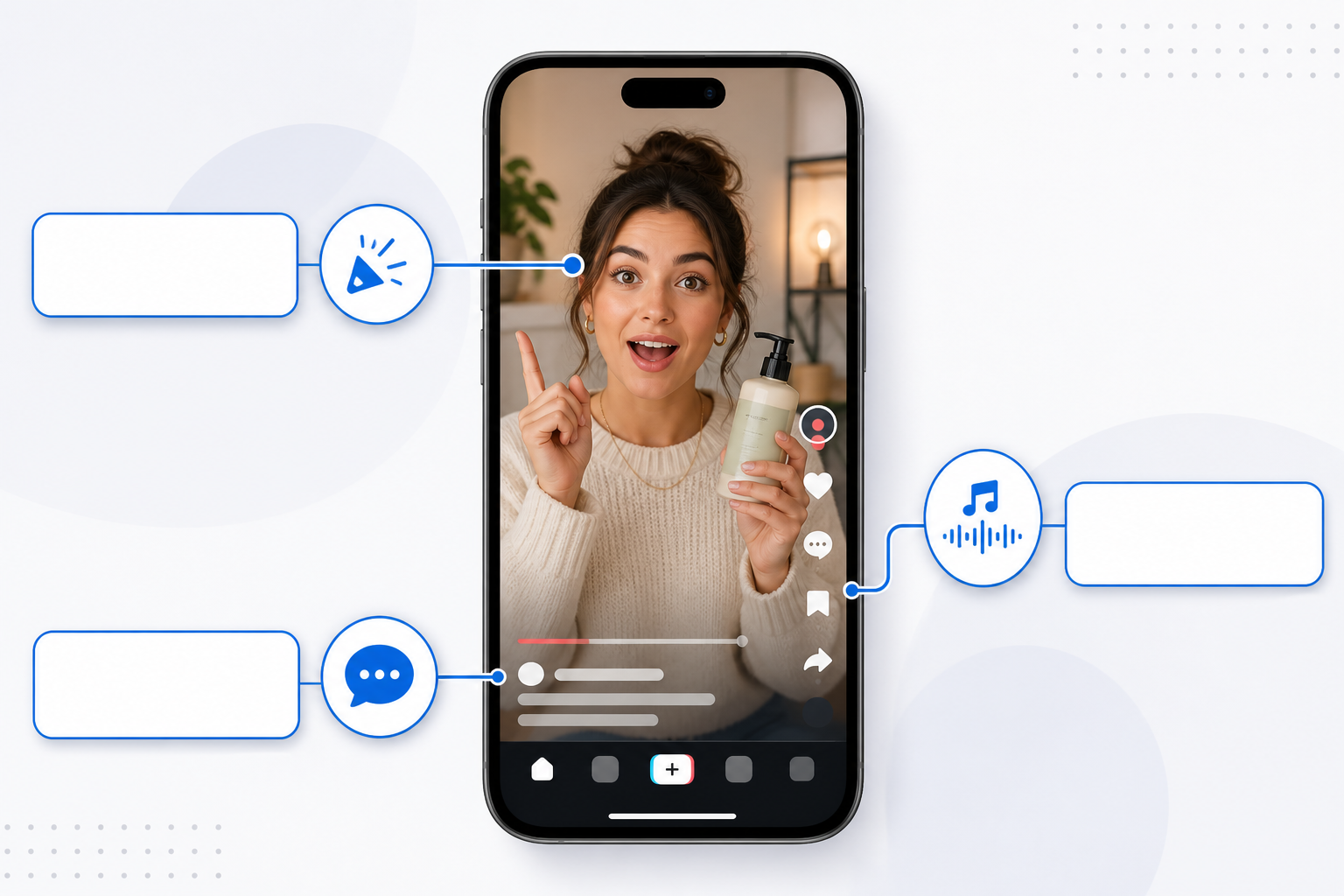
- Creator-native, low-production format often outperforms anything that looks obviously brand-made, regardless of the angle underneath, because rawness itself signals credibility.
- Problem–agitate–reveal hook structure inside the first three seconds is the backbone of most high-performing TikTok ads I've seen tracked, across almost every angle.
- Trend-jacking and sound-led format borrows attention from whatever's already circulating rather than generating it from scratch. This needs speed and judgement in equal measure — it's a hook and format choice, not a substitute for having a real angle.
- "Unpopular opinion" framing can drive comments, and TikTok's algorithm does weight engagement signals including comments, but forced controversy that doesn't fit the brand tends to backfire in the replies.
- Comment-driven creative — responding to objections left under a previous video — turns real audience scepticism into the next ad's hook, and works for almost any angle from price to trust.
Spark Ads (TikTok's format for promoting existing organic posts under the original creator's handle, keeping likes and comments intact) make organic testing more useful, because the testing ground isn't only paid media. If you're using creator content this way, get usage rights and disclosure sorted in writing first — the ASA and TikTok's own advertising policies expect clear #ad labelling on paid partnerships in the UK.
TikTok creative burns out at different speeds depending on spend: a low-spend test might run comfortably for weeks, while a heavily scaled campaign can fatigue within days. Budget your refresh cycle around your own frequency data rather than a blanket rule, and use competitor monitoring as a reference point for which creators and hooks are rotating weekly — not as a perfect predictor for your account.
What's scaling on Google Search and Display
Google plays by different rules than Meta or TikTok, because the person on the other end isn't being persuaded to want something — they already want it. They're deciding who fulfils that want fastest. Clarity beats cleverness here, because the ad's job is confirming relevance quickly, not sparking curiosity.
| Channel | Angle it best expresses | Primary proof mechanism | Decision metric | Common testing mistake |
|---|---|---|---|---|
| Search (direct response) | Price, speed, availability | Specificity in headline: price, timeframe, risk reversal | Conversion rate and CPA on matched queries, not CTR alone | Judging by CTR when the traffic isn't converting |
| Search (branded/competitor) | Trust, differentiation | Direct comparison, feature difference, review signals | Incremental conversions versus branded search you'd get anyway | Assuming all branded clicks are incremental |
| Display (retargeting) | Risk reduction, urgency | Offer-based hooks, social proof, limited-time framing | Click-through conversions, with view-through treated cautiously | Over-crediting view-through conversions to people who'd have converted anyway |
| Display (prospecting) | Category education, identity | One clear visual benefit, strong brand recognition | Assisted conversions and brand lift, not last-click CPA | Judging cold prospecting on last-click CPA alone |
A few things are worth being precise about, because Google's coverage tends to get less rigorous treatment than social. "Exact match" doesn't mean a narrow query set anymore — Google's matching has broadened over several updates, so exact-match keywords still surface a range of related searches, and your search terms report matters more than the match type label. Responsive Search Ads (RSAs) test headline and description combinations automatically, but pinning key claims, calls to action, and legal qualifiers still matters — especially in regulated UK categories like finance, insurance, or health, where the ASA and FCA both have specific rules about what a headline can claim without qualification. CTR tells you whether your headline matched the query. It tells you nothing about whether that click became a customer, which is why conversion rate and CPA, not CTR, should decide whether an angle wins.
Using Google Ads tracking for competitive research
Google Ads tracking becomes useful for competitive research too, not just your own account, but it has real limits worth naming upfront. Watching which headlines and ad extensions a competitor keeps testing week over week tells you which angles they're persisting with. It doesn't tell you their conversion rate, their margin, or whether the campaign is actually profitable. Consistent presence over several weeks is a signal to investigate — worth checking their landing page, offer, and search-term overlap with your own account — not evidence that the angle is working.
Adapting one core angle across three platforms
Here's the process, then a fictional worked example so it's not just theory. "Framewell" below is an invented brand for illustration — the copy is a template, not verified ad copy, and any real brand using something similar would need to confirm every claim against its actual terms and UK advertising rules before running it.
- Separate the angles before picking one. Most offers contain more than one motivation. Write them out individually rather than blending them into one vague pitch.
- Choose the angle to test first, based on what you most need to learn — demand, trust, or urgency.
- Reframe for Meta, TikTok, and Google using the hook, format, and proof framework, not a copy-paste of the same script.
- Check how competitors are expressing similar angles, treating longevity as a reason to look closer, not a verdict.
The scenario: a UK direct-to-consumer eyewear brand, fictionalised as Framewell, using a home-trial model and competing on price, convenience, and try-before-you-buy.
That one offer actually contains three separate angles:
- Price angle: frames from £25, cheaper than typical opticians.
- Convenience angle: order from home, with no optician appointment needed for the initial browse.
- Risk-reduction angle: try five frames at home before committing, with a clearly bounded free-returns window.
For this example, we'll test the risk-reduction angle first, since it's usually the strongest lever for a brand people haven't heard of yet.
Core proposition (risk-reduction angle): "Order five frames to try at home. Keep your favourite, send the rest back free within 14 days."
- Meta ad (video, 20 seconds): Hook, direct to camera: "I wasn't sure ordering glasses online without trying them on first was a good idea, so I tested it." Cuts to unboxing five frames, trying them on, picking a favourite, then an on-screen line: "5 frames, home trial, free returns within 14 days." CTA: "Start your free home trial."
- TikTok ad (creator-led, 15 seconds): Creator holds up their phone mid-scroll: "POV: you can try five pairs of glasses at home before paying for any of them." Quick try-on montage with trending audio, caption baiting comments: "Which frame should I keep? 👀" No hard sell — brand name appears only in the on-screen sticker and bio link.
- Google Search RSA (headlines): "Try 5 Frames At Home First" / "Glasses From £25, Home Trial" / "Free Returns Within 14 Days." Description: "Order 5 frames, try them at home, keep your favourite. Prescription lenses fitted after checkout. Free UK delivery."
- Google Display (retargeting banner): Static image of the five-frame trial box, headline "Still deciding? Your free trial is waiting," CTA "Finish your order."
Same underlying motivation — risk reduction — running through all four. Completely different hook and format, because a Meta scroller needs a reason to stop, a TikTok viewer needs to feel like they found this themselves, and a Google searcher already wants glasses. They just need proof this brand removes their specific friction faster than the next result.
A checklist for cross-platform creative testing
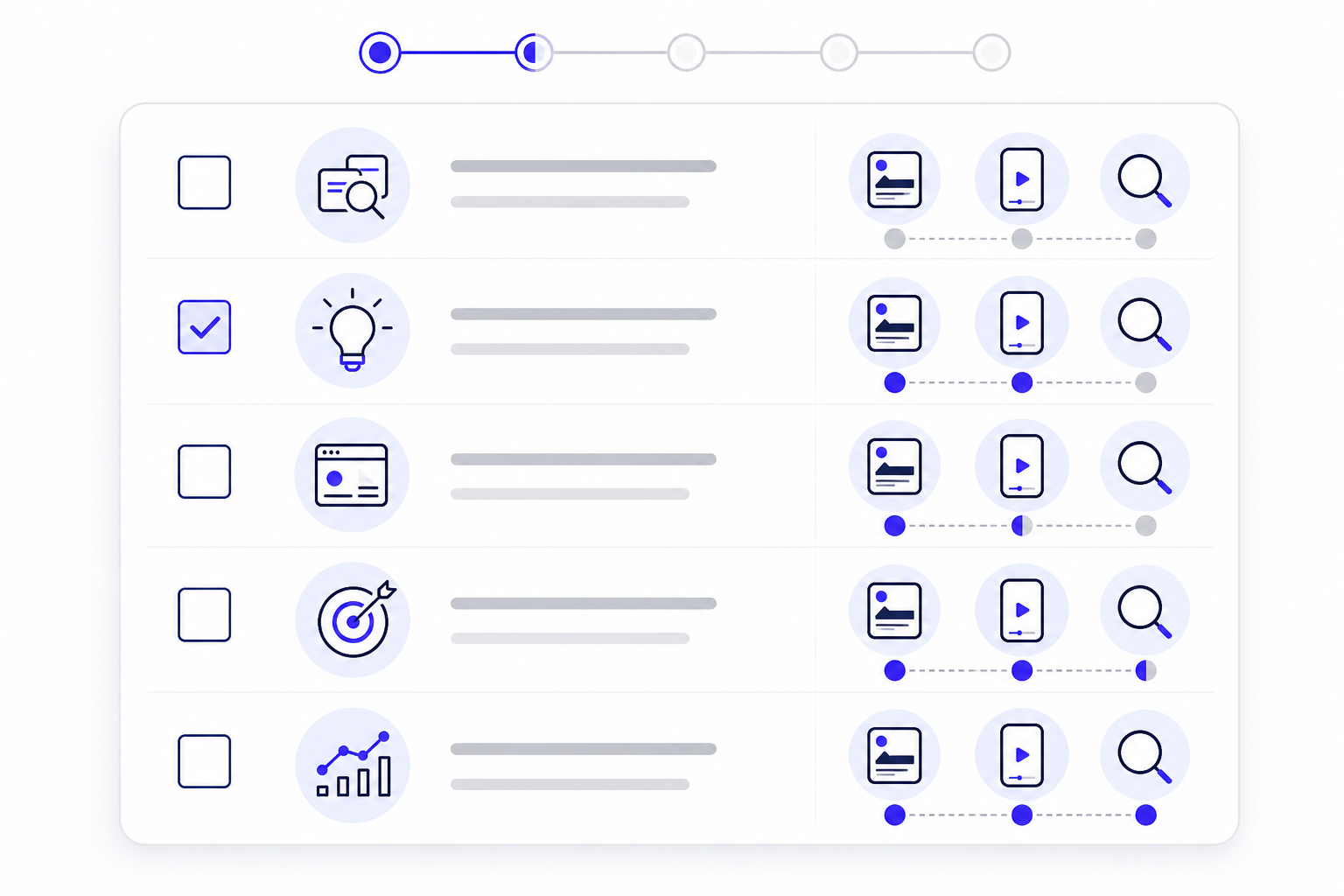
Before committing real budget to a new angle across multiple channels, define a decision framework rather than "trying it and seeing." The single biggest fix here is separating diagnostic metrics — early attention signals — from decision metrics — actual business outcomes — and not letting the first stand in for the second.
| Channel | Diagnostic metric (early signal) | Decision metric (what actually decides) | Minimum data before deciding | Common mistake to avoid |
|---|---|---|---|---|
| TikTok | 3-sec view rate, comment rate | CPA or ROAS on tracked conversions | Enough spend to generate a meaningful number of conversions, not just views — this varies hugely by category, so use your own historical conversion volume as the benchmark | Killing a creative on view rate alone before conversion data exists |
| Meta | Thumb-stop rate, CTR | CPA versus blended target, ideally with a holdout or lift test | A full learning phase plus enough conversions to trust the number — usually more than a handful | Judging performance mid-learning phase, when costs are naturally unstable |
| Google Search | CTR, Quality Score | Conversion rate and CPA on the actual search terms, not just the keyword | Enough impressions and clicks to see a stable conversion rate, typically over one to two weeks | Treating CTR as proof of a winning angle without checking what those clicks did next |
| Google Display | CTR, view-through rate | Click-through conversions, with view-through treated as directional only | Two-plus weeks, since interaction rates are naturally lower | Crediting view-through conversions to people who'd have converted anyway |
Spend levels aren't listed here on purpose — the right budget depends entirely on your category's CPA, average order value, and how much data you need to reach statistical confidence. A three-day kill rule that works for a £10 impulse purchase will strangle a test for a £2,000 service before it's said anything meaningful. Set your minimum data threshold before you launch, not after you see the first few days of numbers.
Alongside your own testing, map where competitors are running a similar angle across Meta, TikTok, Google, and LinkedIn. If several are pushing the same underlying motivation with different execution per platform, that's worth understanding, not copying outright. A weekly review cadence for competitor creative shifts beats a monthly one — reacting monthly means you're consistently a step behind on anything genuinely moving.
Where Rival Ads fits in
Quick disclosure: I work on Rival Ads, so take this section as a pointer rather than neutral advice. Everything above is manageable by hand if you're checking three or four competitors occasionally. It gets hard to sustain once you're tracking a dozen accounts across four platforms every week. Rival Ads detects a competitor's presence across Meta, Google, TikTok, and LinkedIn from just their website, then pulls their active ads weekly — creatives, copy, links — and shows week-over-week differences of what's new, stopped, or still running, delivered to a dashboard and a weekly email digest. It's built for exactly the kind of longevity-and-repetition tracking described throughout this article — useful as a starting signal, not a verdict.
FAQ: winning ad angles across Meta, TikTok and Google
Do winning ad angles really differ between Meta, TikTok, and Google?
Yes, mainly because audience intent changes completely between platforms. On Meta and TikTok, people are being interrupted mid-scroll, so the hook needs to earn attention before the angle can even land. On Google, people are already searching for a solution, so the ad needs to confirm relevance fast rather than create curiosity. The underlying motivation — price, convenience, trust, or risk reduction — can stay identical; the hook, format, and proof usually need to change to match how the person is thinking in that moment.
How should I adapt one core message across platforms without diluting it?
Keep the underlying motivation locked, then let format and hook do the adapting — a story-driven clip for Meta, a raw creator hook for TikTok, and a plain-spoken headline for Google. The promise to the customer shouldn't change; only how much production, personality, and directness surrounds it should.
Which platform is best for testing a new ad angle first?
It depends what you're actually trying to learn. If you don't know whether a hook grabs attention at all, TikTok is cheap and fast for that, because production costs are low, though a high watch time doesn't guarantee profitable conversions elsewhere. If you need to know whether an angle converts once someone's paying attention, Meta usually gives a stronger read, because targeting and buying intent sit closer to purchase behaviour. If you need to know whether demand for the underlying offer exists at all, Google Search is the place to check, since you're testing against people actively looking rather than attention you're trying to create. Many teams test hook strength on TikTok, conversion strength on Meta, and underlying demand on Google — matching the unknown to the platform that measures it best.
How reliable is competitor ad longevity as a sign of a winning angle?
It's a proxy, not proof. A creative running for six weeks is worth investigating, but it can also reflect brand-awareness budget that doesn't need to convert efficiently, an evergreen campaign nobody's touched, or simply low spend that never triggered a review. Combine longevity with other signals — repeated offers across formats, consistent landing pages, and format rotation — before assuming it's genuinely winning.
How should I think about attribution when testing the same angle across three platforms at once?
Running the same message simultaneously across Meta, TikTok, and Google makes clean attribution harder, since a customer might see a TikTok hook, later click a Google ad, and convert. Use platform-reported conversions as directional signals during early testing rather than gospel, and where budget allows, stagger platform launches by a few days so you can isolate which asset is actually driving new demand versus capturing existing intent.