
Creative Testing 101: What Competitor Ad Libraries Teach Us
Learn how eCommerce marketers use competitor ad libraries to shape creative testing, spot iteration patterns and build a smarter test-and-learn cadence
Chris Edington
17 min read
Creative Testing 101: What Competitor Ad Libraries Teach Us is simple: use public competitor ads to form testable hypotheses, not templates to copy. Competitor ad libraries show you what rivals are running, what disappears and what keeps coming back in new versions. That's useful, but you can't tell from the outside whether any of it is profitable. So the word to hold onto is hypotheses. A rival's ad library is a source of ideas to test, not a template to copy.
This guide is for UK DTC marketers, founders and media buyers who keep one eye on rival promotions and creative. We'll cover what you can and can't learn from competitor ads, how to spot iteration patterns, how to build a test-and-learn loop (with a worked example of reading a result), how often to refresh creative, and the mistakes that waste the most money. 🧪
Creative Testing 101: What Competitor Ad Libraries Teach Us
Your competitors are running creative experiments in public, and some of that activity is visible to you. You don't need access to their ad account. You just need to know where to look and how to read what you find.
What Meta, Google, TikTok and LinkedIn ad libraries show
Each platform gives you a slightly different window. Coverage, visible fields and how far back you can look change over time, so check each library's own help pages before you build a process around it.
- Meta Ad Library lets you search ads across Facebook and Instagram. Depending on the ad, you can inspect the creative, copy, platforms and when it started running.
- Google Ads Transparency Center is a searchable repository of ads from verified advertisers across Google properties, including Search and YouTube. Depending on the ad, you can see format, region and dates.
- TikTok Creative Center (Top Ads) is a curated discovery tool with filters for region, industry and objective. It's great for spotting creative patterns, but it's a selection of top-performing examples, not a full archive of a competitor's ads.
- LinkedIn Ad Library lets you search ads by advertiser name or keyword. It's most useful if you sell B2B-adjacent products or run recruitment and wholesale campaigns, and the detail shown varies.
Used together, these give you a cross-platform picture of how a rival is showing up, which beats a single screenshot from your Instagram feed.
What competitor ad libraries can't show you
For ordinary commercial ads, public libraries don't show spend, conversions, targeting or audiences. You see activity, not performance. What's visible can also vary by platform, country, date and ad category, so note the market (for us, the UK) and the date you looked.
So why bother? Because duration and repetition can hint at what a brand is willing to keep running. But an ad can be live because it works, because someone forgot about it, because the budget is tiny or because the brand just wants a constant presence. A concept that runs for a long time and gets reworked into new versions is a stronger clue than a single old ad. It's still a clue, not proof.
The flip side applies too. An ad that vanished after four days might have flopped, hit a stock problem, ended with a promotion or been swapped for a newer version. Treat it as a prompt to investigate, not a reason to rule the idea out.
What competitor ad iterations reveal about creative strategy
One ad tells you very little. A sequence of ads tells you a lot more. When I review competitor creative, I look at what changes and what stays constant. If a rival keeps the offer and visual concept but swaps the opening hook, that's consistent with testing different openers. If the offer, format and message all change at once, it's hard to say what drove the decision.
One rule keeps me honest: I separate what's visible (the ads, their dates, their changes) from what I'm guessing (why the brand did it). The first goes down as fact and the second as a hypothesis. These are the patterns I track.
- The core concept and its siblings. One concept published in several versions, with new hooks, thumbnails or opening seconds. The visible fact is that the team has made multiple versions. The possible reading is that they think the concept is worth developing.
- Ad duration. Compare short-lived ads with those running four weeks or more. Long runners deserve a closer look, and quick exits are worth a question.
- Offer testing. Free delivery thresholds, percentage off versus £ off, bundles, and UK seasonal promos such as Black Friday, Boxing Day sales and Mother's Day.
- Format mix. UGC, static images, carousels, founder-led video. If the balance shifts over a few months, note it. It could reflect a strategy change, a new creative hire or simply a seasonal campaign.
- Copy angle shifts. Problem-led, social proof, price-led or urgency. Angles are often more transferable than executions.
- Landing page changes. Where does the ad link, and does the destination change alongside the creative? A new landing page alongside a new angle means more changed than a hook swap.
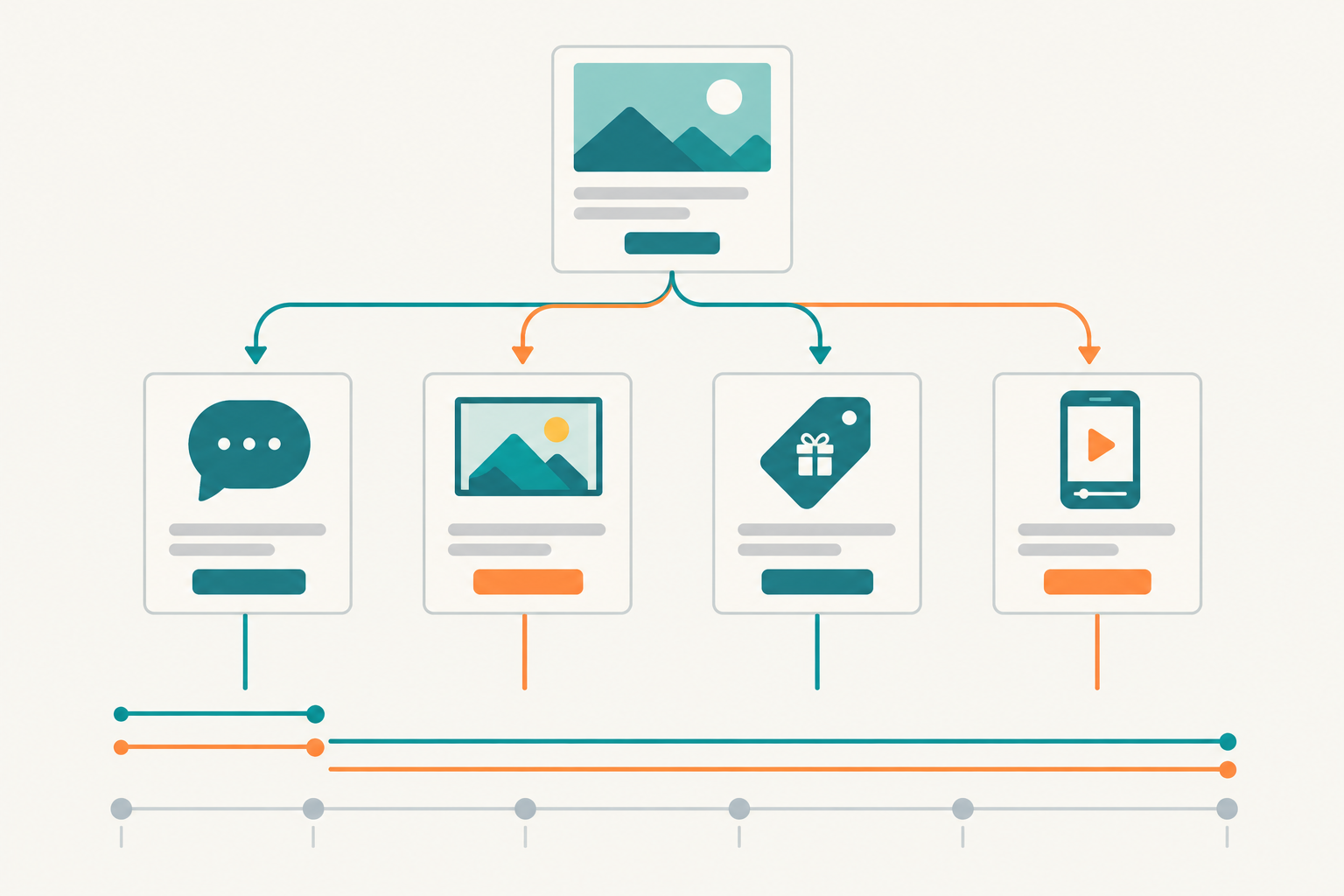
Competitor ad iteration: an example scenario
Imagine a skincare brand with a strong customer testimonial video. In week one, they launch it with a hook about dry skin. In week two, a new version opens with a before-and-after still. In week three, a third version leads with the customer's quote as on-screen text. By week five, two versions have disappeared and one is still running, now with a bundle offer attached.
You can't know the conversion data. But you can form a sensible hypothesis: the testimonial concept may be working, the quote opener may be the strongest, and the brand may be trying an offer on top.
There's a bonus here that I've seen cost teams real money. Without a record of what rivals tried and dropped, it's easy to spend a month testing an idea a competitor already abandoned after a week. That doesn't mean it can't work for you. It does mean you should know about it before you write the brief.
How to turn competitor ad observations into a test
This is how I'd turn that scenario into a test, assuming you sell a comparable product.
- Observation: a rival keeps iterating on a testimonial video and has added a bundle offer to the version that's still live.
- Hypothesis: a customer-quote opener will beat our current product-shot opener on CPA.
- Test 1 (controlled): same testimonial, same audience, same landing page, with only the first three seconds changed. Primary metric: CPA, with thumb-stop rate as a diagnostic.
- Test 2 (later): take the stronger opener and add the bundle offer, but only if your margins allow it.
You're testing the idea (social proof with a different opener, then an offer), not copying their video.
How to interpret a creative test result (fictional numbers)
Below is an illustrative readout for Test 1. These numbers are invented to show the reasoning, not to suggest typical results.
| A: product-shot opener | B: customer-quote opener | |
|---|---|---|
| Spend | £600 | £600 |
| Purchases | 24 | 30 |
| CPA | £25.00 | £20.00 |
| Thumb-stop rate | 28% | 34% |
B looks 20% cheaper per purchase, and the thumb-stop rate points the same way, which fits the idea that the quote opener grabs attention. But the whole result rests on a six-purchase gap out of 54 total purchases. A gap that small can easily come from chance, or from who happened to see each ad.
So what's justified? Treating B as the leading candidate and carrying it into a confirmation round, perhaps with more budget or a repeat run. What isn't justified? Declaring that quote openers beat product shots in general, or assuming the bundle will help. Note the learning in your log (the result, the spend, the purchase counts and how confident you are) and move on.
Why week-over-week ad comparisons beat scrolling
Scrolling a library by hand is painful. You have to remember what was live last week, compare by eye and hope you didn't miss anything. A week-over-week view showing what's new, what's stopped and what's continuing makes the pattern far easier to see. You can build it in a spreadsheet or use a monitoring tool.
How to read competitor ads without fooling yourself
Competitor ad observations are correlational. You're seeing what happened, not why, and not whether it paid off. A repeated discount ad is a reason to look into the offer and audience fit, not evidence that copying the discount will work for you.
Business models differ too. A rival with higher margins, a bigger repeat-purchase rate or stronger brand awareness can afford offers and creative that would crush your own CPA. A household name can run a vague lifestyle ad. A newer brand usually can't.
Look for patterns across several competitors
The most useful signal is behaviour that shows up across several competitors. If three of your five rivals are leaning into bundles this quarter, that's worth testing. If one brand runs an odd, experimental ad, that's just one brand's experiment.
Keep a competitor ad library log
A spreadsheet is enough. Record:
- Date first seen and date last seen
- Platform and market
- Concept or angle
- Format and opening hook
- Offer
- Call to action and landing page
Grouping ads by concept and comparing versions over time makes patterns far easier to see than treating every ad as an unrelated example.
Why archiving competitor ads matters
Libraries mainly show what's active or recently available, and retention varies by platform, ad type and market. Once a competitor stops an ad, you can't count on finding it again, and that's often the very ad you wanted. Screenshot and log as you go. Some monitoring tools also fetch ads on a schedule and archive them, so you keep a record of what rivals tried and dropped.
Building your own creative testing loop
Observing is the easy part. The value comes from turning observations into disciplined tests.
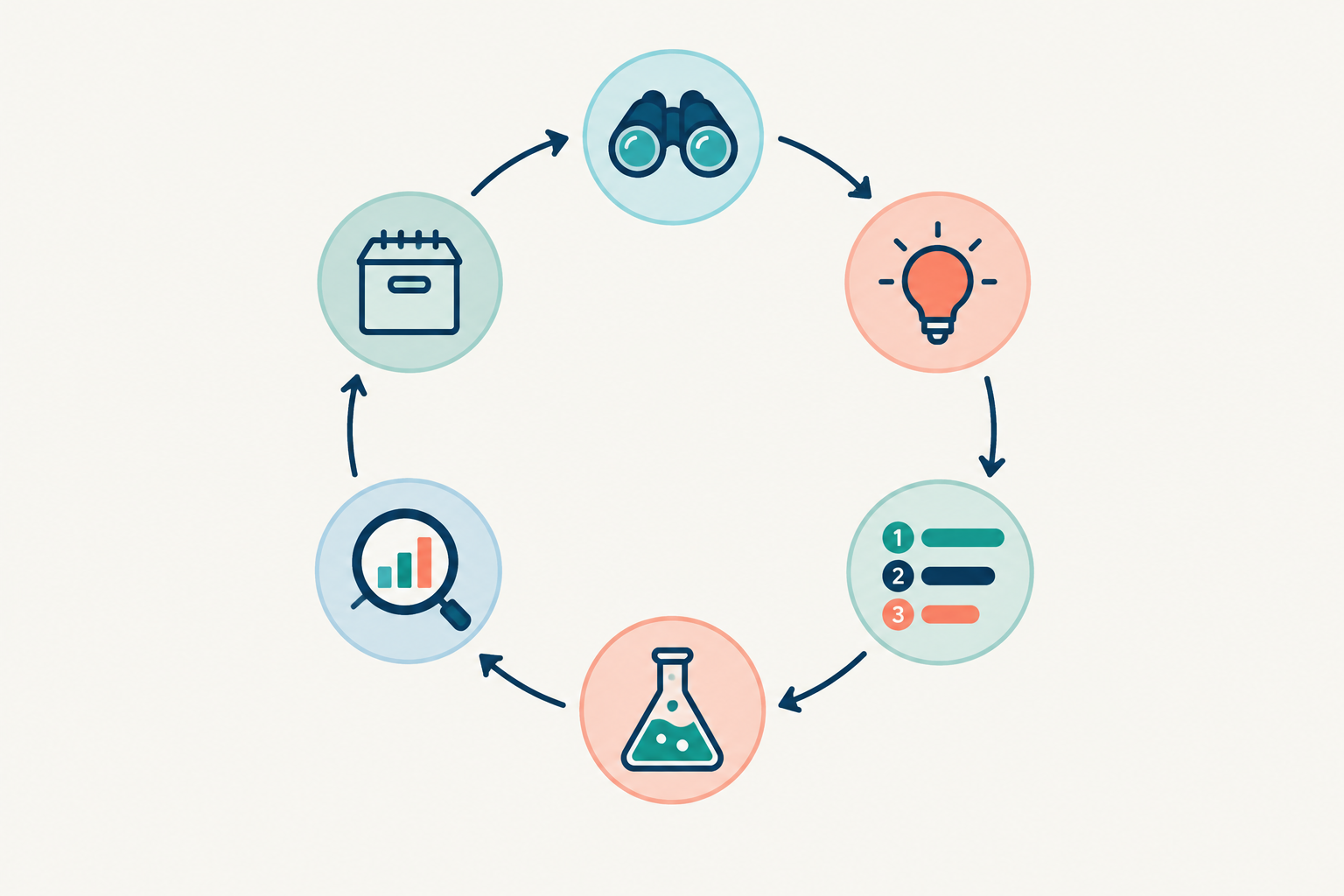
- Observe competitors. Choose three to five direct competitors, plus one or two aspirational brands. More than that and you'll drown in noise. Review changes weekly, noting new launches, stopped ads and continuing concepts.
- Form a hypothesis. Be specific. For example: 'Rivals are leaning into price-led bundles. Will a bundle offer beat our single-product hero ad on CPA?' A good hypothesis names what you'll change and what you expect to happen.
- Prioritise. A simple method is ICE scoring. Rate each idea from 1 to 10 for Impact (how much could this move results?), Confidence (how strong is the evidence, including your own data?) and Ease (how quickly and cheaply can we launch it?), then average the three. Big concept tests usually deserve a look before small tweaks.
- Test. For a controlled test, isolate one variable (hook, offer or CTA) and keep the audience, landing page and tracking consistent. For a concept test, compare two genuinely different approaches, such as a testimonial video against a price-led static. Several things change at once, so you learn which direction performs better, not which element did the work. Both are valid. Just be clear which one you're running.
- Analyse. Choose the primary metric (CPA, ROAS) and the stopping rule before you launch. Thumb-stop rate, roughly the share of people who pause on your video rather than scroll past, is a handy diagnostic, though platforms define it differently. Read the result the way we did in the worked example above: look at the gap, the purchase counts and the diagnostic together.
- Log learnings. Win, lose or draw, write it down and use it to shape the next round.
Step 1 is where most teams stall, because reviewing every rival's changes takes time. That's the part worth systemising, whether with a shared spreadsheet and a Monday routine or a monitoring tool.
How often should eCommerce brands test new creative?
There's no universal, evidence-based schedule. The honest answer is that cadence depends on two things: how much creative you can produce, and how many conversions you can generate to read a test. People tend to forget the second one.
A decision rule for creative testing frequency
Work out your weekly conversions per variant before you decide how many variants to run.
- Take your weekly test budget and divide it by your typical CPA. That's roughly how many purchases you'll get per week.
- Divide by the number of variants. That gives you purchases per variant per week.
- Compare with your minimum read. Many teams use something like 30 to 50 purchases per variant as a rough rule of thumb. It's not a statistical guarantee, but it stops you calling tests on a handful of orders.
Say you spend £2,000 a month on testing (about £460 a week) at a £25 CPA. That's roughly 18 purchases a week. Split across two variants, it's about 9 each, so a clean read could take three to five weeks. In that situation, one simple two-variant test at a time beats five muddy ones.
Illustrative creative testing starting ranges
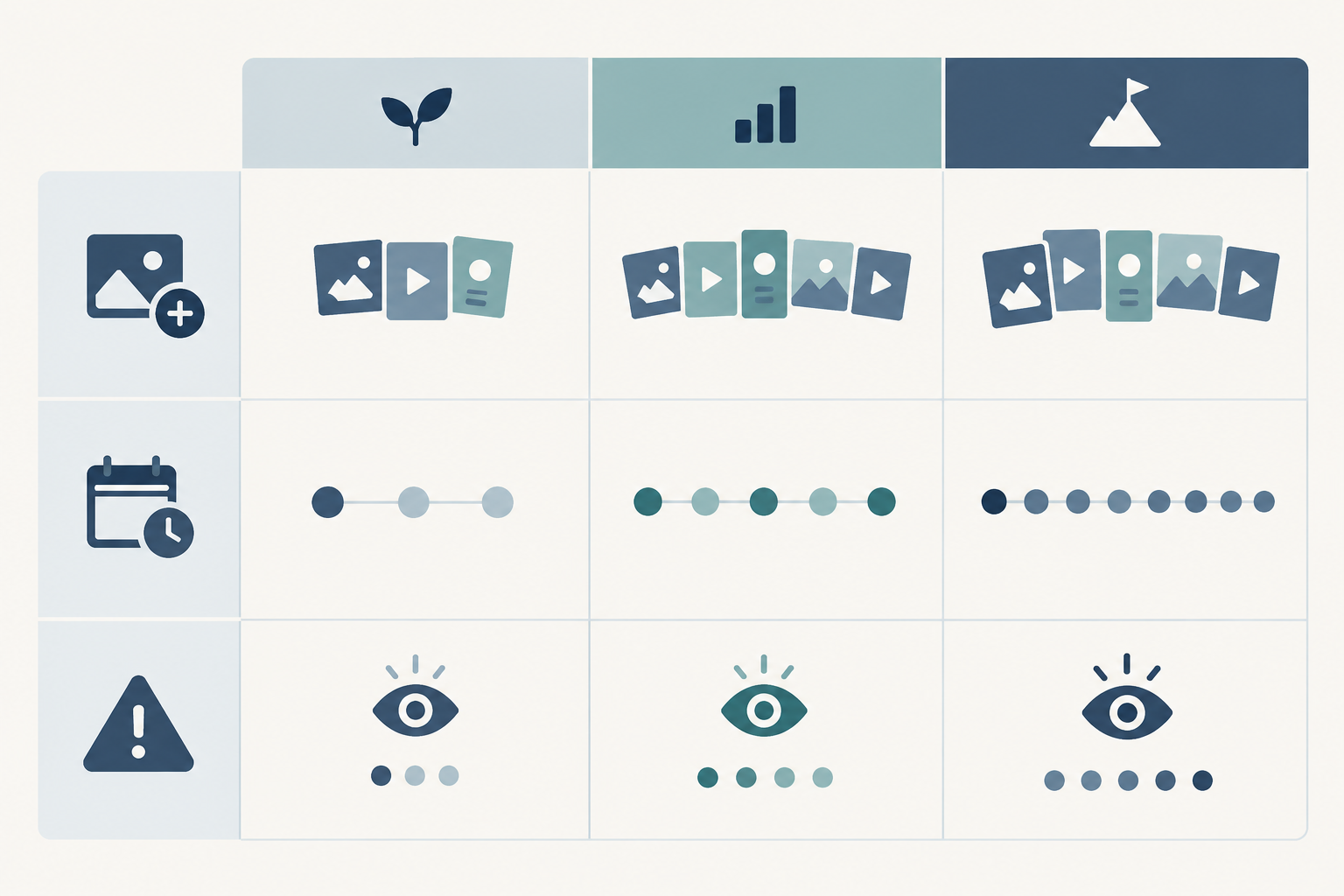
The table below turns that rule into starting points. These are illustrative planning ranges based on typical team capacity, not benchmarks from a study. Adjust them to your account.
| Lower capacity / small spend | Mid-scale | Higher capacity / high spend | |
|---|---|---|---|
| Typical monthly test budget (illustrative) | Under £3,000 | £3,000 to £15,000 | Above £15,000 |
| New creatives (illustrative start) | 2 to 4 every two weeks | 4 to 8 per week | 10+ per week, grouped by concept |
| Concurrent tests | 1 | 2 to 3 | 4+, with clear naming and ownership |
| Typical read time | 2 to 4 weeks | 1 to 2 weeks | Rolling weekly reviews |
| Main risk | Spreading budget too thin | Testing without logging learnings | Volume without clear hypotheses |
The bands are blunt. A low-spend brand with a high conversion rate can read tests faster than a high-spend brand with thin margins. If the purchases-per-variant rule and the band disagree, go with the rule.
Use creative fatigue to decide when to refresh ads
Calendar timing alone is a poor guide. Watch these signals instead:
- Rising frequency: the same people are seeing the ad again and again.
- Falling CTR: the ad is getting less attention at comparable spend and audience.
- Climbing CPA: you're paying more for the same result.
When all three move the wrong way together, it's time for fresh creative. Any one on its own can have other causes, such as a seasonal shift or an audience change.
Plan for competitor refresh rates and UK seasonal peaks
It's handy to know a competitor launches a handful of new ads weekly, but that's context, not a target. Their budget, margins and creative team aren't yours.
The UK calendar does have moments when cadence often needs to rise: Q4 (Black Friday, Cyber Monday, Christmas), Boxing Day and the January sales, plus gifting dates like Mother's Day. Audiences saturate faster when everyone is shouting, so plan briefs ahead instead of scrambling in November.
Common creative testing mistakes to avoid
Some of these cost a few days of budget. Others can cost a whole quarter.
- Copying a rival's ad outright. Test the underlying idea (the angle, the offer structure, the proof point), not the exact execution. Direct copying can also create intellectual property and brand issues.
- Changing too many variables when you need a clean answer. If the hook, offer and landing page all change in a test meant to isolate the hook, you can't say what worked. For a broad concept test, label it that way.
- Calling tests too early. A handful of clicks is noise. Checking every few hours and stopping when one variant briefly leads is how noise gets mistaken for a win. Set the metric, spend and duration in advance.
- Testing tiny tweaks before big concepts. Button colour can wait. Angle, offer and format usually have more room to move results, though your own data should confirm that.
- Optimising for the wrong metric. A higher click-through rate doesn't guarantee more purchases. Match your success metric to your objective.
- Ignoring your own data. What rivals appear to be doing should never override what your account is telling you.
- Watching one platform only. Rivals run across Meta, Google, TikTok and LinkedIn. Check more than one before reading their strategy.
- Not documenting results. Without a log, teams repeat the same tests every few months.
- Forgetting UK specifics. That means ASA and CAP Code rules on claims and testimonials (skincare and supplements need particular care), pricing in £ including VAT, accurate delivery and returns messaging, and a seasonal calendar that differs from the US. A US rival's Thanksgiving-style promo may mean nothing here.
A simple weekly creative testing routine
This rhythm works for small in-house teams and agencies alike.
- Monday: review competitor ad changes. Note what's new, what's stopped and what's still running.
- Tuesday: choose one hypothesis from your notes and brief the creative. Define the variable (or the concept being compared) and the success metric.
- Midweek: launch the test with clear naming conventions.
- The following week (or when your stopping rule is met): review results, log the learning and pick the next hypothesis.
Shared ownership matters. Let one person own the skincare rivals and another the supplement brands, and keep one shared log or dashboard that everyone updates, so nobody duplicates work or tests something a colleague already logged.
Where a competitor ad monitoring tool can help
Everything above works with free libraries and a spreadsheet. If you'd rather automate the monitoring, Rival Ads is the tool we make, so weigh this section accordingly.
You enter a competitor's website URL, it looks for their presence across Meta, Google, TikTok and LinkedIn, and it tracks their ads without needing access to any ad account. It archives creatives, copy and links, and produces weekly new/stopped/continuing views. It also adds AI-generated summaries (using Claude) of what changed, which is meant to speed up step 1 of the loop, the weekly review. Treat those summaries as a starting point and check them against the actual ads, because they describe changes, not performance.
Plans start at $29/month, with tiers based on the number of competitors you monitor. Pricing is in US dollars, so what you pay in pounds will depend on the exchange rate and any VAT or card fees. Check the current pricing page before you commit.
FAQ: Competitor ads and creative testing
How do I use competitor ads to guide creative testing?
Look for patterns rather than single ads: concepts that get repeated, iterated on and kept live for weeks. Turn each pattern into a hypothesis, test it against your own audience and judge it using your own data.
What creative testing mistakes should I avoid?
The big ones are copying a rival's ad outright, calling tests too early, judging results on the wrong metric and not logging what you learn. Be clear whether you're running a controlled test of one variable or a broader concept test.
How often should eCommerce brands test new creative?
It depends on your creative capacity and how many purchases you can generate per variant. Smaller brands might start with two to four new creatives every two weeks, while higher-spending brands often move to a weekly batch or more. Those are illustrative starting points, not benchmarks. Let fatigue signals and your own conversion volume guide you.
Can I see how much competitors are spending on ads?
No. For ordinary commercial ads, public libraries show what is running and for how long, not budget or results.
Is it legal to look at competitor ads in ad libraries?
Viewing ads in public libraries is what those libraries are for, and each platform publishes its own terms for using them. Reusing is a different matter. Copying a rival's creative, copy, images or music can infringe copyright or trade marks and may breach advertising rules. The UK Intellectual Property Office and the ASA are good starting points, and a solicitor can advise on specific cases. This isn't legal advice, so use library ads for inspiration only.
What is the difference between an ad library and an ad spy tool?
Native ad libraries are free but manual and limited to one platform at a time. An ad monitoring tool collects ads across several platforms, archives them and highlights what changed week to week.
The takeaway
Competitor ads won't hand you a winning formula, and anyone who says otherwise is selling something. What they will do is save you from starting every experiment on a blank page, and give you a steady supply of sharp hypotheses. Watch for iteration and repetition, log what you see, design each test so you know what question it answers, and let your own numbers make the final call. Do that consistently and you'll be testing smarter than most of your rivals. 🚀