
How AI Is Changing the Way Marketers Read Competitor Strategy
Discover how AI interprets week-over-week competitor ad changes like a senior media buyer, where human judgement still matters, and what it means for
Chris Edington
13 min read
title: "How AI Is Changing the Way Marketers Read Competitor Strategy" meta_description: "AI can turn week-over-week competitor ad changes into a structured first read of strategy. Here's what it can and can't tell UK media buyers, and how to use it well."
How AI Is Changing the Way Marketers Read Competitor Strategy
Picture this. You check a rival's ads one Tuesday in October and see a handful of lifestyle videos. You look again in mid-November and the account is wall-to-wall 'early access' offers. The ad library can't tell you when that flipped, which creatives went first, or what was switched off to make room.
That gap is where AI is changing competitor analysis. It takes raw ad data (new launches, paused creatives, ads that keep running) and turns it into a structured first read of what a rival appears to be doing. That used to take years of pattern-spotting experience. AI won't replace your judgement, and it can't see a rival's results, spend or targeting. What it can do is hand media buyers at any level a decent starting hypothesis to test against their own data. 🧠
Below, I'll walk through how AI-powered competitor ad analysis works in practice, where it falls over, and how to fit it into a weekly routine without drowning in tabs.
Why competitor ads reveal more about strategy than you think 🔍
An ad library is a snapshot. The Meta Ad Library and Google's Ads Transparency Center are both useful, but each mostly shows what an advertiser is running right now. The strategy lives in the changes between snapshots.
When a competitor launches ten new ads in a week, that looks like a bet. When they switch off a creative they'd run for two months, that's worth noting. When an ad stays live and picks up variants, it's a modest sign they're still using the message. None of these proves anything on its own. But a pattern across several ads and several weeks tells you far more than any single ad.
So the real question is whether AI can read those signals the way a seasoned media buyer would, and stay honest about how uncertain they are.
The old way: manual competitor ad analysis
If you've done competitor research by hand, you know the routine. Meta Ad Library in one tab, Google's Transparency Center in another, then TikTok and LinkedIn in a couple more. Search each competitor, scroll, screenshot, paste into a deck, and promise yourself you'll repeat it next week.
The approach itself is sound. Michael Porter's work on competitive strategy, summarised in his Harvard Business Review article on the five competitive forces, rests on analysing what rivals visibly do and reading the pattern rather than each isolated move. Public advertising is exactly that kind of observable behaviour. On the ethical side, the Strategic and Competitive Intelligence Professionals (SCIP) publish a code of ethics built around gathering competitive intelligence legally and transparently, which is a good standard to hold yourself to.
The trouble is the execution:
- No history. Ad libraries show what's live, not what was live last month.
- No record of what stopped. An ad that disappears leaves no trace unless you captured it first.
- Inconsistent checking. Busy fortnight? The research is the first thing to slip.
- Tab fatigue. Four platforms, five competitors, and by Thursday you're skimming.
There's a hidden cost too. In most teams, the real insight lived in one senior person's head. They'd glance at a rival's ads and say, 'They're pushing a discount now, which can mean pressure on acquisition.' Junior buyers, freelancers and small in-house teams were left guessing, or skipped the exercise altogether.
Here's a scenario most of us will recognise (illustrative, not a specific client). A buyer at a UK subscription brand checks a rival every few weeks. One month the ads are all lifestyle-led. Six weeks later, free-trial offers are everywhere. With no dated record, nobody can say when the shift began or which creatives were swapped first, so the response arrives late.
What AI can actually interpret in competitor ad data
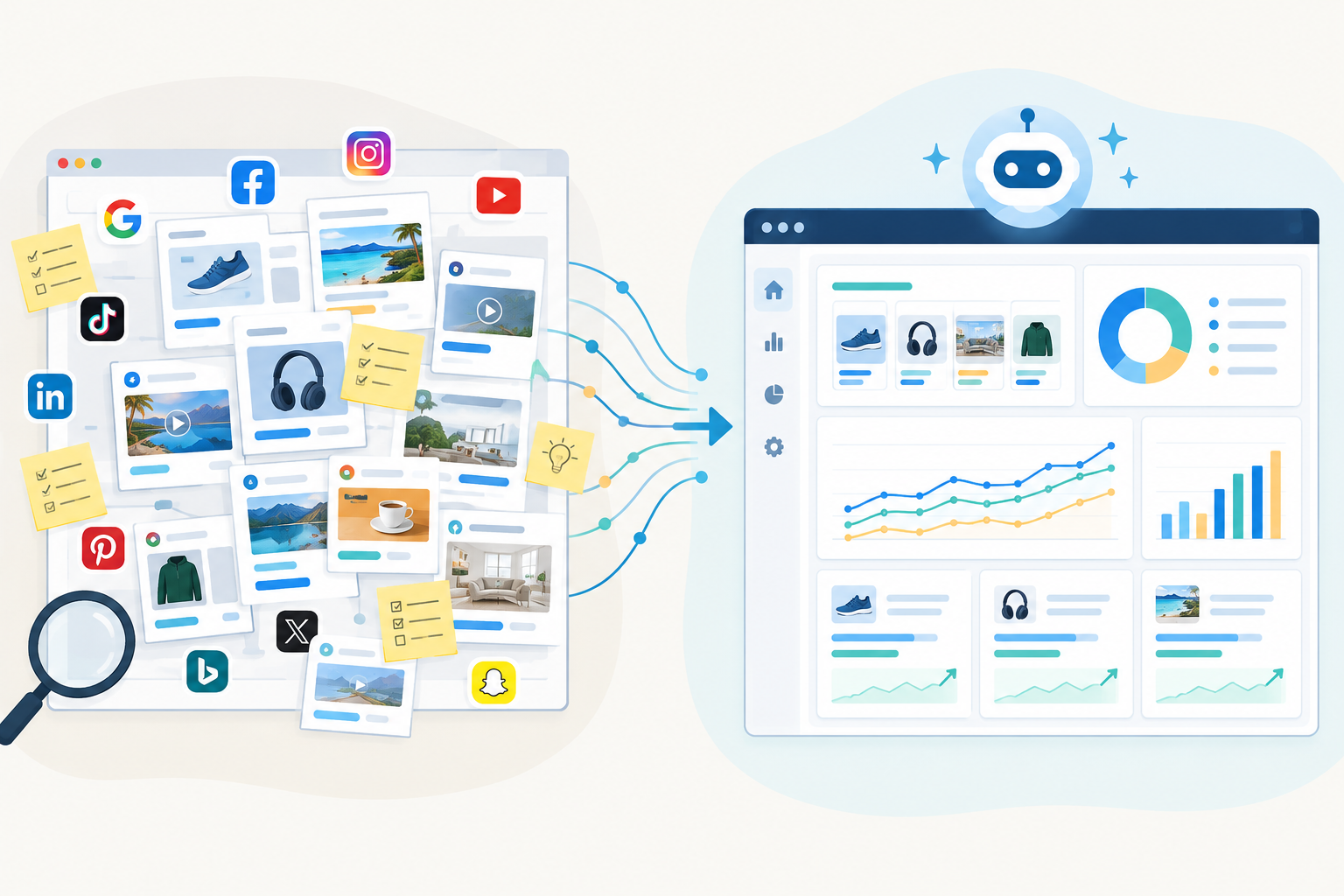
'AI-powered insights' can mean almost anything, so let's be specific. AI works best when it's given structured weekly changes rather than a folder of unlabelled screenshots. 'These 8 ads are new, these 5 stopped, these 21 continue' is a far better input than a pile of creatives. From there, it can reasonably help with the following.
- New launches. A fresh angle, offer or format. One ad could just be a test, but a cluster across platforms hints at commitment.
- Stopped ads. If three testimonial ads vanish the week a new offer goes live, that's worth a note. It could equally be a flight date ending, so treat it as a question rather than an answer.
- Continuing ads and variants. Long-running creatives and duplicated variants are a weak-to-moderate signal that a message is still in use.
- Copy and messaging shifts. A move from 'Learn more' to 'Get 20% off today' looks like a strategic change, not a cosmetic one.
- Creative mix and cross-platform patterns. Some tools can read on-screen text, recognise formats such as UGC versus polished video, and group ads by message. Accuracy varies with input quality, and video or image assets aren't always available, so treat classifications as suggestions. A message that appears on Meta and then turns up on TikTok or LinkedIn a fortnight later is worth watching, as long as the tool actually covers all those platforms.
Here's the one caveat I'd ask you to hold onto for the rest of this post: public ad activity is not performance data. You can see what a rival showed. You can't see ROAS, budget, conversions or targeting. A paused ad may have simply hit its flight dates, and a long-running ad may just be one nobody got round to switching off. So a good AI read frames its conclusions as hypotheses, and you should treat them that way.
How AI interprets week-over-week competitor ad changes: a worked example
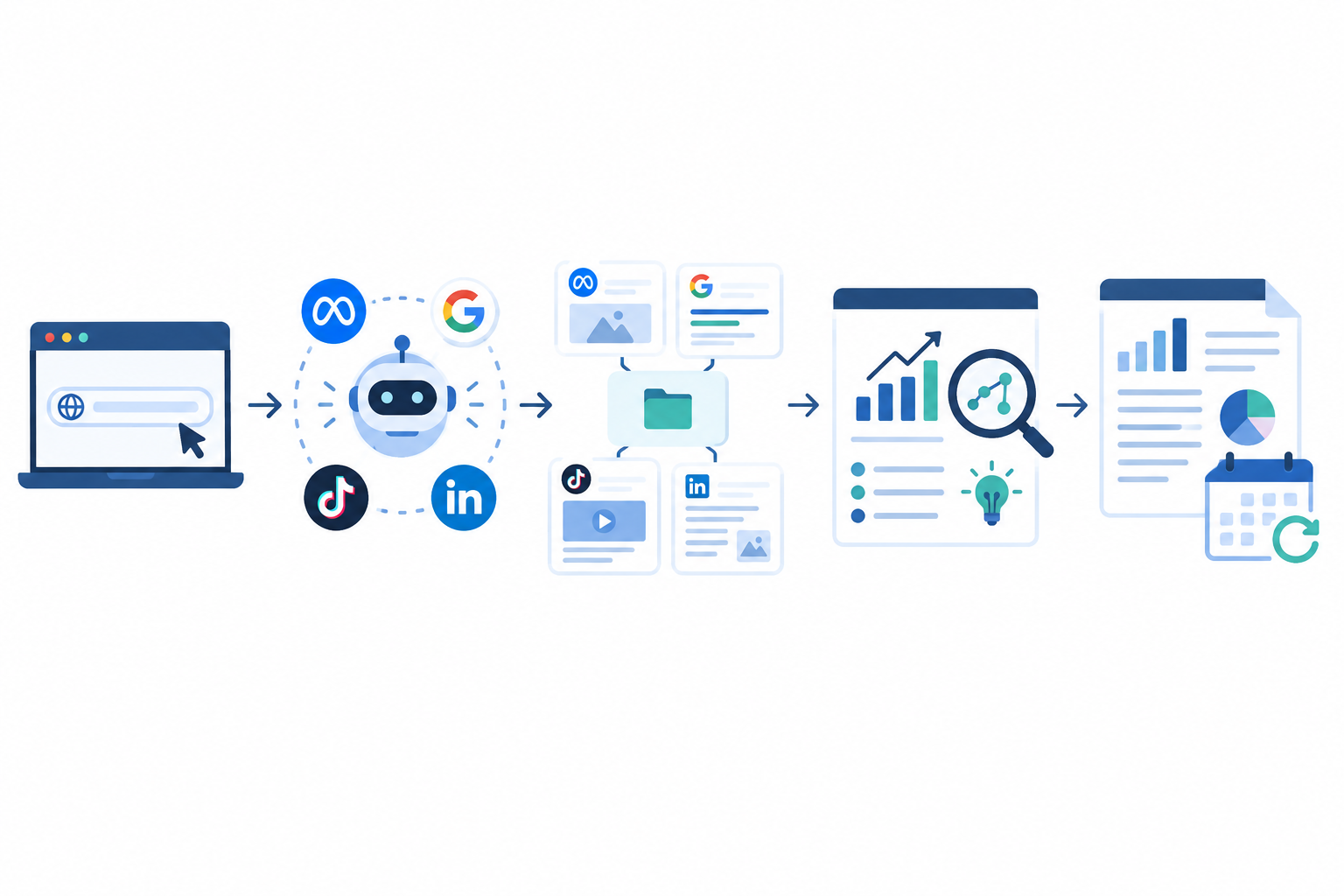
The workflow is broadly the same whichever tool you use:
- Identify the competitor's advertising presence across the platforms you care about.
- Capture the active ads each week, with creative, copy and destination where available.
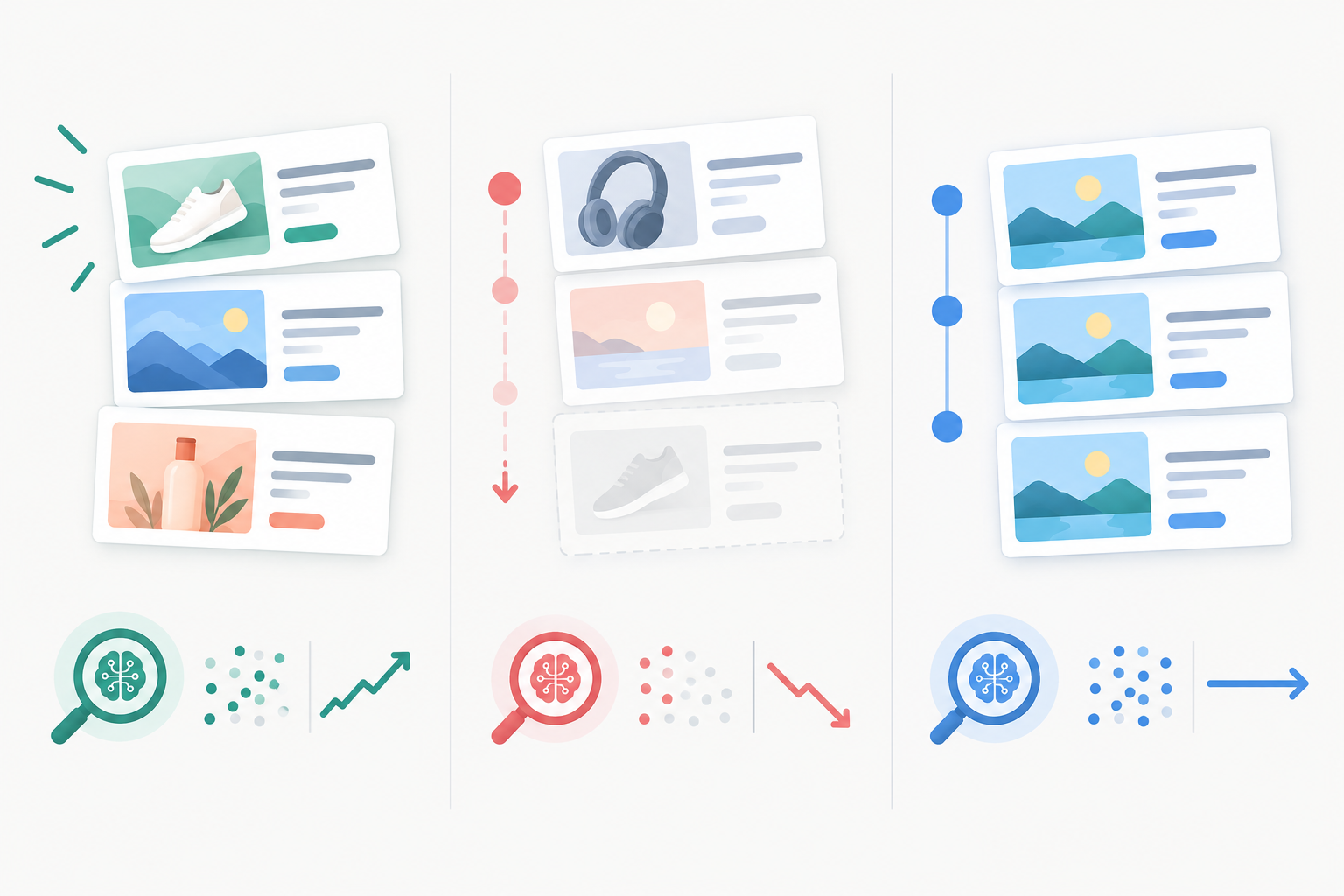
- Compare this week with last week, sorting ads into new, stopped and continuing.
- Interpret the pattern, ideally as an observation, a hypothesis, what would weaken it, and how to check it.
Now a hypothetical, purely illustrative example. A UK online furniture retailer launches eleven new ads this week. Nine are discount-led ('Up to 30% off, ends Sunday'), mostly on Meta and TikTok. Four brand-story videos they'd run since spring are paused. Two long-running free-delivery ads are still live, and one has gained three variants.
A senior buyer might read that like this:
- Observation: Nine of eleven new ads are discount-led, four brand videos are paused, and the free-delivery ads are still live.
- Hypothesis: A short-term conversion push, possibly seasonal, with free delivery still a comfortable message.
- What would weaken it: The same pattern appearing at this time every year, or the brand videos returning next week.
- How to validate: Check your own conversion and CPC trends for signs of being undercut, and review whether you're exposed on delivery messaging.
Notice what the output isn't: 'copy this.' It's a prompt to go and check your own data.
A quick word on how Rival Ads does it. It's our product, so read this as a vendor description. We deliberately built around week-over-week comparison rather than a gallery of ads, because galleries leave the hard part (spotting what changed and why) to you. You enter a competitor's website URL, with no ad account access needed, and we look for its presence on Meta, Google Ads, TikTok and LinkedIn. Active ads are archived weekly, sorted into new, stopped and continuing, and passed to Claude, an AI model from Anthropic, which writes an analysis in the style of a senior media buyer. Coverage depends on what each platform makes public, so a brand's footprint can be incomplete. Check our site for what's currently supported.
Can AI replace competitor analysis? Where human judgement still matters
Short answer: no. AI gives you a first read, and you're the one who decides.
It doesn't know what happens next. Google's Auction Insights report (see Google Ads Help for current definitions) shows metrics like impression share and overlap rate for advertisers in the same auctions. That's helpful, but it doesn't reveal a rival's bids, budget or targeting either. The gap between what's visible and what's effective never fully closes.
You also hold the context. Your positioning, customer base, margins and seasonality all change what a signal means. The UK adds its own layers, and they matter in practice:
- Seasonality. A rival's discount surge in mid-November is expected, because Black Friday is baked into the UK retail calendar. The same surge in early March, or a fresh wave of 'sale' creative in the second week of January, tells you something different. Compare against the same weeks in previous years before reading intent into it.
- VAT and pricing. Consumer ads in the UK generally have to show prices including VAT, while B2B advertisers often quote ex-VAT. So if you sell to businesses and a rival's ad says '£99' while yours says '£99 + VAT', don't assume they're undercutting you. Check what each price actually includes before you compare.
- Advertising rules. The ASA's advertising codes limit what claims anyone can make, including 'was/now' pricing and 'free' offers. A sudden change in wording could be a compliance fix rather than a strategy shift.
An AI can flag a price-led message. It takes a human to know whether that's a threat or the same sale they run every year.
The real win is time. Instead of spending Monday morning collecting and screenshotting, you spend it deciding what to do. 🎯
AI-assisted vs manual competitor analysis: a quick comparison
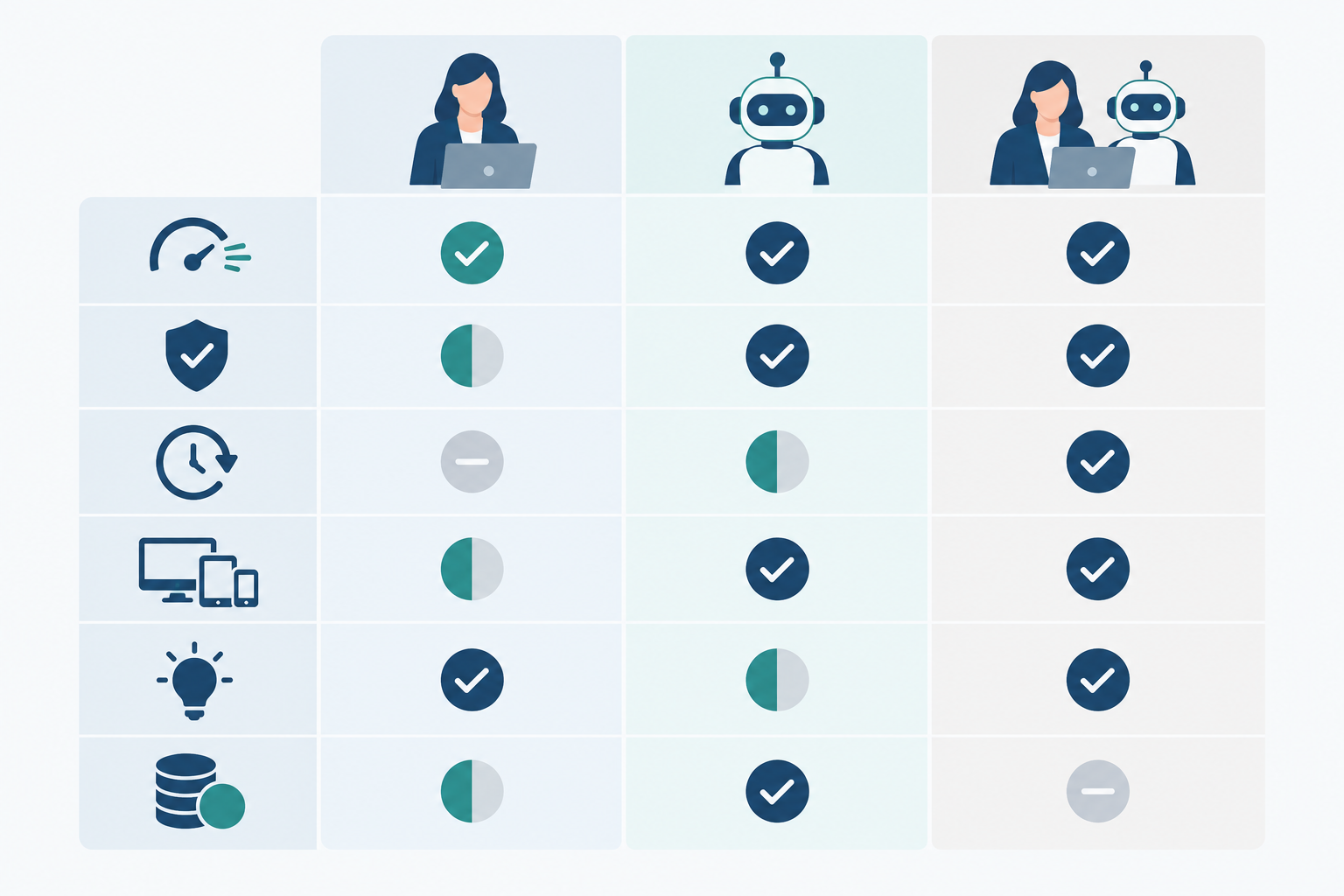
Neither approach wins outright, and results depend heavily on the tool and your workflow. Here's a general guide:
| Manual | AI-assisted monitoring | Hybrid | |
|---|---|---|---|
| Speed | Slow; hours per competitor | Can provide an automated weekly digest, depending on the tool | Fast first read, focused human review |
| Consistency | Varies with workload | Can run on a regular cadence if set up that way | Consistent, with human sense-checks |
| Historical record | Only what you screenshotted | Some tools archive ads from the point monitoring starts; others don't | Archive (if available) plus your own annotations |
| Cross-platform coverage | Whatever you have time to check | Depends on the tool and what each platform makes public | Broad coverage, prioritised by you |
| Depth of context | High, if the analyst knows the business | Lighter on your business context | Best of both |
| Cost | Staff time (the hidden cost) | Software subscription, which may or may not beat staff time | Software cost plus a small time investment |
Manual research is flexible and rich in context, but inconsistent and hungry for time. AI-assisted monitoring can be steadier, but it can't know your business. For most teams, the practical answer is a hybrid.
How AI can democratise the senior media buyer's read 🤝
This is the part I'm most excited about. Pattern recognition used to come from years in the seat: the thousands of accounts you'd seen, the rival launches you'd watched play out. That made it scarce, and it tended to sit with a handful of senior people.
Now a freelancer or a one-person in-house team can get a structured read on a rival's week without a decade of experience. It doesn't replace that experience, but it narrows the gap. Smaller teams get interpretation rather than just data. Agencies can turn competitor reports into a client deliverable, because clients always ask 'what are our competitors up to?' And larger teams can assign specific competitors to specific buyers, so insight doesn't stay locked in one person's head.
The future of AI-augmented media buying
These are my own predictions, and forecasts are only forecasts.
- From reactive monitoring to proactive hypotheses. Instead of 'what did they do?', the question becomes 'what might they be testing, and what should we test in response?'
- More creative volume to track. Generative AI is making ad variations cheaper to produce, and platforms are automating more of the buying itself (Google's Performance Max is a good example). More variation and more automation mean we'll need people who can separate signal from noise.
- Competitor insight as a weekly input. It stops being a quarterly slide and starts feeding briefs, budgets and testing roadmaps.
- Judgement as the differentiator. When everyone has the same baseline data, knowing what competitors are doing stops being an edge. What you do with it is the edge. And the ethical line stays simple: inform your own strategy, don't clone their creative.
How to start using AI to read competitor ads this week
You don't need a grand project. Here's a simple way to begin:
- Pick three to five direct competitors. Include at least one emerging challenger, because the newcomer's playbook is often the most instructive.
- Set up weekly monitoring across the platforms your audience uses, whether that's a tool or a disciplined manual routine with dated screenshots.
- Read the weekly changes, then note one hypothesis per competitor. Just one. 'They seem to be leaning on free delivery' is plenty.
- Check your own performance data before changing anything. If your numbers don't back up the concern, don't react to it.
- Review monthly. Look back at which signals actually predicted a competitor move. That's how you train your own instincts alongside the AI's.
If you'd rather not spend your Mondays in a dozen browser tabs, that's the problem we built Rival Ads to solve.
FAQ
Can AI replace competitive analysis?
Not entirely. AI is good at collecting, comparing and summarising changes in competitor ads at a steady pace, but it can't see competitors' results or budgets, or your business context. Use it as a first read and make the call yourself.
How does AI interpret competitor ad data?
It compares snapshots of a competitor's live ads over time and sorts them into new, stopped and continuing. Then it looks at patterns in copy, format, offers and destinations to suggest possible intent. What you get is a set of hypotheses, not confirmed facts.
What role will AI play in media buying going forward?
AI will increasingly handle monitoring, summarising and pattern-spotting, leaving media buyers to focus on strategy, creative direction and commercial decisions. The advantage will likely go to teams who pair AI insight with strong judgement.
Do I need access to a competitor's ad account to track their ads?
No. Tools like Rival Ads work from a competitor's website and publicly available ad information. Coverage varies by platform, so check a tool's documentation for what it currently supports.
Is it legal and ethical to monitor competitor ads?
Viewing ads that platforms make publicly visible, such as through the Meta Ad Library or Google's Ads Transparency Center, is widely accepted practice. Bulk collection, storage, or reuse of someone else's creative or copy may be restricted by platform terms, copyright and other laws, so check the relevant terms and take legal advice if you're unsure. This isn't legal advice. Ethically, use what you learn to inform your own original strategy rather than copying a rival.