
How Often Should You Really Check Your Competitors' Ads? A Media Buyer's Guide to Monitoring Cadence
Learn how often to check competitor ads with a practical ad monitoring cadence—why weekly reviews work for UK media buyers, and when alerts matter.
Chris Edington
12 min read
How Often to Check Competitor Ads: A Media Buyer's Guide to Ad Monitoring Cadence
If you're checking your competitors' ad accounts every single day, I've got some news that might feel like a relief: you can probably stop.
Here's the short answer to the question I get asked constantly by media buyers and agency strategists in the UK and beyond: for most teams, checking competitor ads once a week is the most useful default. It's not a universal law (more on the exceptions later), but as a starting point, a weekly ad monitoring cadence matches how often meaningful changes tend to happen in ad accounts, and it fits the way real marketing teams actually make decisions: in weekly cycles, not hourly ones. Daily checking feels productive, but it mostly generates noise: minor A/B test blips, creative rotations, and auction fluctuations that don't represent a real strategic shift. Monthly checks, on the other hand, often mean you're spotting trends after the window to act on them has already closed.
The right cadence for checking competitor ads does depend on your category, spend level, and how volatile your competitors' activity is. A fast-moving fashion retailer running constant promotions needs a tighter loop than a B2B software company with a six-month sales cycle. The one exception worth carving out regardless of category: real-time or daily alerts for a small handful of high-priority competitors during product launches or seasonal pushes, like Black Friday, Boxing Day, back-to-school, a big rebrand, or the run-up to Christmas. Outside of those moments, weekly is where the signal usually lives.
Let me walk you through why.
The Case for Checking Competitor Ads Daily (and Why It Backfires)
I get the instinct. Checking competitor ads daily feels like due diligence. You're staying sharp, staying informed, staying ahead. But in practice, daily monitoring rarely changes what you actually do that day for most accounts. That's often the tell that it's busywork dressed up as strategy, rather than a hard rule.
Here's the thing about ad platforms: they're dynamic by design. Google's Auction Insights report is built for comparative analysis over a date range, not as a live alert system. Metrics like impression share and outranking share (a measure of how often a competitor's ad ranked above yours) can shift day to day simply because of budget pacing or inventory availability, not because a competitor made a deliberate strategic move. If you see a competitor outrank you one day and react by raising bids immediately, you might just be responding to short-term noise that resolves itself within a couple of days.
The same logic applies on the creative side. Meta's Ad Library shows you which ads are currently active, but it doesn't tell you spend, targeting, conversion rate, or profitability. That limitation is worth being blunt about, because it shapes everything else in this article. A new ad appearing in the library could be a winning control ad scaling hard, or it could be a small test budget that gets killed by Thursday. From the outside, using only public data, you can't always tell the difference. Treating every sighting as proof of success is one way teams end up copying a competitor's failed experiment.
Here's a small worked example. Imagine you spot a competitor's new ad on a Tuesday and it looks aggressive: bold discount, urgent copy. Panic sets in, and you brief a rushed matching campaign by Wednesday. By the following Monday, that ad is gone. It was a two-day test that didn't work. Now compare that to waiting for your weekly review: by Monday, you'd have seen the ad appear and disappear within the same window, with no action needed at all. That's the practical difference between reacting to a single day and reviewing a week.
Then there's the time cost. In my experience talking to media buyers, many report spending somewhere in the region of 20 to 30 minutes a day manually scrolling ad libraries across platforms: Meta, Google, sometimes TikTok and LinkedIn too. I'd treat that as an illustrative figure rather than a precise industry statistic, but even a rough version of it adds up to two or three hours a week that could go toward acting on insight instead of just collecting it. Worse, this daily habit can create a kind of decision fatigue: you start treating minor, temporary tests as major strategic pivots, which breeds false urgency and reactive budget changes that don't hold up a week later.
The fix isn't to stop watching. It's to separate observation from action, and give yourself a defined review window before you let anything change your strategy.
What Actually Changes Week to Week?
Once you step back from daily checking, a pattern often becomes clearer: much of what matters in competitor ad accounts tends to happen on something closer to a weekly rhythm than a daily one. That said, this varies a fair amount by spend and conversion volume, so treat the following as tendencies rather than fixed rules.
- Creative tests often run anywhere from a few days to two weeks before a brand decides to pause or scale them, with higher-spend advertisers typically reaching statistical confidence faster. A daily snapshot risks catching you mid-test, before there's anything conclusive to see. Importantly, you can observe that an ad is still live without knowing whether it's actually winning.
- New launches and pauses often cluster around internal budget cycles. Many teams review campaigns weekly or biweekly, which means competitor account changes tend to show up in batches tied to those same review points rather than randomly through the week. This is an inference from typical planning rhythms, not something you can verify directly from public ad data.
- Ad copy and offer changes are usually the result of a planning decision, not a live experiment. Nobody's rewriting their value proposition every few hours. When copy or pricing shifts, it's typically deliberate.
- Real signal usually takes a few days to surface. A competitor scaling a genuine winner, or dropping a whole campaign, is a pattern that tends to build over several days of observation rather than appear in a single day's glance. That said, you're inferring the pattern from what stays visible, not from performance data you don't have.

This is really the core argument for a weekly monitoring cadence: it's not an arbitrary compromise between "too much" and "too little." It's timed to roughly match how ad testing and campaign management tend to function on the other end, accepting that we're often inferring that rhythm from visible activity, not confirming it directly.
Why Weekly Competitor Ad Diffs Match Real Decision Cycles
Here's something I think gets overlooked in the daily-versus-weekly debate. The conversation usually focuses on how often competitors change their ads. But the more useful question is how often your team is actually positioned to act on that information.
Most marketing teams plan, review, and adjust strategy in weekly sprints. Monday planning sessions, Friday wrap-ups, weekly stand-ups: this is the operating rhythm most of us already live in, in the UK and elsewhere. A week-over-week view showing what's new, what's paused, and what's continuing to run slots directly into that rhythm. It's the shape of insight that's actually useful heading into a Monday strategy call, rather than a stream of updates you have to mentally file away all week.
For teams using a monitoring platform, a weekly diff can make this workflow considerably easier. We built Rival Ads around a weekly fetch cycle across Meta, Google Ads, TikTok, and LinkedIn rather than a real-time scraper, partly because a flood of constant updates tends to recreate the same noise problem daily manual checking has. The platform pulls active ads from your tracked competitors each week, creative, copy, and links, and lines them up against the previous week's snapshot, so you can see what launched, what disappeared, and what's still running. It's worth being clear about what this does and doesn't tell you: it shows changes in visible activity, not spend, targeting, or profitability, because that data simply isn't public. It removes the manual scrolling, but it doesn't replace judgement about what those changes actually mean.
Signal vs Noise in Different Ad Monitoring Cadences
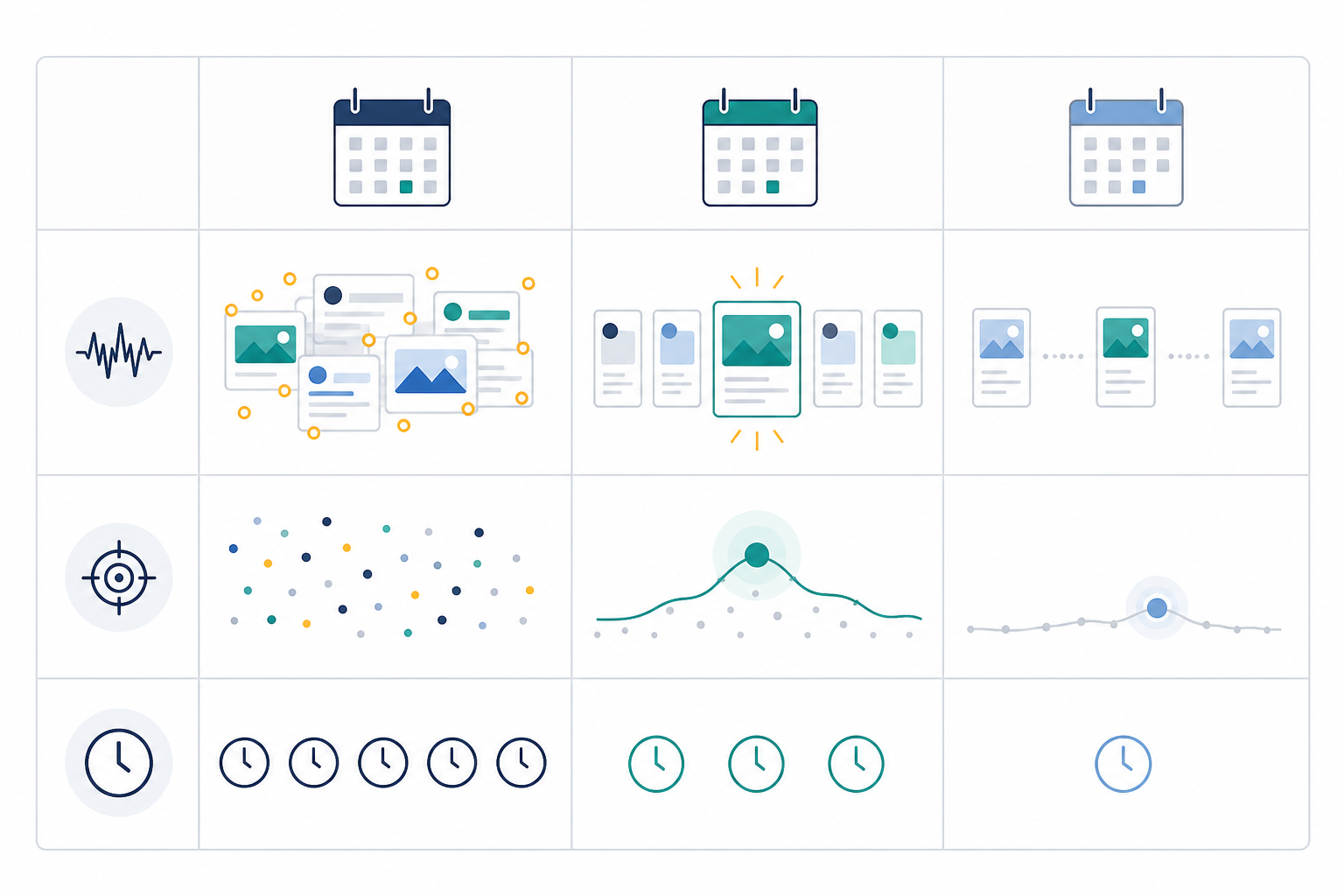
Let's put the three cadences side by side, because the contrast is actually useful when you're deciding how to structure your own workflow. Treat "risk" here as operational risk, the chance of wasted effort or a missed window, rather than a claim that any cadence is risk-free.
| Cadence | Noise Level | Signal Clarity | Time Investment | Operational Risk |
|---|---|---|---|---|
| Daily | High, often dominated by short-lived A/B tests and creative rotation | Low—hard to distinguish real shifts from routine delivery fluctuation | Roughly 20–30 min/day (2.5+ hrs/week), as an illustrative estimate | Overreacting to temporary tests; decision fatigue |
| Weekly | Lower, many short-lived tests will have resolved by the time you look | Generally clearer view of what's new, paused, and still running | Roughly 15–30 min/week | Lower day-to-day burden, but can miss fast-moving changes during high-volatility periods |
| Monthly | Low, but often stale | Delayed—trends may only become visible after the window to act has passed | Roughly 30–45 min/month | Missed creative fatigue signals and missed scaling windows |
Even at a weekly cadence, raw data alone isn't quite enough. You still need to interpret it, and it's worth being honest about the limits of that interpretation. Rival Ads runs each weekly diff through a Claude-powered analysis that aims to read the changes the way an experienced media buyer might: flagging patterns that look more deliberate than experimental, or a pause that might suggest creative fatigue rather than budget reallocation. I'd frame this as an assistive first read rather than a definitive verdict. No tool built on public ad data can know a competitor's actual performance numbers, and any analysis should be treated as a prompt for your own judgement, not a replacement for it.
Building a Competitor Ad Monitoring Cadence That Fits Your Team
Knowing that weekly is a sensible default is one thing. Actually building that into your team's workflow is another. Here's how I'd approach it:
-
Segment your competitors into tiers. Not every competitor deserves the same attention. Identify your top three to five direct competitors, the ones whose moves genuinely affect your positioning, and separate them from a broader market watch list you check less rigorously.
-
Set weekly digest reviews as your default for the core tier. This is where most of your attention should go. A weekly digest, reviewed as a fixed habit rather than an ad-hoc scroll, keeps this sustainable long-term.
-
Assign ownership across your team. If you're running this at an agency or across a larger marketing team, don't let one person carry the whole competitive workload. Give each analyst a defined slice of competitors to own, so they can go deep rather than everyone skimming everything.
-
Build a lightweight ritual around the digest. This shouldn't be a two-hour deep dive. Fifteen minutes, tied to your existing Monday planning or Friday wrap-up, is usually enough to scan what's new, flag anything worth discussing, and move on. A simple checklist helps here: note the date, save any new creative that's relevant, jot down what you think it might mean, and mark whether it needs discussion or can be filed for reference.
-
Reserve deeper analysis for quarterly reviews or launch moments. Save the longer strategic sessions, the ones where you're actually rethinking positioning or creative direction, for quarterly check-ins or when a competitor does something big enough to warrant it.
This structure is also why a consistent, whitelabelled cadence matters for agencies: if you're managing competitive intelligence across multiple client accounts, a repeatable weekly rhythm with clear ownership is what makes it scalable instead of chaotic.
When Real-Time Competitor Ad Alerts Actually Matter
I don't want to be absolute about weekly being right all of the time, because it isn't. There are specific situations where daily or near-real-time monitoring genuinely earns its keep:
- Product launches or major rebrands from a key competitor, where the creative and messaging shift could be significant enough to affect your own positioning immediately.
- Seasonal campaigns, like Black Friday, Boxing Day sales, January promotions, back-to-school, or the run-up to Christmas, where competitors change offers and urgency messaging several times within a single week, and timing really matters. UK bank holiday weekends and payday timing (often the last Friday of the month) can also trigger short bursts of competitor activity worth watching closely.
- New client pitches, where you need the most current creative examples on hand, not a snapshot from a week ago.
- Unusual test activity, where a competitor is clearly experimenting with something outside their normal pattern and you want to react quickly rather than observe from a distance.
In practice, "real-time" doesn't have to mean an instant alert firing the moment something changes. For most teams, it's enough to switch a handful of competitors to a daily manual check during a defined window, then drop back to weekly once the moment passes. The key is treating tighter monitoring as the exception you switch on for a handful of competitors during defined windows, not the default setting you apply to your entire watch list all year round. That distinction is what keeps competitive intelligence useful instead of exhausting.
FAQ: How Often to Check Competitor Ads?
Is daily competitor ad checking worth the effort?
For most media buyers, not usually. Daily checking mostly surfaces temporary A/B tests and creative rotations that don't represent real strategic shifts, and it can eat 20–30 minutes a day that could go toward acting on insights rather than just collecting them. It's also worth remembering that even daily checking only shows you what's publicly visible: active creative and copy, not spend or performance. Save daily attention for the handful of competitors running an active launch or seasonal campaign.
What's the ideal monitoring cadence for busy media buyers?
Weekly is the cadence that works well as a starting point for most teams. It roughly aligns with how ad platforms tend to behave: many creative tests run for several days to two weeks before decisions get made, and it matches the weekly planning rhythm most marketing teams already follow. A weekly view of what's new, paused, or still running usually gives you enough signal to act without the noise of daily fluctuations, though high-volatility categories may warrant a tighter loop.
Do I need real-time alerts, or is weekly competitor ad monitoring enough?
Weekly is generally enough for ongoing competitive awareness. Real-time or daily alerts earn their place in specific situations: a major competitor launch, a seasonal campaign window, or when you're prepping a client pitch and need the freshest creative examples. And whatever the cadence, it's worth remembering that public monitoring shows you activity and messaging, not verified performance. Treat any pattern you spot as a prompt to investigate, not a confirmed fact about how well a competitor's campaign is doing.