
What TikTok Ad Trends Reveal About Consumer Behavior in 2025 (And How to Act on Them)
Explore 2025 TikTok ads trends, from creator UGC to proof-led hooks, and learn how to test shifts in consumer behavior and track competitors.
Chris Edington
15 min read
TikTok Ads Trends in 2025: What They Reveal About Consumer Behaviour and How to Act on Them
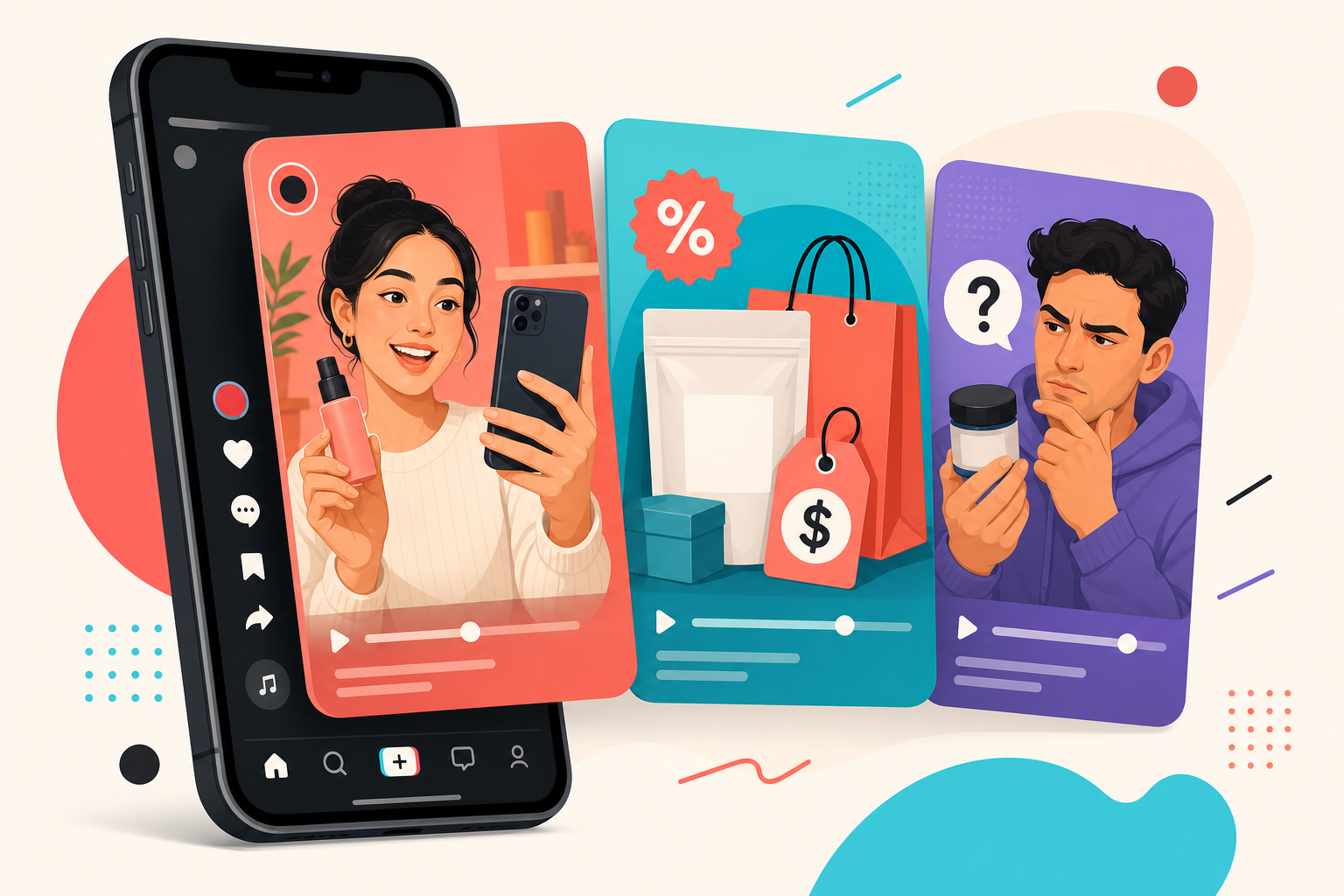
If you're only checking TikTok occasionally, you're seeing TikTok ads trends after they've already peaked elsewhere. In the ads I've reviewed since November 2024, three creative shifts stand out: rougher, creator-led production replacing polished studio work; blunt price transparency sitting right in the ad copy; and messaging that leans into scepticism rather than aspiration. Each points to the same underlying change — people are trusting brands less by default and demanding more proof before they'll listen.
This piece breaks down what I'm seeing, what it plausibly means for consumer behaviour, and how to build a lightweight tracking process so you can test these patterns against your own audience rather than just copying them.
A quick but important caveat: what I'm describing is advertiser behaviour — what brands are testing and running. It's a reasonable clue about consumer behaviour, not proof of it. I'll flag where the evidence is thin, because that distinction matters more than most trend write-ups admit.
How I Gathered This TikTok Advertising Data
Between November 2024 and late January 2025, I reviewed 420 active TikTok ads across four categories: beauty (110), supplements (95), software (130), and DTC (85), split roughly evenly between UK and US advertisers. I used TikTok's Creative Center for discovery, manual spot-checks on the platform itself, and Rival Ads' monitoring tool to track persistence — how long a specific creative stays live, which is a decent but imperfect proxy for it earning its budget.
I coded each ad manually against a simple taxonomy — production style, price messaging, hook type, and tone — and logged prevalence as a rough percentage of the sample, not a precise measurement. Ambiguous ads (mixed formats, or ads that shifted mid-run) were coded against their opening three seconds, since that's what determines whether most viewers keep watching. This isn't a scientific study. It's a structured read of a mid-sized sample, and I'd encourage you to treat every pattern below as a hypothesis to test, not a verdict.
Why TikTok Is a Leading Indicator of Consumer Behaviour
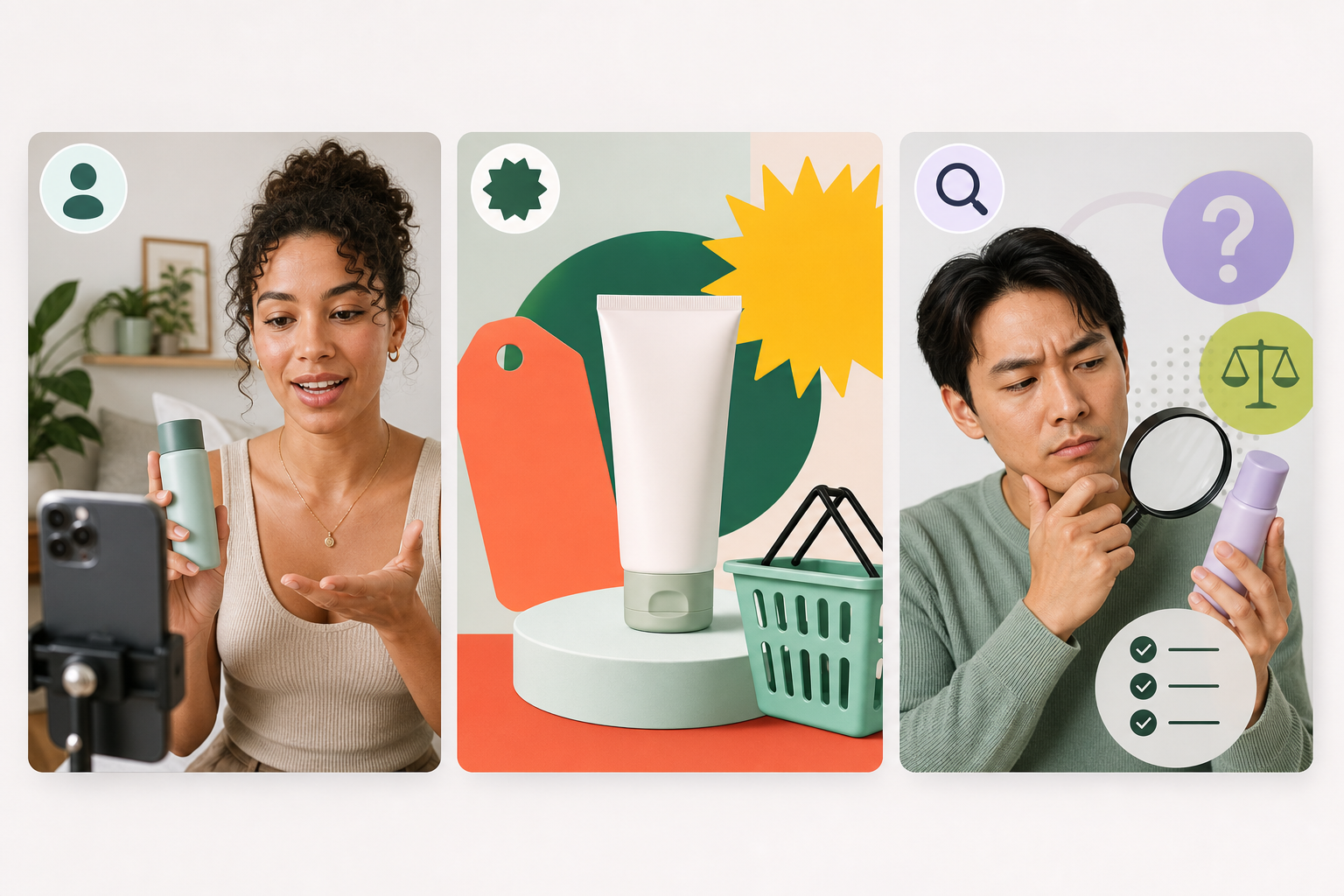
TikTok's format and algorithm reward fast iteration. Creators and small brands can post, watch performance for 24–48 hours, and adjust — there's no lengthy approval chain like you'd find with a TV or OOH campaign. That speed means new creative conventions often get discovered and copied on TikTok before they migrate to Meta, Google, or LinkedIn. To be precise about the claim: this is about creative format adoption, not evidence that TikTok causes broader shifts in how consumers think. It's simply often where you can see a shift first, because the platform's culture rewards experimentation.
Here's a four-step way to think about any pattern in this piece, which I'd encourage you to run yourself before acting on anything below:
- Observed advertiser pattern — what's actually showing up in the ad library.
- Plausible audience response — the most likely reason it's working, if it is.
- Alternative explanation — could this just be brands copying a competitor, an agency template spreading across clients, or an ad staying live because spend is low rather than because it's converting?
- Test required — what you'd need to run on your own audience to know for sure.
One concrete example, treated as a single case rather than a rule: I noticed founder-to-camera "here's what's actually in this product" videos appear heavily in TikTok's supplement ads from around January 2025. By March, near-identical formats — same pacing, same text overlays — were running as Meta Reels ads from a handful of UK wellness brands I track. That's roughly a six-to-eight week gap between platforms, but I only have this one documented example at that level of detail, so I'd treat the timing as an informal observation, not a benchmark to plan a launch calendar around.
A related and more established example is the de-influencing trend that started circulating on TikTok in early 2023 — creators telling followers not to buy certain products. That movement normalised open scepticism as content, and I think it's a direct ancestor of the scepticism-baiting ad hooks now showing up in paid media. It's a useful reminder that these ad formats usually borrow their credibility from organic content that came first.
What does this mean for consumer behaviour specifically? When a format spreads this fast, it's usually meeting people where their guard is already up. Viewers have gotten sharper at spotting polished ad language, so formats that look and sound like a real person talking tend to hold attention longer — not because polish is inherently bad, but because it's become a weak signal of authenticity.
TikTok Ad Formats Gaining Traction in 2025
Here's what showed up most often in my sample, with rough prevalence so you can judge scale rather than take my word for it. I'm using "appearing frequently" rather than "outperforming" deliberately — ad-library prevalence tells you what's being tested at scale, not what's converting best, since I don't have spend or conversion data behind these numbers.
| Format | Approx. % of sample | Consumer behaviour signal |
|---|---|---|
| Unscripted, single-take creator content | ~34% | Distrust of visible polish |
| Price-first hooks | ~22% | Low tolerance for hidden costs |
| Scepticism-baiting hooks | ~15% | Fatigue with inflated claims |
| Split-screen comparison ads | ~12% | Preference for visual proof over assertion |
| POV / day-in-the-life | ~10% | Desire to see product fit into real routines |
| Founder or employee-led ads | ~9% | Trust transferred from a person, not a brand |
| Peer-framed social proof | ~7% | Recommendation trusted more than advertising |
| Duet/reaction-style ads | ~5% | Comfort with imperfect, reactive content |
(Categories overlap, so these don't sum to 100% — plenty of ads combined two or more.)
A few of these are worth unpacking with real examples:
Unscripted, single-take creator content. A UK skincare brand I reviewed in February ran a 40-second ad that was essentially a customer filming themselves applying the product in their bathroom — no music, no cuts. It stayed live for over five weeks, which is long by TikTok standards, though I'd treat that as a clue worth testing rather than proof it's the reason for any sales lift.
POV / day-in-the-life. These frame the product inside an ordinary routine — getting ready, commuting, working — rather than presenting it in isolation. I saw this most in beauty and software, where the pitch is essentially "here's how this fits into a normal day," which reads as lower-effort and more believable than a studio demo.
Founder or employee-led ads. Distinct from generic creator content because the credibility comes from a named, specific person with a stated stake in the product — "I built this because..." This showed up disproportionately in software and supplements, categories where trust in the maker seems to matter as much as trust in the product.
Duet/reaction-style ads. A smaller but growing pattern: brands stitching a customer's organic reaction video into paid media, keeping the rough edges intact. It borrows credibility directly from organic content, which is presumably the point.
Peer-framed social proof. Ads phrased as one friend recommending something to another ("my friend put me onto this") rather than a brand claim. It's a soft version of influencer marketing without the formal endorsement structure, and it's easy to miss in a scroll because it barely reads as advertising.
Split-screen comparison ads. Side-by-side "this vs. that" formats, often unbranded on one side, have become common in software and beauty — a shortcut for proving a claim visually rather than asserting it.
Messaging Shifts in TikTok Advertising Worth Watching
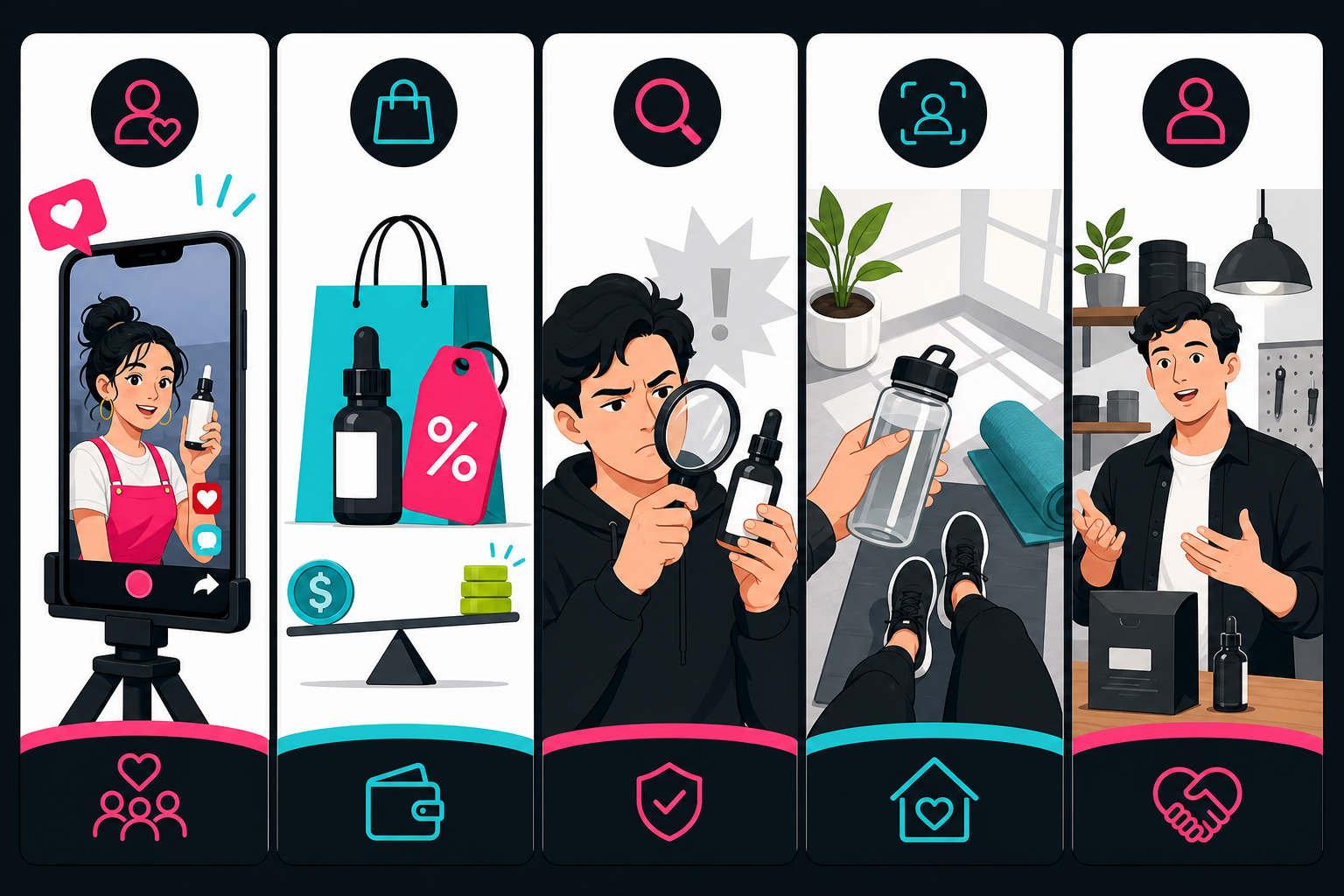
Beyond format, the language in ad copy has shifted too, and I think this is the more interesting signal for consumer behaviour — because it's harder for a brand to fake convincingly.
Radical Price Transparency in TikTok Ads
I'm using this term for ads that state exact costs, delivery timelines, or subscription terms upfront rather than leaving them for checkout. The likely driver is cost-of-living pressure, which has made UK and US shoppers far less tolerant of discovering hidden fees late in the journey.
- Compliant example: "£14, free UK delivery, cancel anytime" stated in the first line of copy and matched exactly at checkout.
- Risky example: "From £14" when £14 is a discounted first-order price and the real recurring cost is £22 — technically accurate, but it hands the customer a reason to feel misled the moment they notice, which is worse than never mentioning price at all.
Scepticism-Baiting Hooks
These hooks — "I didn't believe this either, but—" — work because they mirror the internal monologue viewers already have. The limitation is real: this format can tip into implying a claim is extraordinary when it isn't, which sits close to misleading advertising territory.
- Compliant example: "I didn't believe this either, so here's the lab test" followed by an actual, verifiable result.
- Risky example: the same hook followed by a subjective before/after with no substantiation — technically an opinion, but framed to look like proof.
In the UK specifically, this is worth checking against the ASA's CAP Code. Claims that lean on "you won't believe this actually works" framing need to be substantiated the same as any other performance claim, and influencer-style creator content still needs clear #ad disclosure regardless of how unpolished it looks.
Practical, Proof-Led Claims and Peer Recommendations
A quieter shift sits alongside the two above: copy that swaps adjectives ("amazing," "revolutionary") for specifics ("reduces redness in 48 hours," "setup takes four minutes") or peer phrasing ("the one my colleague recommended") instead of brand phrasing ("the industry-leading solution"). Both read as lower-effort, which — per the pattern running through this whole piece — currently reads as more honest.
For every pattern above, I'd treat it as a hypothesis about consumer motivation, not a proven cause. Price-first messaging correlating with price sensitivity is a reasonable read; it's not confirmed by ad-library data alone.
What These TikTok Ads Trends Mean for Your Campaigns
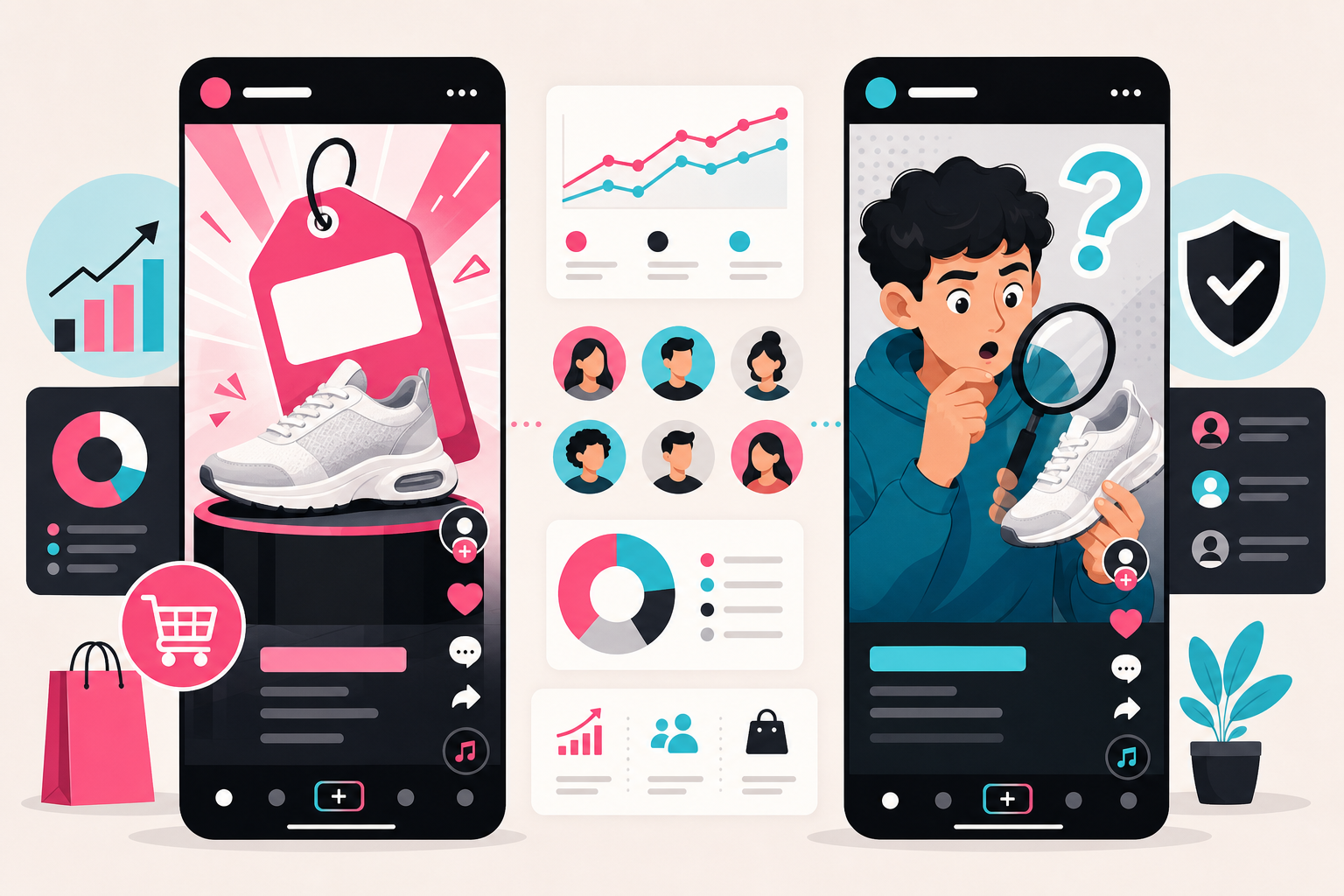
Generic advice like "try more authentic content" isn't that useful, so here's how I'd turn each pattern into an actual test brief — with clearer definitions than I see in most trend pieces, because "hook rate" and "watch-through rate" get thrown around without being defined.
A few shared ground rules first: treat anything under roughly 3,000 impressions as a directional screen, not a decision — you need enough clicks or conversions (not just impressions) to trust a result, and that usually means running each test for a minimum of 7–10 days to smooth out day-of-week noise. Pick one primary KPI per test and let the secondary metrics inform, not override, the call.
-
Unscripted creator format — Brief: one 30–45 second single-take video, no music, real customer or founder, minimal text overlay. Audience: existing customer lookalikes. Control: your current best-performing polished ad. Primary KPI: 3-second hook rate (% of viewers who watch past the first 3 seconds). Secondary metric: cost per click. Minimum data: 3,000 impressions for a directional read; confirm with cost-per-result data once you hit at least 50 clicks per variant. Decision: scale if hook rate beats control by 15%+ once both thresholds are met; stop if it underperforms.
-
Price-first hook — Brief: state the exact price and what it includes in the first line of copy or the first 3 seconds spoken. Audience: cold prospecting. Control: your current benefit-led hook. Primary KPI: landing page bounce rate (% leaving within 10 seconds without scrolling or clicking). Secondary metric: click-through rate, to check you're not just filtering traffic rather than improving it. Decision: scale if bounce rate drops 10%+ without a CTR penalty, measured over at least 500 landing page sessions per variant.
-
Scepticism-baiting hook — Brief: open with a direct acknowledgement of doubt, followed by verifiable proof (data, demo, before/after). Audience: warm retargeting, where some brand trust already exists. Primary KPI: watch-through rate past 15 seconds. Compliance check: run this past your claims checklist first if you're making any comparative or performance statement — this is the one format on this list most likely to attract a complaint if the proof doesn't hold up.
Running these as proper tests against a control, with a defined primary KPI and minimum data threshold, is the difference between spotting a genuine shift and chasing a format that happened to work for someone else's audience.
How to Track TikTok Ads Trends Without Manual Scrolling
You don't need a tool to start — a lightweight manual version works fine at small scale:
- Pick 8–10 competitors or category leaders.
- Once a week, scroll their TikTok profiles and note new creative: format, hook, and whether an old ad is still running.
- Screenshot anything that's stayed live for more than two weeks — persistence is a reasonable, not perfect, signal that it's earning its budget.
- Log it in a simple spreadsheet with date, brand, format tag, and hook type.
Where this breaks down is scale. Manually checking 8 competitors weekly is manageable; tracking 40 across five platforms isn't. Here's roughly how the options compare:
| Manual scrolling | TikTok Creative Center | Third-party ad intelligence tool (e.g. Rival Ads) | |
|---|---|---|---|
| Cost | Free | Free | Paid |
| History depth | Limited to what's live now | Limited | Typically stores historical creative for trend tracking |
| Cross-platform coverage | Manual, one platform at a time | TikTok only | Often covers Meta, TikTok, and others in one view |
| Detects new/paused ads automatically | No | No | Usually yes, via automated flagging |
| Spend or conversion data | No | No | No — this is a limitation across the category, not just one tool |
An ad intelligence tool or ad spy tool saves the scrolling and, in most cases, lets you monitor a competitor's ad accounts across platforms without connecting any of your own ad accounts — it's pulling from public ad libraries, not your data. What it doesn't replace is judgement: you still need to watch the ads and ask what they reveal about your audience, not just log that they exist. And it's worth repeating once, clearly, here: active-ad visibility isn't spend data. Treat persistence as a clue, not proof, regardless of which method you use to find it.
Building a Repeatable TikTok Ad Intelligence Habit
A process only works if it's small enough to actually stick to. Here's the roughly 35-minute weekly version I use:
- Minutes 0–10: Scroll your tracked competitor list on TikTok and your monitoring tool. Tag anything new against your format taxonomy (creator-led, price-first, comparison, scepticism-hook, POV, founder-led, other).
- Minutes 10–20: Check which ads from last week are still running. Anything still live after two weeks goes on your "worth testing" shortlist.
- Minutes 20–30: Add one item to your creative-testing backlog with a one-line hypothesis, e.g. "Price-first hook may reduce landing page bounce for cold traffic — test against control by [date]."
- Minutes 30–35: Quick cross-platform check — has anything on your TikTok shortlist started appearing on Meta or Google yet? Note the lag if so. Over time this builds your own migration-timing data, rather than relying on anyone else's estimate (including mine).
Over a quarter, this gives you a backlog of tested hypotheses rather than a folder of screenshots you never act on — which, honestly, is where most competitor research ends up dying.
Frequently Asked Questions About TikTok Ads Trends
What TikTok ad formats are trending right now?
Unscripted single-take creator content, price-first hooks, scepticism-baiting hooks, split-screen comparisons, POV/day-in-the-life clips, founder-led ads, and peer-framed social proof are all appearing frequently across the beauty, supplement, software, and DTC ads I track. None are guaranteed winners — they're patterns worth testing against your own audience.
How do TikTok trends predict broader consumer behaviour?
They don't predict behaviour so much as reveal it early. Because TikTok rewards fast creative iteration, formats that resonate with shifting attitudes — like reduced trust in polish or lower tolerance for hidden pricing — surface there first and get copied onto other platforms weeks later. It's a leading indicator for creative adoption, not a causal driver of consumer psychology, and it's worth checking for alternative explanations (like agencies copying each other) before assuming it reflects audience sentiment.
How can I track competitor TikTok ads at scale?
Start manually: pick a shortlist of competitors, scroll weekly, and log format, hook, and persistence in a spreadsheet. Once you're tracking more than 15–20 brands, a dedicated ad intelligence tool becomes worth it for automatic flagging, historical tracking, and cross-platform coverage — though you'll still need to review the ads yourself to draw useful conclusions.
Do I need to connect my own ad accounts to use a TikTok ad intelligence tool?
No. These tools work from public ad libraries and public profiles, not from your advertising account data, so there's nothing to connect and no access to your own campaign data required. That's a meaningful difference from analytics platforms, which do need account access.
Does a longer-running ad mean it's performing well?
Usually — brands rarely keep paying for creative that's losing money — but it's not proof. Persistence is a proxy, not a performance metric, since most public ad libraries don't show spend or conversion data. Treat a long-running ad as a hint worth testing, not a guaranteed winner.
Three Rules for Using These TikTok Advertising Insights
Strip away the format names and the pattern is fairly simple: people are more sceptical, more price-aware, and more responsive to things that look real rather than produced. That's not a TikTok-specific insight so much as a wider mood that TikTok happens to surface first, because its culture rewards creative risk-taking faster than most other platforms.
If you take one thing from this piece, make it this three-step habit rather than any single format: observe what's persisting and spreading across your tracked competitors, validate it with a proper test against a control on your own audience, and watch for saturation and compliance risk before it becomes the obvious choice everyone's making — because the formats working right now are working partly because they still feel unusual. Once everyone's doing the sceptical hook, it stops sounding sceptical and starts sounding like copywriting again.
Test properly, keep a control, and don't mistake "everyone's doing it on TikTok" for "this will definitely work for you."