Why Whitelabel Competitive Intel Is a Growth Lever for Agencies
Discover how UK agencies can use whitelabel competitive ad intelligence to boost client retention, create recurring revenue and grow with smart pricing.
Chris Edington
15 min read

Why Whitelabel Competitive Ad Intelligence Is a Growth Lever for UK Agencies
Why Whitelabel Competitive Intel Is a Growth Lever for Agencies? Because whitelabel competitive ad intelligence lets you resell ad monitoring under your own brand. Competitor ad data becomes a recurring service that clients see as part of your expertise. It gives you a weekly reason to land in clients' inboxes and a natural upsell path, and you don't have to build the product yourself. The plausible payoff is stronger retention and extra revenue without much extra headcount. I should be upfront that this is a mechanism that makes sense, not a guaranteed result. Margins depend heavily on how much team time goes into interpreting the data.
A quick disclosure: I'm part of the team at Rival Ads, which sells a whitelabel competitive intelligence platform, so I have a commercial interest here. I've kept the advice general where I can and flagged where I'm describing our own product.
Why Whitelabel Competitive Intel Is a Growth Lever for Agencies
You know the pattern. A client is happy for months, then a cheaper agency pitches, and suddenly your paid social management looks like a line item to trim. PPC and paid social are easy to commoditise, and clients often can't see the value beyond the monthly performance report.
That's the trouble with reporting: it looks backwards. It tells clients what we did, but rarely what's happening in their market right now. And clients are under pressure. Gartner's 2024 CMO Spend Survey found marketing budgets averaging 7.7% of company revenue, down from 9.1% in 2023, with 64% of surveyed CMOs saying their budgets were insufficient to execute their strategy. That's large-enterprise data, not an agency churn figure, but the direction is clear: clients are being asked to justify every pound.
Retention matters commercially, too. The much-quoted Reichheld and Sasser analysis in Harvard Business Review suggested a 5% increase in retention could lift profits by 25% to 95% across the service businesses studied. It's a 1990, cross-industry number, so treat it as a rationale, not a forecast. It also doesn't show that competitive monitoring improves retention. It only says retention is valuable. That link is my hypothesis, so test it with your own clients.
Picture two quarterly business reviews. In the first, the account manager walks through click-through rates, CPAs and a few green arrows, and the client checks their phone. In the second, the account manager opens with, 'Two of your biggest rivals both launched new offers on Meta this week, and one has pulled a TikTok campaign it had been running for a month. Here's what we'd consider doing about it.' Same agency, same results, a very different conversation. Competitive intel won't fix a poor service or a bad relationship, but it can help turn a reporting relationship into an advisory one.
What Clients Want From Competitive Ad Intelligence
This is practical guidance based on how agencies commonly position these services, not survey research. Clients tend to value:
- Visibility into what competitors are running on the channels that matter, without digging through ad libraries brand by brand.
- Timeliness: what's new, stopped or apparently scaling, week over week. A three-month-old snapshot is history, not intelligence.
- Interpretation. They want someone to say what it might mean, because a folder of screenshots isn't insight.
- Real creatives and exact copy they can react to in briefings.
- Low effort, with no new data-sharing headaches.
Most clients don't want a raw ad spy tool. They want a trusted advisor who uses one, and that distinction is the whole business model. SCIP, the competitive intelligence professional body, frames competitive intelligence as a process that supports informed decisions, not just the collection of information.
There's one practical habit worth building in from day one: separate what's observed (a competitor is running this ad, with this copy, since this week) from what's inferred (we think they're testing a price-led angle). Clients can then judge your recommendations rather than taking them on faith.
UK context helps here. Rivals launching early Black Friday teasers, bank holiday promotions or January sales pushes are exactly the moves a client wants flagged before the peak, not picked over in the post-mortem.
What Whitelabel Competitive Intelligence Means for Agencies
In plain English: the platform runs behind the scenes, and your agency's brand is out front. The vendor does the data collection and analysis, and you keep the client relationship. That's different from an affiliate or referral arrangement, where clients sign up with the vendor and the vendor owns the relationship.
The question I hear most is, 'Will my clients see my brand or the vendor's?' The honest answer is that it depends on the vendor and the plan. At a minimum, look for your logo on a client-facing dashboard. Branded email digests, branded exports and a custom domain are separate features, and not every tool offers all of them. Confirm each one in a live demo and in your contract, and ask whether any vendor references remain anywhere in the client experience.

The split of responsibilities also varies, but it typically looks like this:
- The vendor collects publicly available ad data from the platforms it supports, archives creatives and copy, shows changes over time and produces automated analysis. Coverage, refresh cadence and data sources differ by tool, channel and country, so get them in writing.
- You control the client relationship, which competitors are tracked for whom, the commentary you add, and how the service is priced and sold.
On our side, Rival Ads offers dashboards and weekly email digests that can carry agency branding, plus team roles and competitor assignment so a client only sees the competitors you've given them. Those are vendor claims, so check the current feature list on our website and test them in a trial rather than taking my word for it.
How to Package Ad Monitoring as Your Own Agency Service
The agencies that do best with this don't say, 'We've bought a tool.' They launch a service. Here's a simple way to build one:
- Decide the core promise. Something like, 'Weekly competitor ad intelligence for your market.' Be specific about audience, cadence and the decisions it supports.
- Choose the competitor set per client. Typically 3 to 10 direct rivals. Fewer than three gives you little to compare, and more than ten turns the digest into noise.
- Build the deliverables. Dashboard access, a weekly digest and a monthly strategy call make a solid starting package.
- Layer your expertise on top. Treat automated analysis, including AI-generated analysis in any tool, as a first draft. Someone on your team should check it against what the ads actually show and add client context: margins, brand rules, what they've already tested.
- Name and brand it. 'Market Watch' or 'Competitor Radar' beats 'our ad spy tool'.
- Connect it to existing services. Feed insights into creative briefs, media plans and QBR agendas. If it lives in a silo, it'll be the first thing cut.

Here's how tiers might look (illustrative, so adapt them to your clients):
- Essentials: 3 competitors, dashboard access, weekly digest.
- Growth: up to 6 competitors, plus a monthly 30-minute strategy call and a short written summary of key moves.
- Enterprise: up to 10 competitors, fortnightly calls, a quarterly deep-dive and creative support.
Clear scope also protects you from creeping requests. If a client wants twelve competitors tracked, that's a conversation about the next tier, not a favour.
How to Price and Position a Competitive Monitoring Service
Short answer to 'How do I price a monitoring service?': price the insight, not the software. Clients aren't buying a tool. They're buying sharper strategy and faster responses. These four models are common, and none is a market benchmark:
| Model | Best for | Revenue potential | Retention impact | Effort |
|---|---|---|---|---|
| Bundled into retainer | At-risk or high-value clients | Indirect (protects existing fees) | Potentially high | Low |
| Standalone monthly subscription | Clients who want intel without full agency services | Steady, recurring | Medium | Medium |
| Paid add-on by competitors tracked | Retainer clients wanting more depth | Scales with tier | Medium to high | Low to medium |
| One-off competitor audit | Prospects and sceptical clients | Project fee, then conversion | Builds the case for ongoing | Medium |
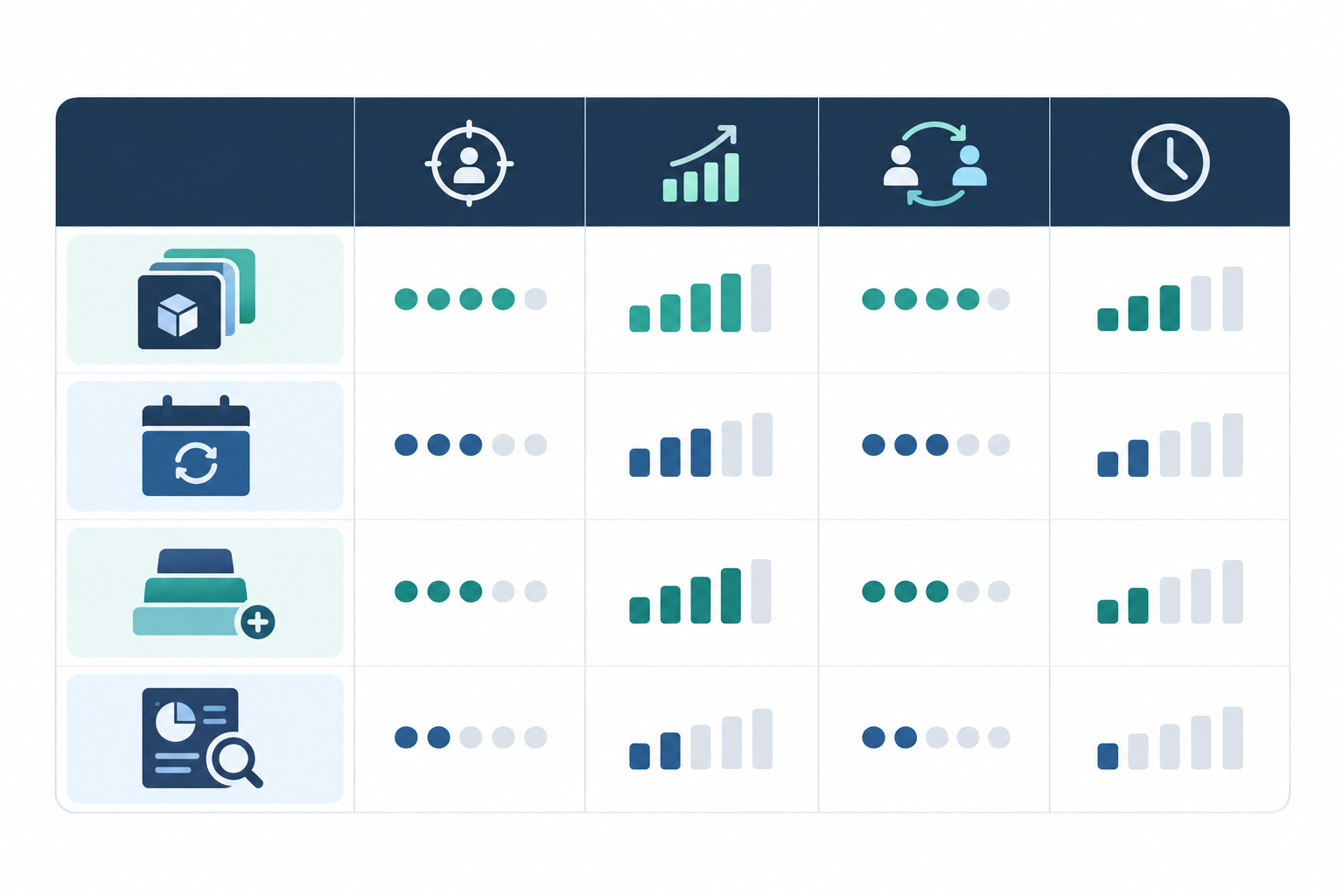
Bundling is a retention play: you absorb the cost to make the relationship stickier. Standalone subscriptions suit clients who run campaigns in-house but want an outside view. Tiered add-ons scale neatly, since your cost and your price rise together. One-off audits are a useful door-opener. Show a client what their rivals have been running, then offer to keep watching.
A worked margin example for agency pricing
Every figure below is an assumption for illustration, not a quote or a market average. Swap in your own numbers.
- Client price: £250 a month for a Growth-style package, excluding VAT (which is collected for HMRC and isn't margin).
- Platform cost: £20 a month allocated per client. This is a placeholder, so use your vendor's current quote divided across the clients you'll serve.
- Delivery time: 2.5 hours a month (reviewing weekly digests, writing commentary, a 30-minute call with prep) at an internal cost of £45 an hour, so £112.50.
- Onboarding: 3 hours one-off, spread over 12 months, so £11.25 a month.
- Support and admin: half an hour a month, so £22.50.
| Item | Monthly cost |
|---|---|
| Platform (allocated) | £20.00 |
| Delivery time | £112.50 |
| Onboarding (spread over 12 months) | £11.25 |
| Support and admin | £22.50 |
| Total | £166.25 |
That leaves £83.75 on a £250 fee, roughly a 33.5% gross margin, before overheads such as sales time. It's decent, not spectacular, and it's mostly a labour business rather than a software one. Templating your commentary helps, and so do deeper tiers. Ad hoc requests outside the package hurt.
The bigger commercial case is often retention rather than the fee itself. If the service helps you keep a client paying £3,000 a month for a few extra months, that outweighs the standalone margin. But that's a hope, not a guarantee, so model it with your own churn data.
Positioning competitive intelligence for clients
- Sell the outcome. 'Respond faster to competitor moves' lands better than 'weekly ad archive'.
- Tie it to decisions like campaign planning, positioning, creative briefs and quarterly reviews.
- Don't underprice. A £30 add-on signals a throwaway extra. If you want it taken seriously, price it like a service.
How Competitive Intelligence Creates Agency Upsell Opportunities
Competitive intel gives you reasons to talk to clients. Each example below comes with a caution, because ad activity is a clue, not proof.
- A rival appears to scale a new creative angle. That's an opening for new creative: 'They've run this testimonial format for three weeks and it's still live.' An ad being live doesn't mean it's performing, though.
- A rival enters a new channel. It could be a test, so frame it as something to watch before you propose expansion.
- A rival stops advertising. It might signal a gap, a budget change or a failed test, and you can't tell which from outside. Raise it as a question.
- Weekly digests keep you visible between reporting cycles, with your brand on every email.
- New business pitches get sharper. Showing a prospect their competitors' actual ads before the first meeting is hard to beat.
Here's a clearly hypothetical scenario, not a client result. A retail client's digest shows a rival running a customer-testimonial video format for three weeks. You flag it as an observation and suggest a small test of a similar format, and the client approves a modest creative budget. The result is measured against the client's own CPA baseline. Whether it works is for their data to decide, but you've given yourself a reason for a creative upsell that's grounded in evidence. Link every observation to a decision: what changed, why it matters, what you'd consider doing, and how you'd measure it.
What Competitor Ad Data Can and Can't Tell You
This is the part vendors tend to skip, so let me be direct:
- Spend: for commercial ads, public ad libraries generally don't show how much a competitor spends.
- Performance: you can see that an ad is live or how long it has run, but not conversions, CPAs or return on ad spend.
- Intent: why a competitor launched or stopped a campaign is guesswork without other evidence.
- Completeness: coverage depends on what each platform publishes, which differs by channel, country and ad format. No tool sees everything.
Present findings as observations, label interpretations as hypotheses, and let the client's own data decide what's worth testing. That's what makes you credible.
What to Look for in a Whitelabel Competitive Intelligence Tool
Not all tools suit agency resale. Here's the checklist I'd use:
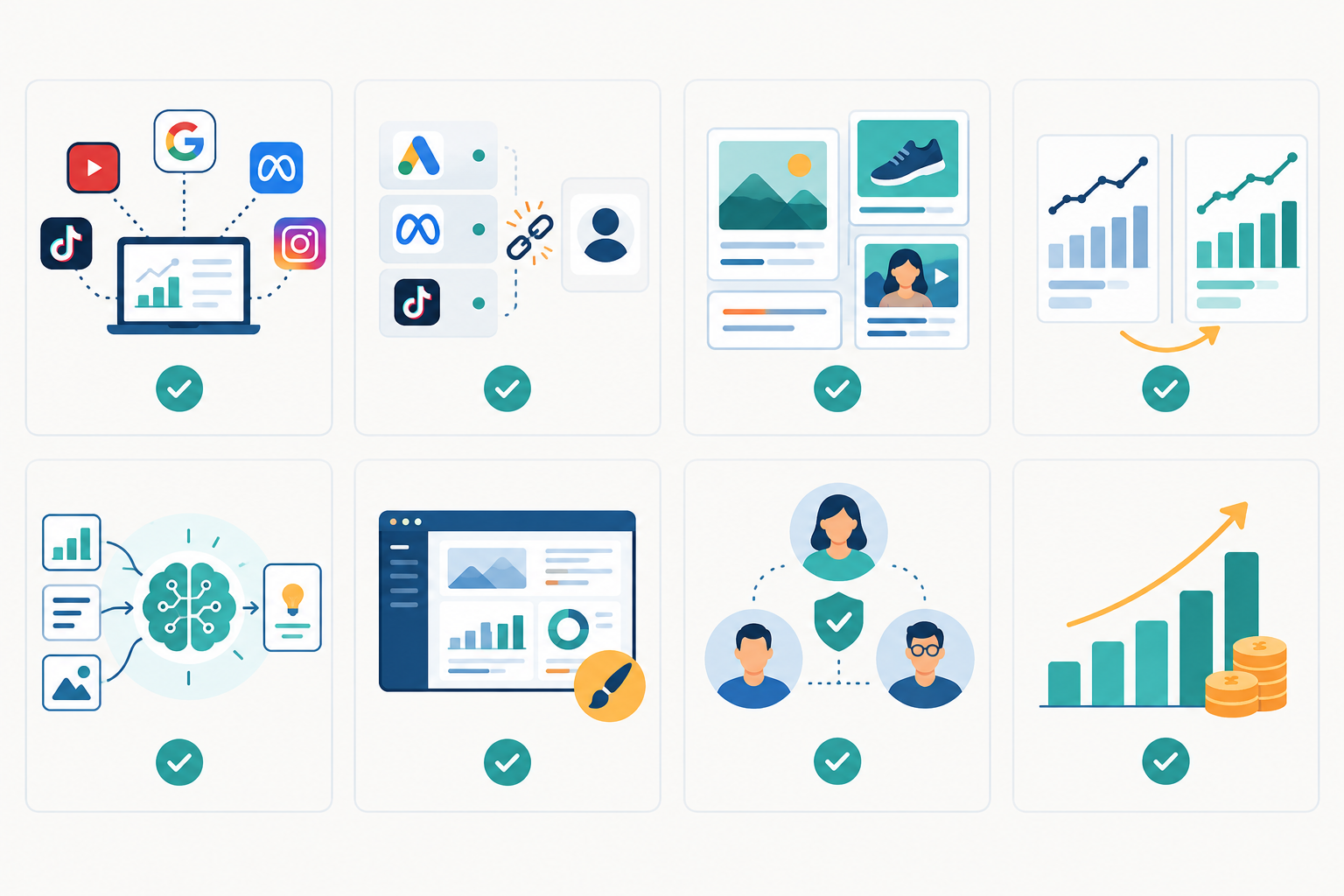
- Platform coverage. Meta, Google, TikTok and LinkedIn in one place is ideal, but ask what each channel includes and what's missing. Test it using competitors your clients actually need to monitor, by platform, country, ad format and refresh cadence.
- Low-friction setup. Tools that use public ad data shouldn't need access to your clients' ad accounts. Ask how the vendor identifies a competitor's ads, for example from a website, and what happens when detection fails.
- Real creatives, exact copy and landing page links, not just summaries.
- Change tracking that shows what's new, stopped and apparently scaling, and how quickly changes appear.
- Editable analysis. Check how it's generated and whether you can edit it before the client sees it.
- Branding depth. Dashboard, emails, exports and domain, each confirmed separately.
- Team features such as roles, competitor assignment and client-level separation.
- Transparent, scalable pricing that still makes sense at thirty clients, not just three.
UK data protection considerations for agencies
Most data in a competitor ad tool is company advertising, but you'll still handle some personal data, such as your own and your clients' users' names and email addresses. Individuals in creatives may also be relevant where they're identifiable, depending on context. As a UK agency, look at the UK GDPR and the Data Protection Act 2018. This isn't legal advice, so take specialist advice if you're unsure. A sensible starting point:
- Work out who does what with which data. Whether the vendor is a processor or a controller depends on the data and the relationship, and the ICO's guidance on controllers and processors explains how to assess it.
- Where the vendor processes personal data on your behalf, you need a written contract with the terms UK GDPR requires.
- Ask where data is stored, whether it leaves the UK, and what safeguards apply.
- Check your client contracts for their own supplier and sub-processor requirements.
Questions to ask a whitelabel tool vendor in a demo
- Can I see a branded dashboard and a branded email digest, not a mock-up? Does branding carry through to exports, and can I use my own domain?
- How often is data refreshed, and how quickly do new or stopped ads show up?
- What are the coverage limits by channel and country, and what are your data sources?
- Can I separate clients and control who sees which competitors?
- What happens to pricing if I double my competitor count?
- Where is data stored, and what are your data-processing terms?
Test it on a real client account before committing, and make sure a non-technical account manager can produce something polished without a tutorial.
How to Get Started With Your First Competitive Intelligence Clients
Don't roll this out to everyone on day one. A staged launch works better:
- Start with 2 or 3 friendly, long-standing clients who'll give honest feedback.
- Run a quick competitor audit for each. It's the fastest way to make the value tangible.
- Set up monitoring and brand it before they see anything.
- Review the first two or three digests together. Prune the competitor list and adjust your commentary.
- Collect a quick win from each, such as a creative tweak or a faster promo response. With permission, these become case studies.
- Roll out wider and add it to your proposals and pitch decks.
Keep the message simple: 'We're adding a new layer of market intelligence to your service.' No jargon, no tool talk.
Over the first 90 days, month one is setup, audits and learning what 'useful' means for each client. Month two is refining competitor sets and building the weekly habit. By month three you should have a couple of concrete stories and the beginnings of upsell conversations. Don't expect a revenue spike overnight. What you can expect is a stronger relationship and a pipeline of next steps. 🙂
FAQ: Whitelabel Competitive Intelligence for Agencies
How can agencies make money from competitive intelligence?
There are three main routes: a standalone subscription, a paid add-on to retainers, or a bundle that supports retention and higher fees. It can also sharpen new business pitches. See the worked margin example above, because profitability depends mostly on delivery time.
What does whitelabel mean for an agency?
The platform runs under your agency's branding while the vendor handles data collection and analysis. How far the branding extends varies by vendor and plan.
How do I price a competitive monitoring service?
Price the insight, not the software. Use tiers by competitors tracked, an add-on fee or a retainer bundle, and build your own margin calculation with real costs, VAT treatment and expected churn.
Will clients see my brand or the vendor's?
That depends on the vendor's dashboard, email, export and domain options. Confirm each element in a live demo and in your contract.
Do clients need to connect their ad accounts?
Not for tools built on public competitor ad data. With Rival Ads, you provide a competitor's website and the platform looks for their ads on supported channels, but detection and availability vary by platform and region. Test with your clients' real competitors during a trial.
Final Thought: Make Competitive Intel Part of Your Agency's Value
I think whitelabel competitive intel works because it changes what clients believe they're paying for. Instead of a monthly report on the past, they get a regular view of their market, delivered under your name and interpreted by people they trust. Whichever vendor you choose, start small: pick one friendly client, run an audit, and let the first digest do the talking. If you'd like to see what a branded setup looks like, you can explore Rival Ads, our own product, and judge it against the checklist above.