How to Read Week-Over-Week Ad Changes Like a Media Buyer
A tactical guide to interpreting week-over-week ad changes: spot genuinely new ads vs iterations, read scale-up signals, decode pauses, and turn compe
Chris Edington
15 min read
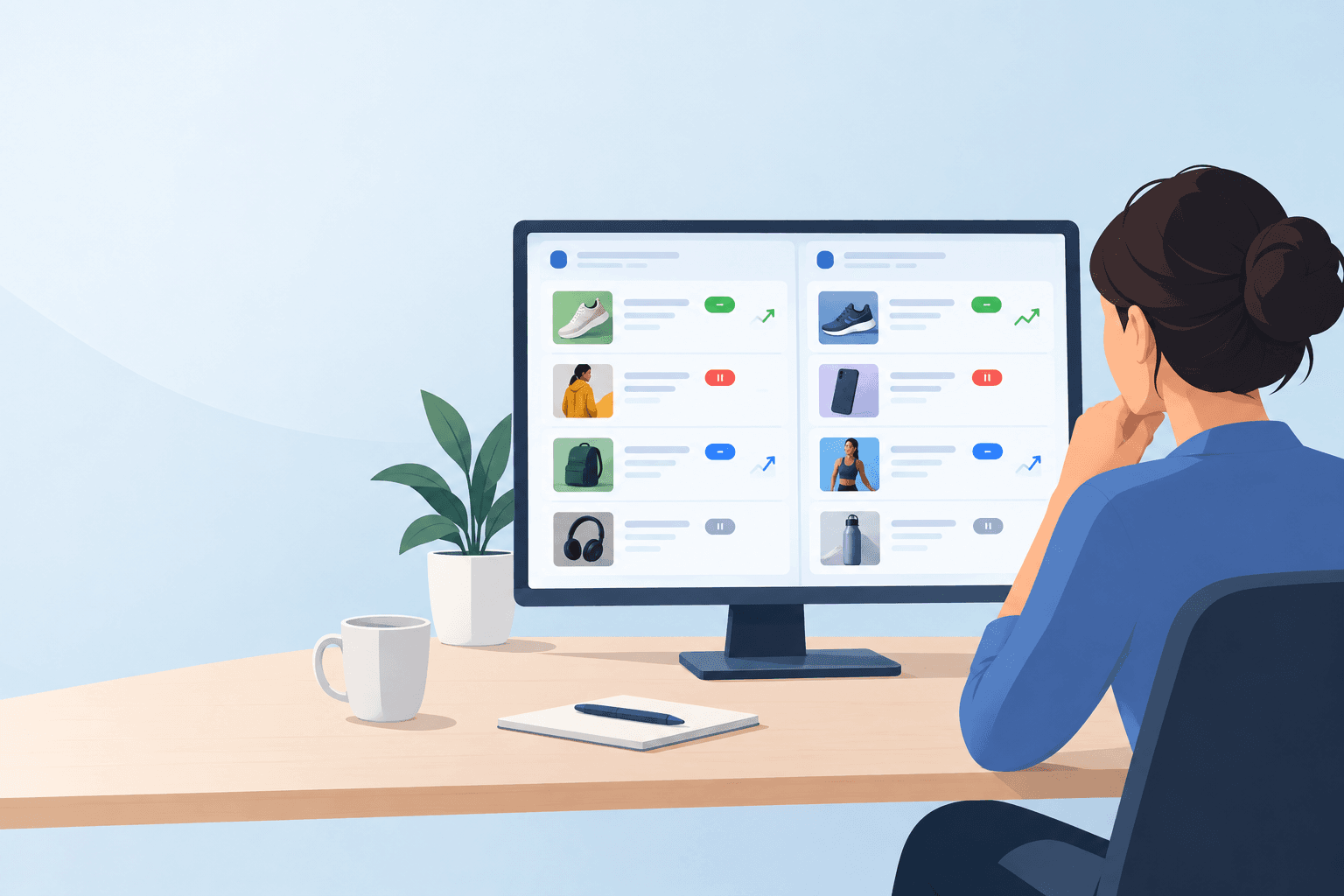
A week-over-week ad diff shows you three things: which of a competitor's ads are new, which have stopped, and which are still running. Reading these week-over-week ad changes well comes down to interpretation. A new ad only signals something if it's a genuinely new angle. A pause only means something once you account for how long the ad ran and what replaced it. Ongoing investment shows up as variants, duplication and persistence, not as a single number. Read the three buckets together, tie them to a hypothesis, and you can turn a raw diff into a short weekly brief your team will actually use.
That's the whole idea. The rest of this guide is how we do it in practice, so you can read week-over-week ad changes the way a seasoned media buyer would, instead of scrolling the Meta Ad Library and guessing.
What Does a Week-Over-Week Ad Diff Show?
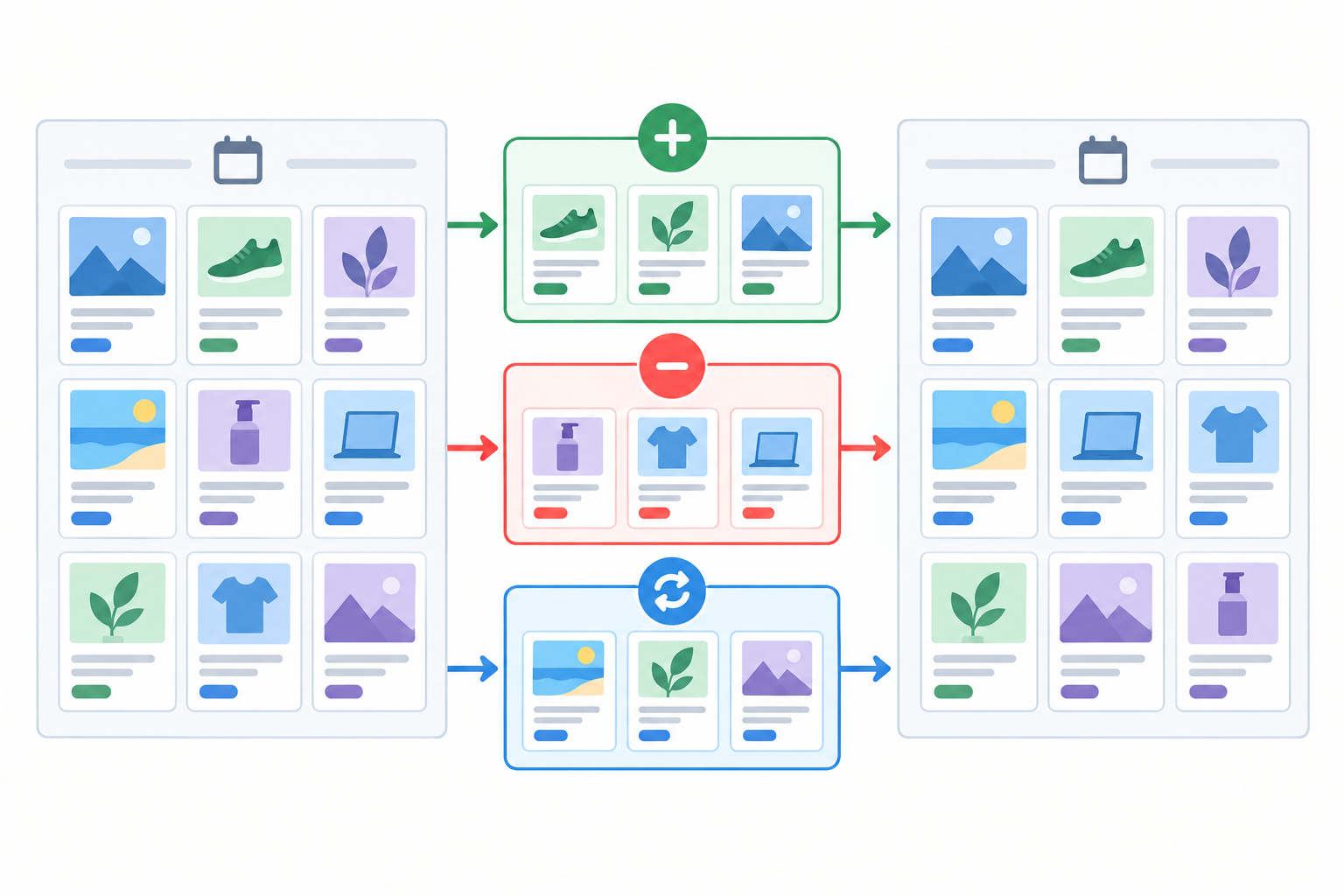
In plain English, a week-over-week ad diff is a snapshot comparison. You take the ads a competitor has running this week on the platforms that expose them (typically Meta, Google, TikTok and LinkedIn), set them against last week's snapshot, and sort the differences into three buckets:
- New: ads that weren't there last week.
- Stopped: ads that were there last week and have gone.
- Continuing: ads that appear in both snapshots.
Each bucket tells you something different. New ads show what a competitor is testing. Stopped ads show what they've dropped, though not necessarily why. Continuing ads are the quiet ones, and they matter most, because an ad that keeps running week after week is usually one the team is happy to keep funding.
Now the honest bit, and I'll only say it properly once. A public diff gives you no spend, impression or conversion data. You can't see what an ad cost or whether it converted, so everything you conclude is inference from behaviour. That's fine, as long as you label it that way. I'll use phrases like 'likely investing' and attach a confidence level to each finding, and that's the only reminder you'll get.
Why Consistent Weekly Ad Snapshots Beat Occasional Manual Checks
Popping into an ad library once a month feels like research, but it has a nasty blind spot: you only see what's live when you look. An ad that launched on Tuesday and ended on Friday never shows up. Neither does a concept that grew from two variants to eight between visits. Worse, you end up comparing today's ads with your memory of last month's, and memory is a terrible archive.
That's why we built Rival Ads around a weekly fetch. You give us a competitor's website, we look for their presence on Meta, Google, TikTok and LinkedIn, and we archive the active ads we can find, with the creative, copy and links where the platform makes them available. No ad account connection is needed. Coverage isn't identical everywhere, because it depends on the platform, the market, the ad type and what each platform's public transparency tools expose. If you want to see the raw sources yourself, start with the Meta Ad Library, the Google Ads Transparency Center and the LinkedIn Ad Library. Because each week is archived, your diff comes from stored snapshots rather than a vague recollection.
What Counts as a 'New' Ad vs an Iteration?
Raw 'new ad' counts mislead. A swapped headline or a recoloured background isn't a new strategy, but it bumps your count just the same. So before you report that a competitor launched 14 ads, classify them.
I use three tiers:
- Net-new concept: a different core idea, offer or audience.
- New angle on an existing concept: same product and proposition, but a different way in (a new problem, proof point or emotional hook).
- Minor iteration: a copy tweak, crop, CTA change or colour swap.
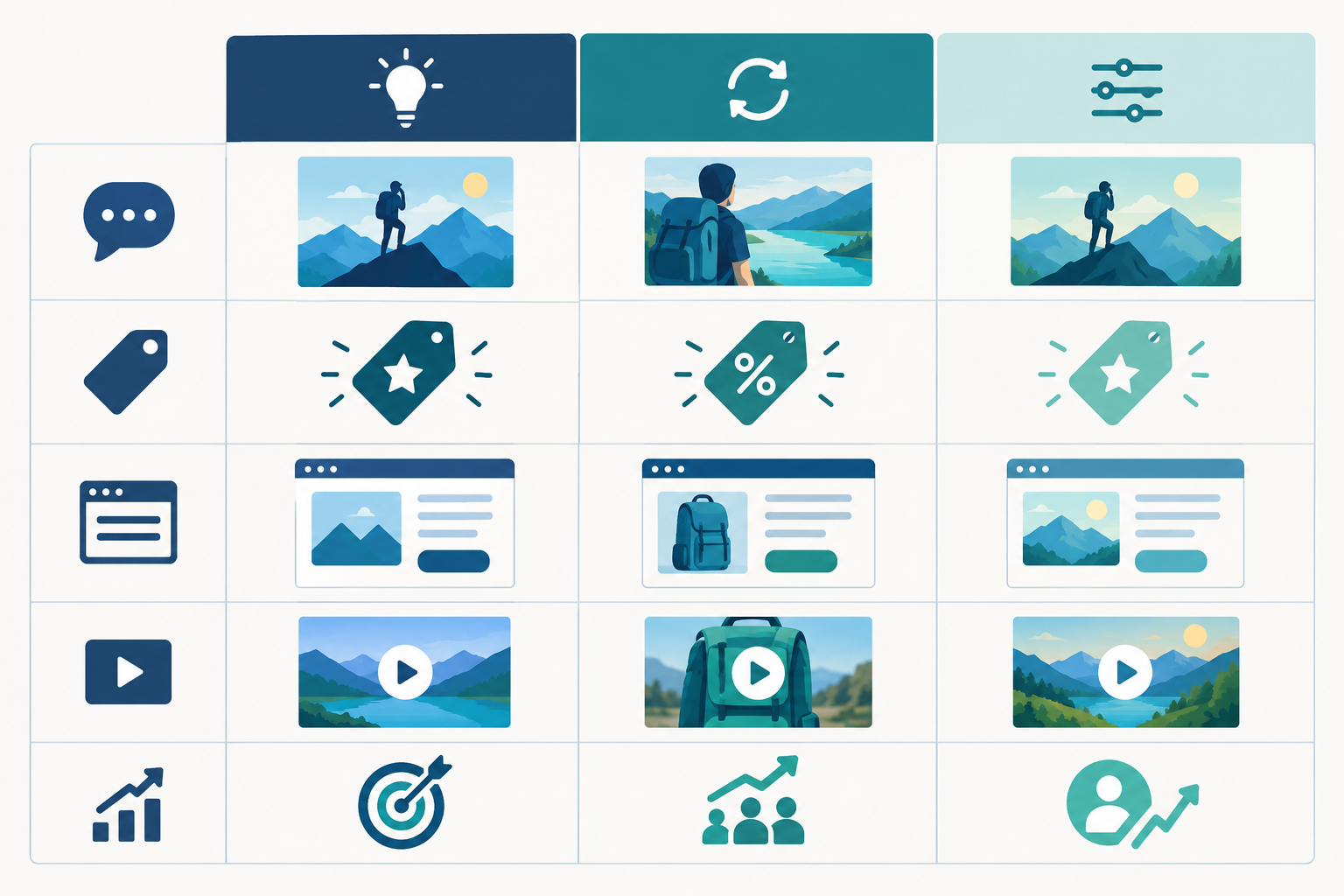
| Net-new concept | New angle | Minor iteration | |
|---|---|---|---|
| Hook | Entirely different opening idea | Different framing of a familiar idea | Same hook, reworded |
| Offer | New or restructured offer | Same offer, new emphasis | Unchanged |
| Landing page | New page or new journey | Often same page, new section or variant | Same URL |
| Format | Often a new format too | Same or similar | Same, or a crop or resize |
| Significance | High: a real strategic test | Medium: iterating around a theme | Low: housekeeping or A/B testing |
What to Look at When Classifying New Ads
Five things do most of the work:
- The hook: the first three seconds of a video or the first line of copy.
- The offer: discount, free trial, bundle, guarantee, or none at all.
- Audience cues: who is the ad talking to? Job titles on LinkedIn ads, life stages on Meta, and so on.
- Format: static, video, carousel, UGC, or a responsive search ad.
- The landing page URL.
That last one is often the most revealing. Creatives are cheap to change, but a genuinely new landing page suggests someone has built something, written something and probably briefed a developer. When the destination changes in substance, I take the shift more seriously. Check before you get excited, though. A changed URL can also be a new tracking parameter, a localised version of the same page, or a simple page test. Open both pages and compare what the visitor actually sees.
Check Whether the New Ad Concept Appears Across Platforms
Also ask where the concept appears. If the same idea turns up on TikTok and LinkedIn as well as Meta, it may be a considered, brand-level push. If it exists on one channel only, it may just be a channel-specific test. Either reading is a hypothesis, so look at the other signals before you commit.
A Worked Example: Separating New Ad Concepts from Variants
Say a competitor launches 14 'new' ads this week. You look closer and 11 of them are the same UGC testimonial with different opening lines. The other three are a static price-led offer, a founder video and a carousel. So what you've really got is one test (the testimonial, with hook variations) plus three separate experiments. Not 14 new ideas. Reporting it that way is the difference between a useful brief and a noisy one.
How to Spot Ad Scale-Up Patterns and Ongoing Investment
Here's the awkward truth about scaling: you can't see the budget. Inside your own account, scale is easy to read because spend, conversions and CPA or ROAS move together. From the outside you have none of those numbers. What you can see is the behavioural footprint that continued investment tends to leave behind.
The distinction matters. A public diff can show evidence of ongoing investment or testing. It can't show that an ad is profitable or that its budget has gone up. Keep those two ideas separate in your notes.
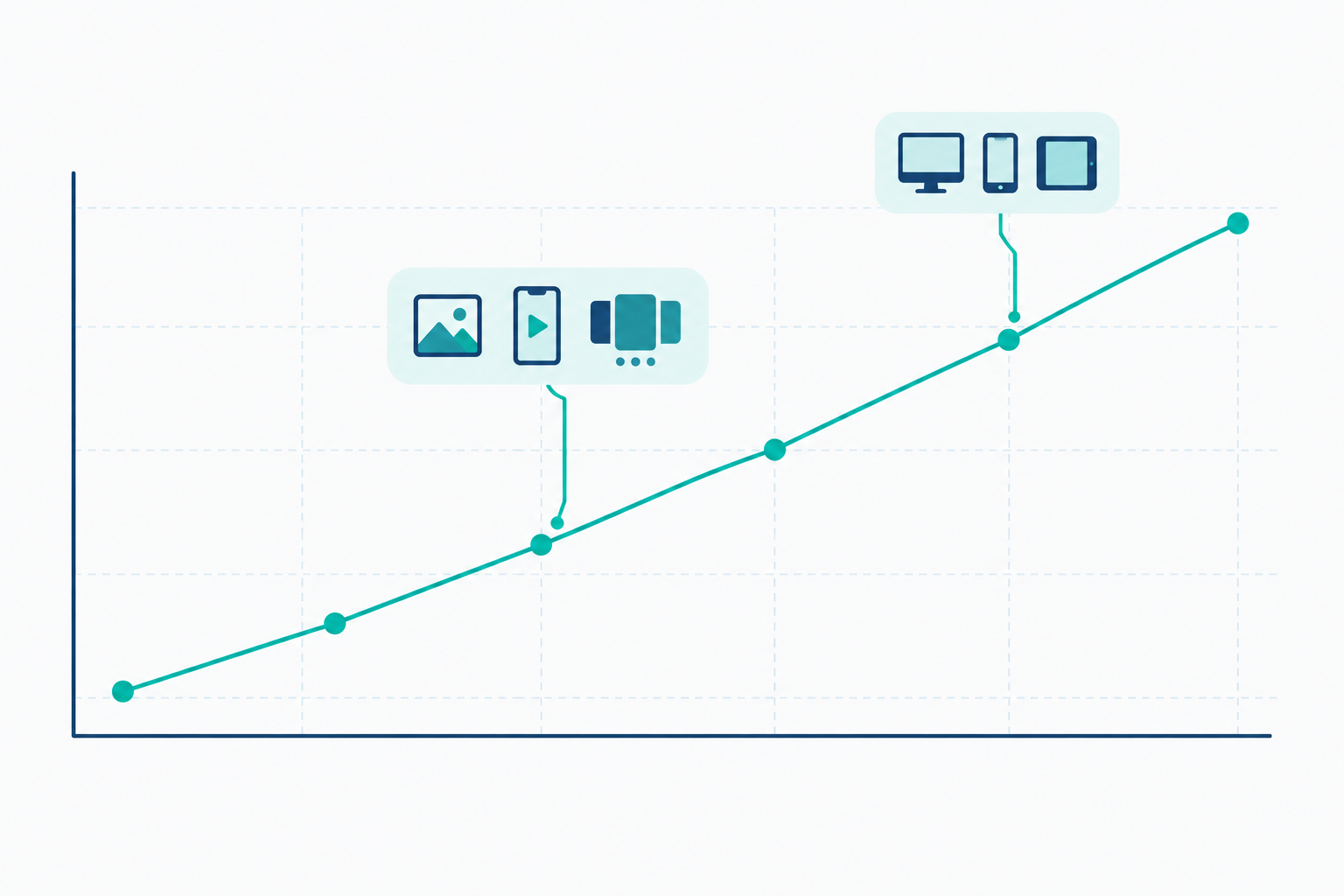
Here's the six-step routine I run through, with the alternative explanation for each signal so you don't over-read it.
- Check longevity. An ad that survives several weekly snapshots is likely one the team is content to keep running. It might be performing well. It might also be an evergreen brand ad, a scheduled rotation or something nobody has got round to switching off. A month of persistence is a stronger hint than one day, but still only a hint.
- Look for variant sprawl. When a concept is cloned into new hooks, lengths and formats, the team is probably iterating around an idea they like. The alternative is a planned creative test, where many variants launch at once regardless of results.
- Watch for format expansion. A static ad that reappears as a video, a carousel or a Google Ads responsive variant suggests the idea is being stretched to reach more of the audience. It can also be a platform requirement, such as needing a vertical cut for TikTok.
- Track active ads per concept over time. The count of live ads behind one idea is a rough indicator of how much attention it's getting. Count concepts, not total ads, and remember that duplicated campaigns can inflate the number without any extra budget.
- Look for cross-platform spread. A Meta concept turning up on TikTok or LinkedIn can mean the team trusts the idea enough to take it somewhere new. It can equally be a planned multi-channel launch where everything went live together.
- Spot the shrink signals. Variants dropping off one by one, or a once-dominant concept that is no longer being refreshed, often mean attention is moving elsewhere. Check the calendar before you decide it's meaningful.
How to Tell If a Competitor's Ads Are Scaling or Shrinking
Here's the rule I use. One signal alone is low confidence. Two signals pointing the same way, such as longevity plus new variants, is medium. Three or more across at least three weekly snapshots is medium-high. I never use 'high' for anything involving spend, because I can't see it.
Then write down what would change your mind. For example: 'If the variants disappear next week without replacements, this was probably a short test, not a sustained push.' That one sentence keeps you honest and tells you what to look for in next week's diff.
Why We Borrow from In-Account Media Buying
The logic mirrors how a buyer reads their own account. Healthy growth usually means spend, impressions and conversions rising while CPA or ROAS stays acceptable. We can't observe those metrics for a rival, but we can observe what advertisers tend to do when their own numbers look good: they duplicate, extend and spread. If a rival adds siblings to an ad week after week, that's consistent with a healthy result, though it could just as easily be a team committed to a test.
Two bits of platform context help when you interpret early pauses. First, Meta has described a learning phase for ad sets, with a reference point of roughly 50 optimisation events within seven days. Treat that as a platform reference rather than a universal rule, and check Meta's current Business Help Centre documentation, because the details change. The takeaway is simply that advertisers often give ads a little time to settle, and that big edits can reset delivery. Second, conversion delay means recent results often look weaker than they will once attribution catches up, so a rival's team may judge ads on complete weeks.
A Mini Story: Turning Ad Changes into a Hypothesis
Picture a media buyer at a UK DTC agency who notices one offer-led ad from a rival go from one variant to nine over four weeks. The variants share the same offer but use different hooks, and by week four one has appeared as a video. No single number proves anything, but persistence, variant growth and format expansion all point the same way. She writes it up as 'likely sustained investment, medium confidence', notes that she'd revise it if the variants vanished, and moves a counter-test of her own offer into next month's plan. That's the point of the exercise: a diff that ends in a decision.
How to Read Paused and Stopped Ads Correctly
It's tempting to read every stopped ad as a loser. Don't. A pause only means something once you account for how long the ad ran and what happened next.
- Paused after a few days: possibly a failed test, or a creative or compliance issue (a disapproval, for example).
- Paused after many weeks: could be a fatigued winner, a finished promotion or a seasonal end. That's the life cycle of a good ad, not a failure.
- Paused with a replacement: the same concept returns with a new hook. That suggests a refresh, not a retreat.
- Paused across the whole account: possible budget freeze, rebrand, product change or site issue. Check their website before you theorise.
- Bulk pauses plus a wave of new ads: often a deliberate creative reset or the start of a new campaign phase.
Check the Calendar Before Interpreting an Ad Pause
Before you read anything into a pause, cross-check it against the calendar. For a UK audience that might mean Black Friday wrapping up, the January sales ending, Easter and May bank holidays, school half-terms, or the end of the tax year on 5 April for finance and accounting brands. A retailer's Boxing Day sale ending isn't a strategy change. It's Tuesday. These effects depend on where your competitor's audience actually is, so a US-focused rival may follow a completely different calendar from a UK one.
The rule of thumb I'd pin above every media buyer's desk: never read a pause in isolation. Always pair it with what replaced it.
How to Turn Week-Over-Week Ad Changes into a Story
Once you've sorted new, stopped and continuing, stop thinking in buckets and start thinking in narrative. What are they testing? What seems to be sticking? What did they abandon? A good diff reads like a short plot: 'They retired the discount-led concept after six weeks, replaced it with a premium outcome-led angle, and the testimonial format is now multiplying.'
Look for themes across channels too. A shift from price to premium messaging, or from features to outcomes, rarely shows up in one ad. It shows up as a pattern. Then watch for positioning moves: new audiences appearing in LinkedIn ads, new offers, new proof points like awards or review counts, or location cues that hint at geographic expansion.
This is where an AI layer can save time. The Claude-powered analysis in Rival Ads reads the week's changes and drafts a hypothesis, so you start from a story rather than a spreadsheet of creatives. A typical output might read: 'Three new testimonial variants launched on Meta; the discount-led concept stopped after five weeks with no replacement; one offer-led ad has now persisted for four snapshots. Likely shift from price to social proof. Confidence: medium.' Treat that as a first draft that generates hypotheses, not a verdict.
You know your category, your seasonality and your competitor's habits better than any model does. If a rival always goes quiet in the last week of the quarter, you'll spot that. Let the analysis save you time, and make the call yourself.
How to Write a Weekly Competitive Ad Brief
Insight that stays in your head helps nobody. Here's how I turn the diff into a one-page brief people will actually read.
- Set a fixed rhythm. Monday morning, reviewing the previous week, works well for most teams.
- Open with a one-line headline: the single biggest change this week.
- Summarise new, stopped and continuing in three short bullet groups, each with a 'so what'.
- Add a confidence level (high, medium or low) to every hypothesis, plus what would change it.
- End with one to three recommended actions, such as testing an angle, defending a keyword, adjusting an offer, or deliberately doing nothing. Doing nothing is a valid output.
- Keep it to one page and share it through the email digest or dashboard, so the whole team (including agency clients) can read it in minutes.

A Simple Weekly Competitive Brief Template
- Headline: one sentence on the biggest shift.
- What changed: new, stopped, continuing, in a few bullets.
- What it likely means: your hypothesis, with a confidence tag and what would change it.
- What we do about it: one to three actions, with owners.
Agency angle: if you run an agency, you can whitelabel the output so the brief lands in client inboxes under your own brand. It turns monitoring into a visible, billable part of your service.
Common Mistakes When Reading Competitor Ad Changes
I've made most of these myself, so no judgement here.
- Counting ads instead of concepts. Fourteen ads can be one idea.
- Treating a single week as a trend. Look for at least three to four weeks of data before you call a direction.
- Copying the ad instead of the insight. Ask why it might work (the pain point, the proof, the offer), then build your own version.
- Ignoring landing pages and offers because the creative is more fun to look at. The page and the offer often tell you more.
- Overreacting to seasonal noise. A sale ending isn't a pivot.
- Tracking too many competitors and reading none of them well. Start with three to five direct rivals and read them properly.
A 20-Minute Weekly Routine for Reviewing Ad Changes
You don't need a day a week for this. Twenty minutes will do.
- Minutes 0-5: scan the diff headline and the new ads.
- Minutes 5-10: classify the new ads as net-new, new angle, or iteration.
- Minutes 10-15: check continuing ads for investment signals and review the pauses (with their replacements).
- Minutes 15-20: write the brief and decide on one action.
Consistency beats cleverness. One week of notes is a snapshot, but twelve weeks of notes tells you how a competitor thinks, tests and spends their attention. That compounding record is where the real strategic insight lives.
Frequently Asked Questions About Week-Over-Week Ad Changes
What Does a Week-Over-Week Ad Diff Show?
It compares a competitor's active ads from one week to the next and sorts them into new, stopped and continuing. It shows what they're testing, what they've dropped and what's sticking around. It doesn't show spend or performance, so your conclusions are informed inferences.
How Do I Know If a Competitor's Ad Is Scaling or Shrinking?
Look for longevity across several weekly snapshots, a growing number of variants of the same concept, new formats of the same idea, and spread to other platforms. These point to continued investment rather than proven profitability, and no single signal is conclusive. Several together, across a few weeks, justify a medium-confidence hypothesis.
Does a Paused Ad Mean It Failed?
Not necessarily. A pause after a few days often points to a failed test, but a pause after weeks may be a finished promotion or creative fatigue. Always check what replaced it and whether the timing matches a seasonal event.
How Many Weeks of Data Do I Need Before Spotting a Trend?
Aim for at least three to four weeks before calling something a trend. One week shows activity. A month starts to show direction.
Do I Need Access to a Competitor's Ad Account to Review Their Ads?
No. Platforms publish transparency tools for ads, such as the Meta Ad Library, Google Ads Transparency Center and LinkedIn Ad Library, though what's visible varies by platform, market and ad type. Rival Ads only needs the competitor's website to find and archive the ads it can retrieve, with no ad account connection needed.
How Long Should a Weekly Competitive Brief Be?
One page at most. Lead with the headline change, summarise new, stopped and continuing ads with a short 'so what' for each, and finish with one to three recommended actions.