Can AI Really Replace a Media Buyer's Strategic Instincts? A Balanced Look
Can AI replace a media buyer's strategic instincts? We weigh what AI reads of competitor ads get right, where human judgment still wins, and how to co
Chris Edington
13 min read

Can AI Really Replace a Media Buyer's Strategic Instincts?
Not entirely, and that's the honest answer. AI is brilliant at the heavy lifting: spotting patterns across hundreds of competitor ads, flagging what's new, what's stopped and what's scaling, and doing it every week without getting tired. But instincts built from budget pressure, brand context and market feel still make the final call. The best results come from treating AI as a sharp first-pass analyst and yourself as the decision-maker.
That's the short version. The longer version is more interesting, because the useful question isn't whether AI can replace a media buyer's strategic instincts. It's which parts of the job you should hand over and which parts you should hold on to. Let's get into it.
The question every media buyer is quietly asking 🤔
Picture a Monday morning. You've got a dozen tabs open: the Meta ad library, Google's Ads Transparency Center, a few TikTok searches, a couple of LinkedIn company pages. Your client wants to know what the competition is up to, and you've got forty minutes before your first call. You're scrolling, screenshotting, squinting at dates and trying to remember whether that carousel was there last week.
No wonder so many of us wonder whether software should just do this. And then, a few seconds later, we wonder what that means for our jobs.
Here's how I'd frame the tension. It isn't 'AI versus me'. It's 'what should I hand off, and what should I keep?'
To answer that, we need to be clear about what we mean by strategic instincts. I'd break them into four things:
- Pattern recognition from past campaigns. You've seen a discount-led push before, and you know how it usually plays out.
- Commercial context. Margins, stock, seasonality, client constraints and the politics of getting something signed off.
- A feel for timing. Knowing when a move matters and when it's noise.
- Knowing when a rule doesn't apply. That's the exception experience teaches you to spot.
A quick bit of transparency before we go on. We build a tool in this space, Rival Ads, so I have a stake in this conversation. That's exactly why I want to be upfront about where AI falls short as well as where it shines. If I oversold it, you'd spot it in a heartbeat.
What AI gets right, fast: competitor ad analysis at scale
Let's start with the good news, because there's plenty of it. AI does best when the job is high-volume, repetitive and needs doing consistently. That's true across advertising generally. Google's Smart Bidding uses auction-time signals such as device, location and time to tailor bids, which no human could do by hand across thousands of auctions. IAB's primer also points to high-volume monitoring, like flagging delivery changes or unusual performance, as a practical use that frees buyers to investigate causes and make decisions.
Competitor analysis has the same shape. Here's where AI earns its keep:
- Scale and consistency. It reads every active competitor ad across Meta, Google, TikTok and LinkedIn each week, including the boring ones you'd skip on a Friday afternoon.
- Week-over-week diffs. Separating new, stopped and continuing ads shows you momentum rather than a static snapshot. A single screenshot tells you what a competitor is running. A diff tells you what they're doing.
- Patterns humans miss. Shifts in offer language, changes in the creative format mix, landing page tweaks, or a messaging theme quietly repeating across a dozen variants.
- Longevity as a signal. Ads that keep running week after week are often working, and software tracks that more reliably than memory does.
- A fast first read. Raw ad archive data becomes a structured summary in minutes rather than hours.
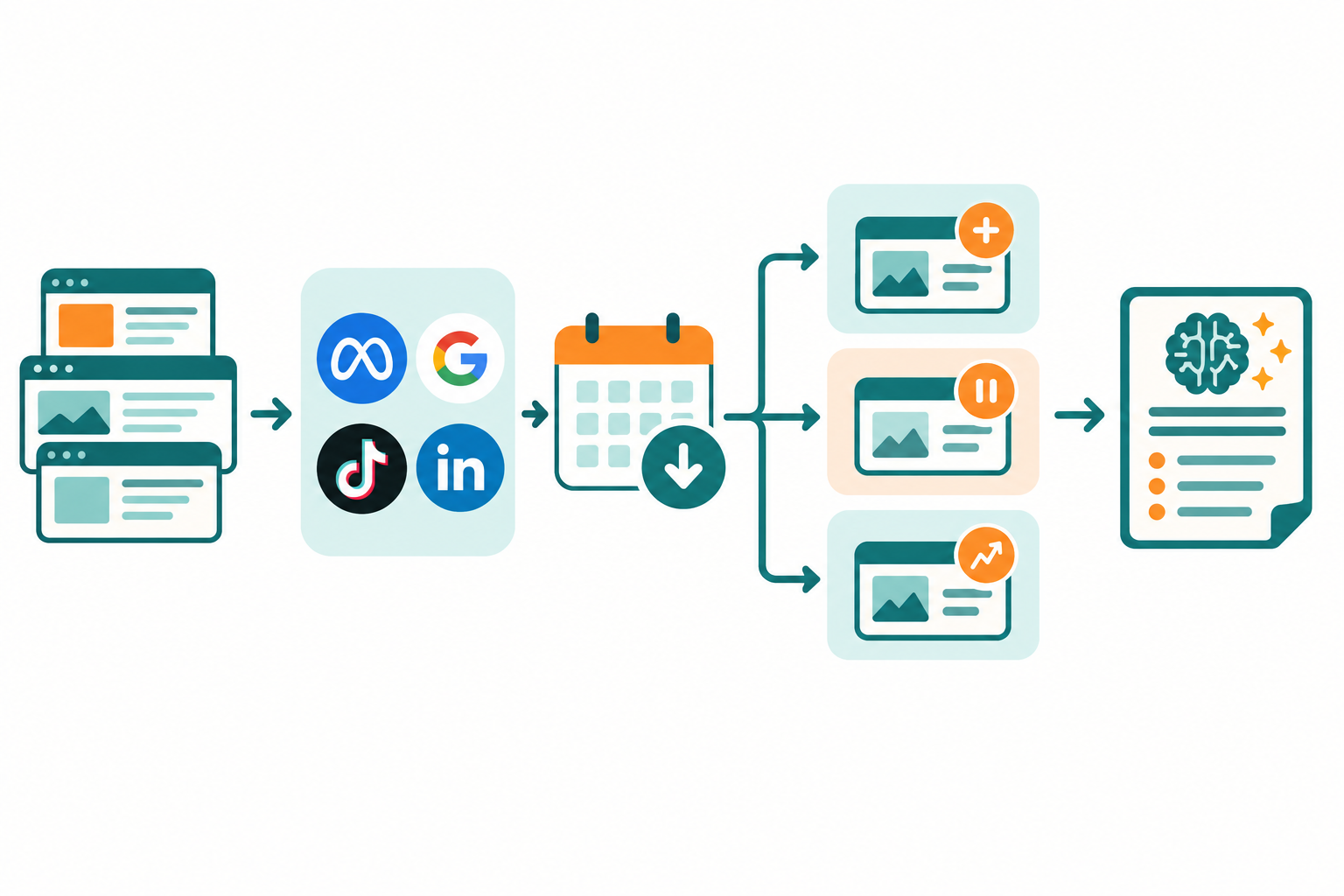
How AI ad monitoring looks in practice
This is the workflow we built Rival Ads around. You give it a competitor's website, and you don't need to connect an ad account. It detects their presence across Meta, Google, TikTok and LinkedIn, fetches every active ad weekly (real creatives, exact copy and links) and produces the week-over-week diff. Then Claude interprets those changes the way a senior media buyer would, flagging what's new, what's stopped and what's continuing to scale.
In practice that's ad monitoring plus a first-pass analyst, delivered to your dashboard and inbox.
What AI can't see in competitor ads
AI sees ads. It doesn't see spend, conversion rates or audience targeting. No ad spy tool does, however slick the interface. Longevity and creative volume are useful proxies, but they're still proxies. Hold onto that, because it shapes everything in the next sections.
There's a wider strategic boundary too. As the IAB's primer puts it, AI optimises towards the goal and signals it receives, but it doesn't independently decide whether that goal is commercially sound or whether a short-term change reflects a lasting opportunity. That remains the buyer's job.
Is AI accurate at analysing competitor ads?
It depends which kind of accuracy you mean. I find it helps to split it in two.
Factual accuracy is about what exists: which ads are live, what the copy says, when they started or stopped, where they link. AI-assisted tools can be genuinely dependable here, provided the data comes directly from platform sources such as the Meta Ad Library and Google's Ads Transparency Center rather than scraped guesswork. Source quality matters enormously. A confident summary built on shaky data is just a confident mistake.
Interpretive accuracy is about why. Why did they pause that ad? Why the sudden offer-led messaging? What's the strategy? Here AI offers a well-reasoned hypothesis, not proof. It's a probability, not a certainty. And to be fair, there's no standardised accuracy score for AI systems that analyse competitors' ads, so any claim that an AI can reliably pick out a rival's 'winning creative' needs validating against campaign-level evidence.
Known blind spots in AI ad analysis
Public ad archives only show what the platforms choose to make available. They don't reliably reveal:
- Budget or ROAS
- Audience settings and targeting
- The testing rationale behind a variant
- Attribution method or profitability
- The internal reason a competitor paused something
Coverage also varies by platform. Meta, Google, TikTok and LinkedIn each disclose different levels of detail, so your picture of a competitor will be sharper in some places than others. Anything an AI says about those hidden factors should be read as an estimate, not a fact.
How to verify AI-generated competitor analysis
Check AI claims against the actual creative and copy. That's why archiving real creatives and links matters so much. If an analysis says a competitor has shifted to urgency-led copy, you should be able to click through and see the ads yourself in about thirty seconds. Keep the evidence, separate what was directly observed from what was inferred, and have a human look at anything ambiguous, especially imagery or cultural references that software can misread.
Where a media buyer's strategic instincts still win
Now the other side of the ledger. This is the stuff that never shows up in a competitor's ad feed.
- Commercial context. Your margins, stock levels, seasonality and client constraints are invisible to any tool watching competitor ads. A rival's 30% off might be a brilliant move for them and a disaster for your client.
- Reading intent. Is a competitor testing, panicking, clearing stock or genuinely scaling a winner? The ads look similar in every case, but the reasons are wildly different.
- Brand fit. Just because a rival's UGC-style TikTok is scaling doesn't mean it suits your brand voice. Borrowing a tactic that clashes with your positioning can cost more than ignoring it.
- The 'so what'. AI can tell you what changed. You decide whether to respond, ignore, or zig when they zag.
- UK market nuance. ASA advertising rules, regional pricing sensitivity, bank holiday and event calendars, payday timing, and humour that doesn't travel from US-centric data. A tool trained on broad patterns won't instinctively know that a certain joke lands flat in Manchester, or that a claim would get you a stern letter from the ASA.
- Relationships and politics. Client appetite for risk, internal sign-off, and what you can realistically ship this week. Strategy that can't be approved isn't strategy.
A short, illustrative example of human judgment
Imagine a competitor suddenly launches a burst of new ads in a single week. On the dashboard it looks like a major push, and a summary might reasonably call it an aggressive scale-up. But anyone who knows that market recognises the pattern: it's a one-off clearance ahead of a product refresh. Responding with a big budget increase would have been a mistake. Nothing in the ad data says 'clearance'. Only market knowledge does.
That's the kind of call instinct makes, and it's why I don't think instinct is going anywhere.
Real examples: AI reads vs human reads
Let's make this concrete. The scenarios below are illustrative examples, not real client data. They show how an AI read and a human read can agree, partly agree or diverge.
| Scenario | AI read | Human read | Which was more useful? |
|---|---|---|---|
| 1. 15 new Meta ads in a week, heavy discount angle | Aggressive promotional push; shift towards offer-led messaging | It's the week before payday and a known sales window, so likely tactical rather than a lasting change | Human. The AI spotted the shift, but the calendar context changed the response (partly agree) |
| 2. Long-running Google search ad stopped; LinkedIn thought-leadership series starts | Pivot towards B2B upper-funnel | You've heard they hired a new head of brand, which explains the move and suggests it'll stick | Both. AI flagged it early, the human explained why it matters (agree) |
| 3. Rival's TikTok creatives scale fast with a new hook format | This format is working; here's the pattern | Fits their younger audience but would feel off for your premium positioning, so borrow the hook structure, not the style | Both, in sequence. AI found the pattern, the human adapted it (partly agree) |
| 4. Same ads running unchanged for months | Stable, probably performing | Could be neglect. Check landing page and offer freshness before assuming it's a winner | Human. Longevity isn't always success (diverge) |
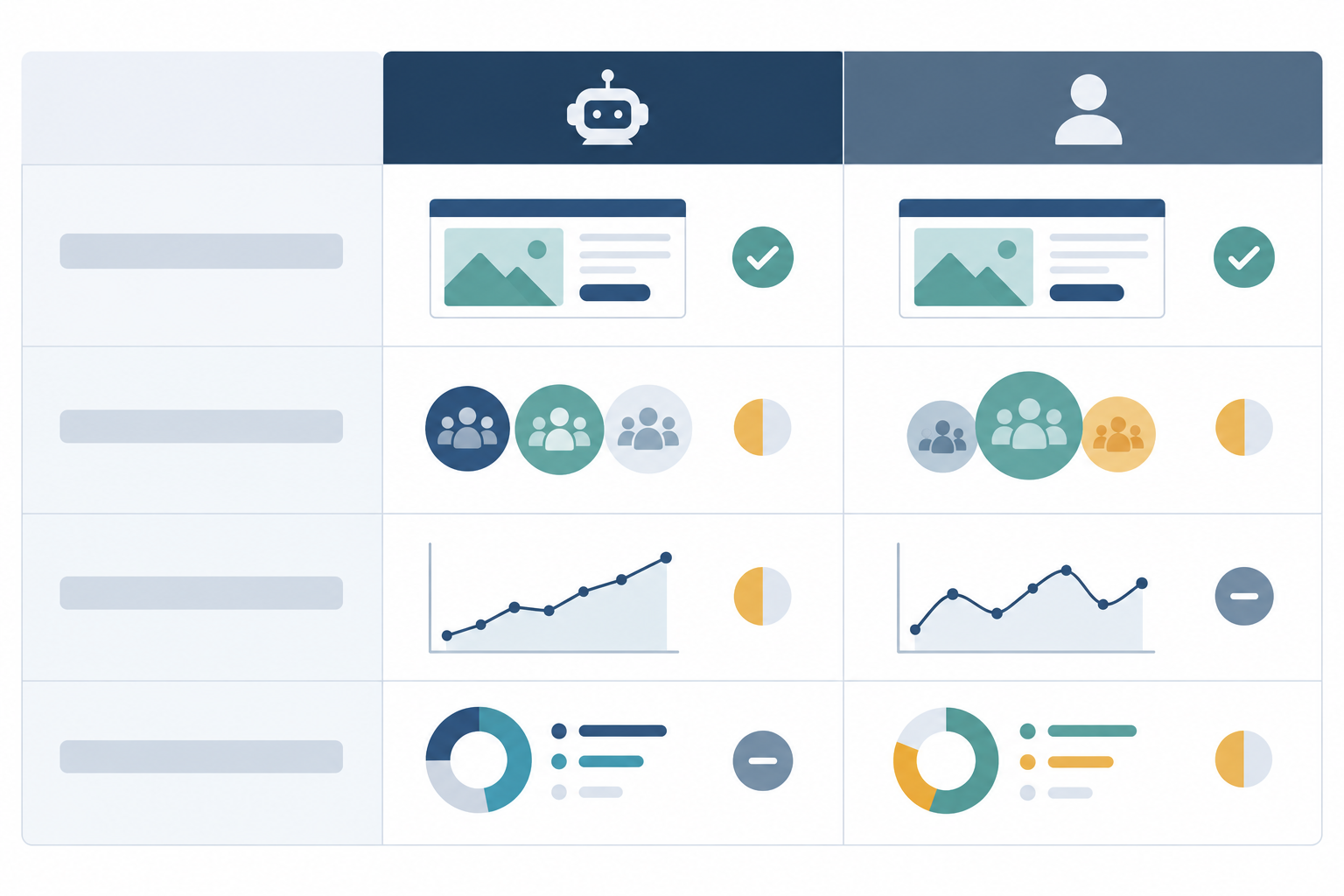
Notice the pattern. In none of these did the AI get it wrong, exactly. It described what was visible accurately. The gap appeared when the question shifted from 'what's happening?' to 'what should we do about it?'. That's where context, calendars, hearsay and brand sense take over.
Should media buyers trust AI-generated strategy notes?
My rule of thumb is trust, but verify. Treat AI notes like a briefing from a smart junior. They're fast, thorough and often spot things you'd miss, but they're worth a sanity check before they land in a client deck.
Trust can be higher for:
- Descriptive summaries of what changed
- Which ads are continuing to scale
- Which messaging themes are repeating
Trust should be lower for:
- Causal claims about why a competitor did something
- Predictions about what they'll do next
Red flags in AI strategy notes
- Overconfident language ('they are clearly doing X') with no hedging
- No reference to specific creatives or copy
- Generic advice that could apply to any brand in any sector
Green flags in AI strategy notes
- Notes tied to specific ads
- A clear separation between observation and inference
- Links back to the source creative so you can check for yourself
One habit pays off more than any other: keep a simple log of which AI reads you acted on and what happened. Over a few months you'll build a calibrated sense of when to lean on the analysis and when to push back. It's the same way you learned which colleagues' hunches were worth following.
A hybrid approach that works: combining AI insights with your own judgment
So how do you put this together? Here's the routine I'd recommend.
- Let AI do the monitoring. Set up competitor tracking across Meta, Google, TikTok and LinkedIn so you're never relying on remembering to check the ad libraries. Consistency beats heroic bursts of effort.
- Start with the weekly diff. Look at what's new, what's stopped and what's scaling before you read any commentary. Form your own first impression.
- Read the AI analysis as a hypothesis. Note what it claims and what evidence it points to. Does it cite specific ads?
- Layer in your own context. Think client goals, budget, seasonality, and anything you know about the competitor from the market.
- Decide on an action tier: ignore, watch, test or respond. Write down why. Future you will be grateful.
- Share it with the team. Shared dashboards, competitor assignments and role-based access mean strategy conversations start from the same data, not from whoever shouted loudest.
- Review monthly. Compare AI reads with outcomes. This sharpens both the tool's usefulness and your own instincts.
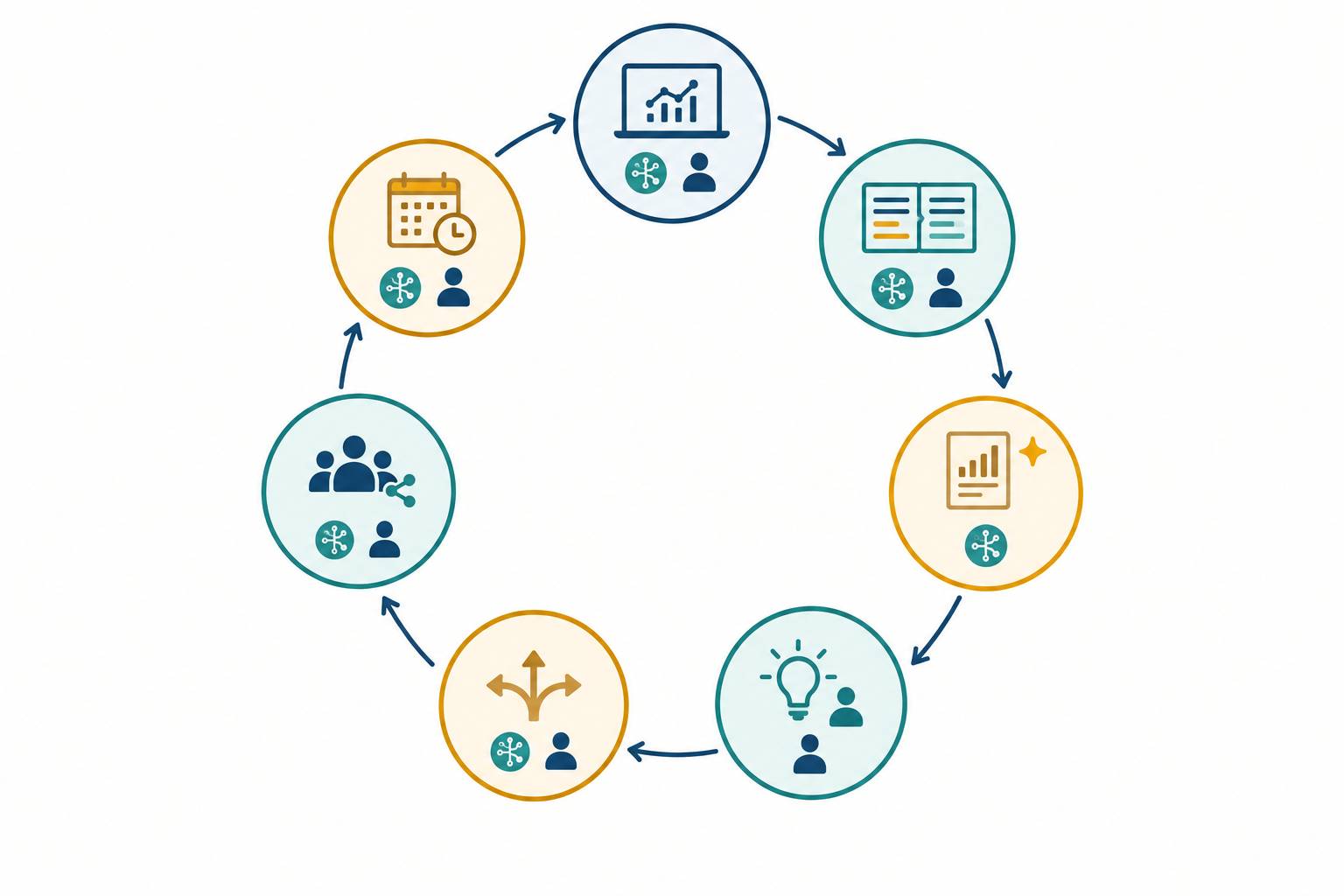
Notice who leads each step. AI leads the first one or two, you lead the middle, and the loop closes with a joint review. It's a partnership, with the human holding the pen.
How agencies can combine AI analysis with human strategy
If you run an agency, this model has a bonus. Whitelabel reporting lets you add your own strategic layer on top of the AI analysis and present it as your own value-add. The AI handles the weekly legwork of creative tracking and diffs, and your team supplies the judgement clients actually pay for. That's a better use of senior time than screenshotting ad libraries.
What AI means for a media buyer's role and time ⏱️
The biggest shift is that the job moves from collecting information to interpreting it. Honestly, that's the more strategic half of the work anyway. Few of us got into marketing strategy because we love scrolling through ad archives.
The time you save can go into things that actually move results: creative testing, client conversations and deeper analysis. Junior buyers benefit too, since they can learn faster by comparing the AI's read with senior feedback, a bit like checking your working against the answer sheet.
On cost, a monitoring tool starting from $29/month is a modest outlay next to the hours of manual checking many teams spend each week. McKinsey has estimated that generative AI could lift marketing productivity by the equivalent of 5–15% of total marketing spend. That's a broad estimate rather than a promise for any one team, but it points the same way: the value is in freeing people for higher-order work.
So here's where I land. AI doesn't replace instinct, but it gives instinct better raw material. The buyers who'll do best are the ones who let software read everything and then bring the one thing it can't: a view on what it all means for their business.
FAQ: AI and media buying strategy
Is AI accurate at analysing competitor ads?
It's very reliable at the factual layer, such as which ads are live, what the copy says and what's new or stopped week to week, provided the data comes straight from platform ad libraries. It's less certain on the 'why', because it can't see spend, conversion data or targeting. Treat interpretations as informed hypotheses.
Should media buyers trust AI-generated strategy notes?
Trust them as a strong first draft, not a final verdict. They're most dependable when summarising changes and patterns, and least dependable when predicting competitor intent. Check notes against the actual creatives and add your own commercial context before acting.
How do I combine AI insights with my own judgment?
Use AI for monitoring and first-pass analysis, then apply your knowledge of your client, market and budget to decide what to do. A simple routine works well: review the weekly diff, read the AI analysis, add your context, then choose to ignore, watch, test or respond.
Can AI see how much competitors are spending on ads?
No. Ad libraries and transparency tools show what's running and for how long, but not budgets, ROAS or targeting. Longevity and creative volume are useful proxies, but they aren't spend data.
Do I need access to a competitor's ad account to track their ads?
No. Because the ad data is publicly available, you only need the competitor's website. Rival Ads uses it to detect their presence on Meta, Google, TikTok and LinkedIn, then archives their active ads each week.