
Turning Competitor Ad Data Into Your Creative Testing Plan (Without Copying a Single Ad)
Turn competitor ad data into a smarter creative testing plan. Learn why copying ads fails and build a practical testing calendar that drives results.
Chris Edington
11 min read
Turning Competitor Ad Data Into Your Creative Testing Plan: Why Copying Competitors Rarely Works
Turning Competitor Ad Data Into Your Creative Testing Plan starts with resisting the temptation to copy a competitor's ad. If you've ever spent an afternoon scrolling through a competitor's Meta Ad Library, you'll know the temptation. You spot an ad that's clearly been running for weeks, the copy's punchy, the creative's slick, and your brain immediately goes: let's just do that, but with our logo.
I get it. But competitor ad data is most valuable when you extract the underlying angle, hook, or offer structure, not when you copy the ad itself. The approach that actually works is to turn competitor ad data into a creative testing plan: log recurring patterns across competitor creative (not single ads), translate those patterns into 3–5 testable hypotheses per month, and run them through your own testing calendar with clear success metrics tied to what you learned, not just what performed.
This isn't about ignoring competitors, quite the opposite. It's about treating competitor ad intelligence as a source of informed hypotheses rather than a copy-and-paste template. Below, I'll walk through the framework we use, including a worked example, a competitor ad research log template, and a sample monthly creative testing calendar, so you can build a repeatable system of your own rather than reacting to whatever you saw last week.
A quick note on scope: this works a bit differently depending on your spend and account maturity. If you're running a handful of campaigns a month with limited budget, you might only manage 2–3 tests rather than 5, and you'll need longer to reach significance. Treat the numbers below as sensible starting points, not fixed rules.
I've seen plenty of marketers get burned by this, so let's address it head-on. Copying a competitor's winning ad feels efficient, but it tends to backfire for a few reasons.
First, context doesn't transfer. An ad that converts well for one business depends on that business's audience trust, pricing position, and brand history, things a near-identical ad from you won't carry. Your audience might be earlier in their buying journey, more price-sensitive, or simply less familiar with your brand. Same words, often a very different result.
Second, near-duplicate creative tends to struggle on performance, though not always for the dramatic reasons people assume. It's not that Meta or TikTok have some blanket 'copy detector' that punishes you automatically. Delivery depends on auction dynamics, your account history, and audience overlap too. But creative that looks like something a user has already scrolled past rarely earns the engagement signals that help it compete in the auction. Undifferentiated ads can also create brand or intellectual property risk. The safer assumption is that a direct copy starts at a disadvantage, not that it's guaranteed to fail.
Third, timing works against you. By the time you've spotted a competitor's ad through manual Ad Library searches, it's often already been live for weeks. It could be fatiguing, nearing the end of its run, or about to be pulled. You're reacting to old news, and a straight copy launched now is unlikely to catch the same wave.
And finally, the one I think matters most: copying removes your ability to learn. You might get a result, good or bad, but you won't understand why. Was it the hook? The offer? The visual style? Without that insight, you can't repeat success or avoid failure next time. You're gambling with someone else's homework instead of doing your own.
How to Extract Creative Angles From Competitor Ads
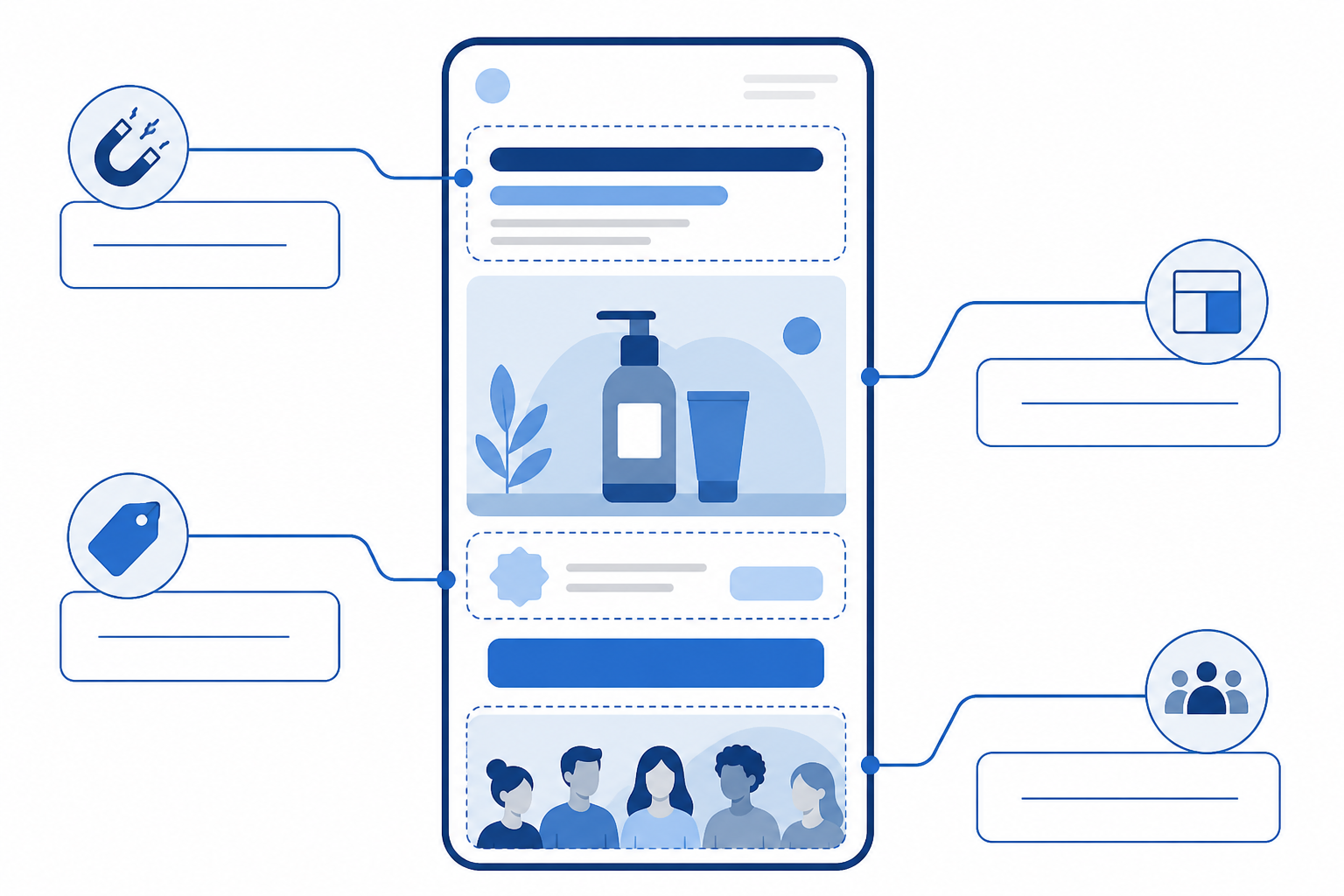
So what should you log when you review a competitor's creative? The goal is to identify patterns, not individual executions. Here's what I'd track. For UK teams, the same logic applies whether you're pulling data from Meta Ad Library, TikTok's Creative Center, or LinkedIn's ad transparency page:
- Hook pattern – Problem–agitate–solve, a bold claim, social proof up front, or a curiosity gap?
- Offer structure – A straight discount, an urgency mechanic (ends tonight, limited spots), a free trial, a demo booking, or a guarantee-backed offer?
- Format and platform choice – Native UGC-style content on TikTok, long-form thought-leadership text on LinkedIn, or clean static carousels on Meta? The platform choice tells you something about who they're targeting.
- Messaging themes that persist – A single ad tells you very little. A message that shows up consistently across 4–6 weeks of competitor ads is a stronger signal it's scaling, though persistence alone doesn't prove profitability. Some brands run evergreen or retargeting ads for months regardless of performance.
- Audience signals from copy – Who are they clearly speaking to? Does the language suggest a different ICP to yours, or meaningful overlap?
- Creative fatigue signs – Ads that vanish quickly after launch probably underperformed, or were only ever a short test. Ads still running a month later are more likely, but not guaranteed, to still be delivering results.
Here's a simple competitor ad research log format, with a worked example from a fictional UK subscription box competitor:
| Competitor | Pattern observed | Evidence period | Audience signal | Transferable mechanism | Confidence |
|---|---|---|---|---|---|
| Competitor A | FOMO messaging tied to a price increase ('prices go up Friday') | 5 weeks, 3 ad variations | Price-sensitive, existing-customer language | Urgency + loss aversion around a real deadline | High |
Tools like Rival Ads exist specifically to make this kind of week-over-week competitor ad tracking easier than manually re-checking the Ad Library, since you can see what's new, what's been paused, and what's still scaling. But the principle matters more than the tool: a single competitor ad glimpsed once rarely tells you much. Patterns across weeks are where the real signal lives.
How to Turn Competitor Research Into Test Ideas
Spotting a pattern is only half the job. The next step is to translate the observation into a testable creative hypothesis for your own brand. Here's the full process, using the example above.
- Write down the pattern in plain language. 'Competitor A keeps running FOMO messaging around a price increase, across three ad variations over five weeks.'
- Ask why it might work for them specifically. Their audience is existing customers who already trust the brand, and the deadline is real and verifiable, which makes the urgency credible rather than manufactured.
- Reframe it as a hypothesis for your own brand. 'If we test urgency-based messaging ahead of our own Q1 price change, we expect a CTR lift among existing-customer retargeting segments, because the deadline is genuine and the audience already trusts us.' Note the second hypothesis worth testing alongside it: 'Cold audiences, who don't yet trust us, will respond better to a value-led angle than an urgency angle, because they have no existing relationship to protect.'
- Define success before you launch. For this test, the primary KPI is CTR and the secondary KPI is CPA. We're looking for at least a 15% CTR lift over the control ad, measured over a minimum of 2,000 impressions per variant or 7 days, whichever comes later.
- Build the test brief. Audience: existing customers, UK, retargeting list. Format: static image plus a 15-second video cut-down. Budget split: 60% to the urgency variant and 40% to the control, given this is competitor-inspired rather than a proven internal winner. Duration: 2 weeks. Decision rule: if the CTR lift holds at day 7, extend budget; if CPA rises more than 20% despite the CTR lift, pause and review the creative execution separately from the angle itself.
- Assign it a testing slot, not an immediate launch. This is the step most teams skip, and it's the one that keeps your creative testing roadmap intentional instead of reactive.
This translation step is where competitor ad intelligence actually becomes strategy. Without it, you're just collecting screenshots.
Building a Monthly Creative Testing Calendar
Once you've got a handful of hypotheses, the next challenge is structure. Without a calendar, it's easy to launch too many tests at once, muddy your results, and end up with data you can't interpret.
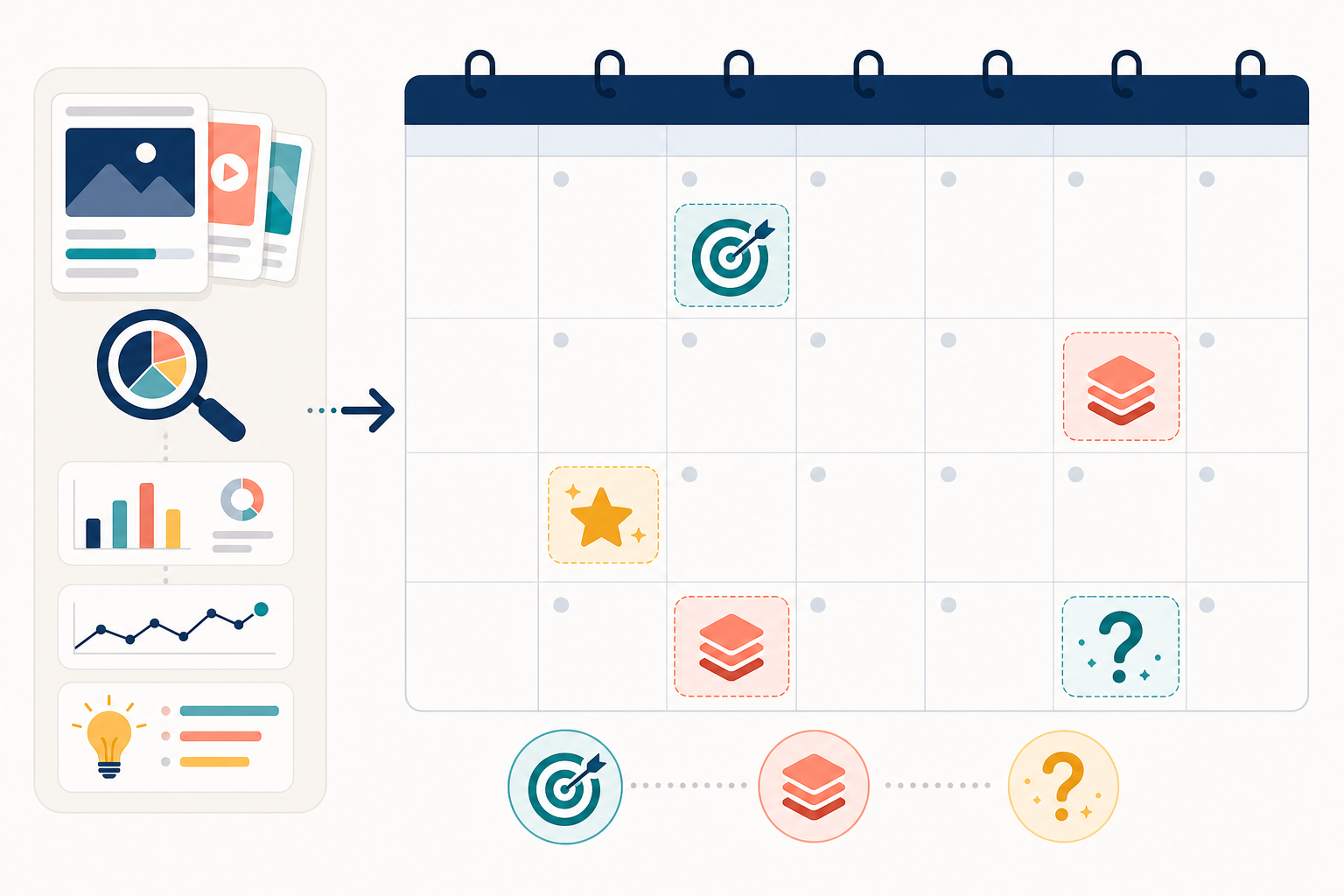
Here's a sample four-week creative testing calendar built from the example above, assuming a mid-sized account running two platforms:
| Week | Test | Type | Platform | Budget split | Review date |
|---|---|---|---|---|---|
| 1–2 | Urgency vs. control (existing customers) | Angle test | Meta | 60/40 | Day 14 |
| 1–2 | Value-led angle (cold audience) | Angle test | Meta | 50/50 | Day 14 |
| 2–3 | Same hook, static vs. video | Format test | TikTok | 50/50 | Day 14 |
| 3–4 | Wildcard: no competitor precedent | Angle test | 100% new | Day 21 |
A few structural rules that make this work:
- Cap it at 3–5 hypotheses per month, per platform, and use fewer if your spend or volume is lower. Any more and overlapping variables make it hard to know what actually moved the needle.
- Separate angle tests from format tests. An angle test changes the core message or hook. A format test keeps the same angle but changes the execution: video versus static, long-form versus short. Mixing the two tells you little about which lever worked.
- Treat your competitor digest as a planning input, not a trigger to panic-launch. Review it in your planning meeting, not the afternoon it lands.
- Leave one wildcard slot each month for an angle with no competitor precedent. If every test is competitor-inspired, you'll never discover something genuinely novel.
- Tag each test with its source: competitor-inspired, internal idea, or customer feedback. Over a quarter, this reveals which source actually produces your best creative.
Measuring What You Learn From Creative Tests
A lot of testing programmes track whether a test won or lost, but not whether the underlying hypothesis held up. That's a missed opportunity, because that's where the actual learning happens.
- Classify each hypothesis as supported, partially supported, or rejected, rather than just pass/fail on the ad. In our example, if CTR lifts but CPA also rises sharply, that's partially supported: the angle worked, but the execution or audience targeting needs adjusting.
- Separate a wrong angle from a weak execution. A test that fails because the core message didn't resonate needs a different fix from one that fails because the creative itself was clunky. Conflating these leads to the wrong next move: don't abandon an angle because of a bad video edit.
- Keep a simple learnings log. One line per test: what we expected, what happened, and what we'd change next time. A shared spreadsheet works fine, as long as someone actually updates it.
- Revisit competitor-inspired tests after 60–90 days. Check whether the competitor is still running that angle. Continued activity is a reasonable signal of durability, though it's not proof. Some brands keep underperforming ads live for operational or brand-consistency reasons.
- Feed strong learnings back into your creative brief templates. If a hook style keeps winning, bake it into your default briefing process so it compounds over time instead of being rediscovered each cycle.
How Often Should You Refresh Your Creative Testing Roadmap?
Different parts of the process run on different clocks, and the right cadence depends partly on your spend and creative volume:
- Weekly or fortnightly for monitoring. Higher-spend accounts with frequent creative refreshes benefit from weekly checks; smaller accounts can often get away with fortnightly without missing much.
- Monthly for planning. Set your hypotheses at the start of each cycle rather than reshuffling constantly.
- Quarterly for strategy. Step back and ask whether your creative direction still matches where the market is heading.
- Immediate review only for major shifts: a competitor launching a new product line or pivoting messaging wholesale. Everything else can wait for its scheduled slot.
This rhythm keeps you informed without making you reactive, which is the whole point of treating competitor ad data as an input rather than a script.
FAQ: Competitor Ad Research and Creative Testing
How do I turn competitor research into test ideas?
Log patterns, not individual ads: messaging themes, hooks, or offer structures that repeat across a competitor's creative over several weeks. Then translate each pattern into a specific hypothesis for your own brand, including the audience it applies to, the result you'd expect, and why you'd expect it. Build a test brief with a budget split and a decision rule before you launch, so you're not retrofitting a story afterwards.
Should I copy a competitor's winning ad?
Generally not directly. Your audience, brand trust, and offer are different, and near-duplicate creative often starts at a disadvantage in terms of engagement and differentiation, even if platforms don't apply a blanket penalty. What transfers well is the underlying angle or structure, adapted to fit your own positioning, audience, and budget.
How often should I refresh my creative testing roadmap?
Monitor competitor activity weekly or fortnightly depending on your spend, set new testing hypotheses monthly, and review your overall strategy quarterly. Break this rhythm only for major competitor shifts, such as a new product launch or a significant messaging pivot.
How long should I watch a competitor ad before treating it as a real signal?
An ad still running after 3–4 weeks is a reasonable signal of continued investment, but not proof of profitability. Some ads stay live for retargeting, evergreen testing, or brand consistency regardless of how they're performing. Themes that persist across multiple ads and multiple weeks, rather than a single long-running ad, are a more reliable signal worth building a hypothesis around.
Turning Competitor Ad Data Into Your Creative Testing Plan is a starting framework rather than a fixed rulebook. The right cadence, budget split, and number of concurrent tests will shift depending on your account maturity, spend, and how much creative volume you're realistically able to produce each month. Adapt the numbers here to where you actually are, then tighten them up as you learn what your own creative testing programme can support.