
What Your Competitor's Ad Spend Signals About Growth Plans (And How to Read Them)
Decode competitor ad spend signals to spot funding, expansion, and strategy pivots early, with a practical ad intelligence framework for CMOs.
Chris Edington
10 min read
Competitor Ad Spend Signals: How to Spot Funding, Expansion and Strategy Pivots Early
Competitor ad spend rarely stays quiet before a big move. Sudden platform expansion, spikes in creative output, new geographic targeting and messaging pivots are all early signals that a competitor has raised funding, is entering a new market or is repositioning its product. If you know what to watch for across Meta, Google, TikTok and LinkedIn, you can often spot these shifts weeks or months before a press release confirms them.
I've watched this play out enough times now to trust it as a pattern rather than a coincidence. A competitor goes quiet on messaging for a few weeks, then suddenly they're everywhere: new platforms, new copy, new creative volume. Three weeks later there's a funding announcement or a market expansion post on LinkedIn. The ads told the story first. This guide breaks down exactly what to watch for and how to turn those signals into something you can bring to your leadership team.
Why competitor ad behaviour leaks strategy early
Here's the thing about advertising: it's one of the fastest-moving, most visible signals a company produces. Hiring plans take months to show up publicly. Product launches get held under NDA until launch day. But ad spend? It changes weekly, sometimes daily, and it's sitting right there in the Meta Ad Library or a TikTok feed for anyone paying attention.
Marketing teams also tend to move faster than legal, PR or finance. Budget gets deployed the moment leadership gives the nod, often well before a formal announcement goes through comms review. By the time a company puts out a press release about entering a new market, the marketing team has usually been running ads there for weeks.
There's also a simple logic to why ads are such an honest signal: they're a public commitment. A company won't scale spend behind a message, a new vertical or a new platform unless leadership has already signed off on the underlying strategy. Nobody burns budget testing a positioning angle that hasn't been internally agreed. So when you see spend patterns shift, you're not seeing a marketer's whim. You're seeing a decision that's already been made upstream.
I've seen this pattern repeatedly with teams using Rival Ads. A fundraise or a pivot shows up in ad behaviour days or weeks before it's confirmed anywhere else. The ad account doesn't lie, even when the comms team hasn't caught up yet.
Four competitor ad spend signals to watch
1. Sudden platform expansion can signal new funding
This is probably the single clearest signal in competitive ad intelligence, and it's the easiest to spot if you're monitoring consistently.
- A competitor who's only ever run Google Search ads suddenly appearing on Meta, TikTok or LinkedIn usually means new budget has landed, not just a new creative idea someone had on a Tuesday. Testing a brand-new platform means new pixel setups, new creative formats and new ad accounts. That's real investment, not a whim.
- Platform expansion often follows a funding close, because testing new channels requires cash reserves that most bootstrapped or cash-conscious teams won't risk. If a competitor has been disciplined about channel focus for a year and then suddenly diversifies, that discipline had a reason, and money loosening up is usually it.
- The specific combination of platforms tells you where they're headed. LinkedIn expansion often signals a push into enterprise or B2B territory. TikTok expansion usually points to a consumer growth play aimed at a younger demographic. Read the combination, not just the fact that expansion happened.
With Rival Ads, this is one of the easiest signals to catch automatically. You just point it at a competitor's website (no ad account connections needed) and it detects their presence across Meta, Google Ads, TikTok and LinkedIn on its own. You're not manually checking four platforms every week hoping you notice a new one; the ad monitoring does that for you.

2. Creative velocity spikes reveal budget and growth changes
If platform expansion is the clearest signal, creative velocity is probably the second-clearest, and it's one that a lot of teams miss because they're not tracking week-over-week changes closely enough.
- A jump from 2–3 active ads to 20+ in a single week almost always means a budget increase, not just a creative refresh. Refreshing creative usually means swapping out a handful of tired ads for new ones, not multiplying output by 10x overnight.
- Creative velocity spikes often precede product launches. Teams need dozens of creative variants to find what resonates before committing to a bigger push, so a sudden burst of testing activity is often the warm-up act before a much larger campaign.
- Testing spikes and scaling spikes look different once you know what to check for. A testing spike looks like many small variations of the same offer: different headlines, different visuals, same core message, spread thin. A scaling spike looks like fewer creatives running with much higher apparent reach. The second pattern is the stronger growth signal: it means they've already found something that works and they're pouring money behind it.
This is exactly what week-over-week diffs are built for. Seeing what's new, what's been paused and what's continuing to scale tells you whether a competitor is still exploring or has already committed. A one-off snapshot won't show you that. A rolling comparison will.

3. New geographic targeting can expose market expansion
Geographic expansion is one of the sneakier signals because it often hides in plain sight, in the copy itself rather than the platform or volume.
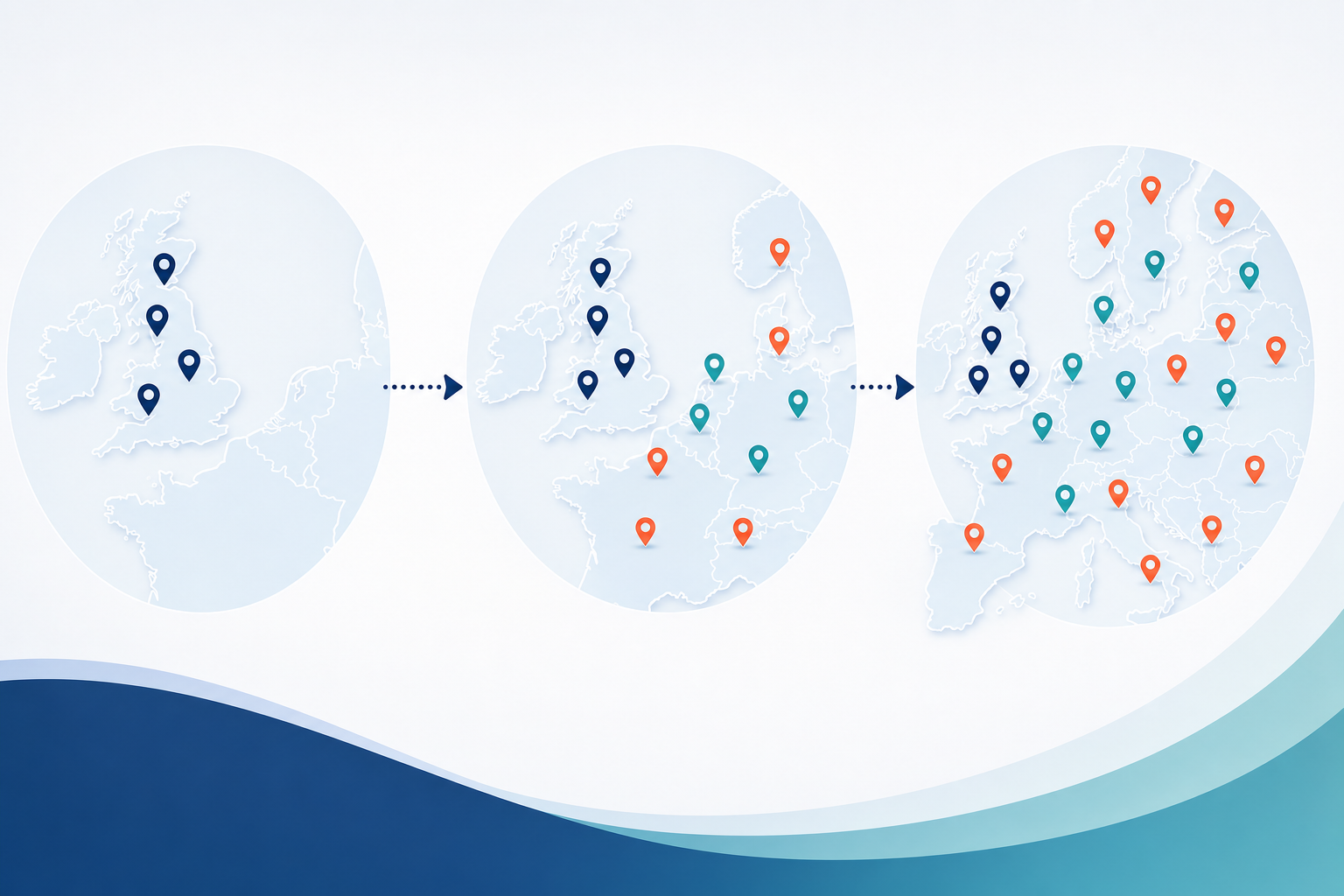
- Ad copy suddenly referencing new cities, currencies or regional offers is one of the clearest tells. If a competitor who's only ever mentioned London starts referencing Manchester, Dublin or Berlin, that's not accidental. Someone approved region-specific messaging for a reason.
- Localisation often shows up in ads before it shows up on the website. New translations, region-specific landing pages and currency swaps in ad copy tend to get built and tested in creative well before the main site catches up. If you're only checking their website for expansion clues, you're behind.
- For UK-based teams, the pattern to watch is the shift from London-centric messaging to broader UK regional targeting, or from UK-only to EU or US expansion. This kind of geographic broadening frequently maps directly onto a new funding tranche earmarked specifically for growth. It's rarely subtle once you know to look for it.
- Landing page links inside the ads themselves are worth checking too. Rival Ads captures exact copy and creatives alongside the destination links, so you can often spot country-specific domains or region-specific pricing pages well before any announcement goes out.
4. Messaging pivots show a change in positioning
Messaging pivots are the subtlest signal on this list, but they're often the most strategically revealing, because they tell you not just that something changed, but what a competitor thinks their next move needs to be.
- A shift from feature-led copy to outcome-led copy (or vice versa) often signals a repositioning effort, usually tied to a new ideal customer profile or a new vertical they're chasing. If the copy used to say "automate your reporting" and now says "cut your ops headcount in half," that's a different buyer being targeted.
- Sudden emphasis on enterprise language, things like "security," "compliance" and "dedicated support," usually means a move upmarket. This pattern shows up often after a Series A or B raise, when a company needs to justify bigger contract values to investors.
- A pivot towards urgency-driven language ("limited spots," "ending soon") can indicate pressure to hit a specific growth metric. Sometimes that's tied to a board meeting deadline, sometimes to a metric they need to hit before their next funding conversation. Either way, urgency copy is rarely random. It's usually a symptom of an internal deadline.
This is where AI-generated strategic analysis genuinely earns its keep. It's easy to scroll past a subtle copy change when you're looking at dozens of ads a week. Rival Ads' Claude-powered analysis interprets these shifts the way a senior media buyer would, flagging the pivots you might otherwise miss and putting language to what changed and why it probably matters.
How to turn ad intelligence into boardroom insight
Spotting these competitor ad spend signals is only half the job. The other half is translating them into something your leadership team will actually act on. Here's how I'd approach it:
- Synthesise the pattern into a single sentence. Don't present raw ad screenshots and expect people to draw conclusions themselves. Something like "Competitor X expanded to LinkedIn and TikTok in the same week, alongside a 3x creative volume increase, likely a fresh funding round" does more work than ten slides of screenshots.
- Pair ad signals with public data where you have it. Companies House filings, LinkedIn hiring pages and press mentions strengthen your case considerably. But don't wait for confirmation before you start planning your response. By the time it's confirmed, the window to react early has usually closed.
- Use a weekly digest format to build a rolling narrative, not a one-off report. Growth signals compound over several weeks rather than appearing in a single snapshot. A consistent weekly view for leadership shows you're tracking a trend, not reacting to a blip.
- Assign ownership if you're managing multiple competitors. Agencies and in-house teams juggling several competitor accounts need someone accountable for flagging pattern changes, which is exactly why team roles and competitor assignment features exist within a proper ad intelligence setup.
- Bring a recommended response, not just an observation. Leadership wants to know what you think a signal means for pricing, positioning or the roadmap, not just that something changed. "Here's what happened" is interesting. "Here's what I think we should do about it" is useful.

Frequently asked questions about competitor ad spend signals
Can competitor ad spend really hint at a funding round?
Yes, and it's one of the more reliable early indicators available. Funding rounds almost always come with a mandate to grow faster, and marketing budgets get deployed quickly once that money lands, often weeks before any official funding announcement. Watch for combined signals: new platforms appearing at once, a jump in creative volume and messaging shifting towards growth-stage language like "scaling teams" or "now available in." Any one signal alone could mean something smaller, but two or three together are a strong indicator worth acting on.
What does a sudden increase in ad volume usually mean?
It typically means one of a few things: a product launch, a new funding tranche being deployed, or a push to hit a growth metric ahead of an internal deadline such as a board meeting or the next funding round. Context matters here. Check whether the extra volume is concentrated on one offer (a testing spike) or spread across many variants with similar messaging (a scaling spike). Looking at the ad copy and creative changes alongside the volume jump usually clarifies which scenario you're actually looking at.
How do I present competitor ad signals to my leadership team?
Keep it simple and pattern-based rather than screenshot-heavy. Summarise what changed, over what timeframe, and what it likely signals, then give your recommended response. A short weekly note referencing consistent trends across platform expansion, creative velocity and messaging shifts lands far better than a one-off deep dive, because it shows leadership you're tracking this continuously rather than reacting to a single data point.
Final takeaway: monitor the pattern, not a single ad
Competitor ad behaviour is one of the most honest signals available to any marketing team. It's public, it's frequent, and it reflects real budget decisions rather than PR spin. The trick is watching consistently enough to catch the pattern before the announcement, rather than after. Whether you're doing this manually across four platforms or using an ad intelligence platform to catch it automatically, the framework stays the same: watch the platforms, watch the volume, watch the geography and watch the words. Put those together, and you'll usually know what's coming before anyone else does.