
Holiday Ad Strategy: What DTC Brands Can Learn From Rivals' Q4 Ads
Build a smarter holiday ad strategy by watching what rivals actually run in Q4. Learn how UK DTC brands time launches, match urgency messaging and avo
Chris Edington
16 min read
Holiday Ad Strategy for DTC Brands: What to Learn From Rivals' Q4 Ads
Meta description: A UK-focused holiday ad strategy guide for DTC brands. Learn what to watch in rivals' Q4 ads, when to launch, how to handle urgency messaging and how to avoid promo fatigue.
The best holiday ad strategy starts before your rivals' Black Friday ads go live. From early October, track what competitors launch and what they stop running. Then use those patterns to pick your launch window, sharpen your urgency messaging and space out offers so customers don't tune out. Watching rival ads turns Q4 from a guessing game into a run of timing decisions you can actually defend.
That's the short version. The rest of this post is the practical one: what to watch, when to watch it and how to turn it into decisions your team can act on. I'll use public data where it exists, and I'll say so when it's US-heavy, because most published holiday benchmarks are. The UK calendar has its own quirks, and we'll get to those.
Why Holiday Ad Timing Is Everything 🎄
Here's the core tension of Q4. Launch too early and you burn budget and goodwill on people who aren't ready to buy. Launch too late and your rivals own the attention before you've said a word.
The UK makes this harder than it looks. We don't get one big weekend. We get Singles' Day on 11 November, Black Friday and Cyber Monday, Christmas delivery cut-offs, Boxing Day sales and then the January sales. These windows overlap, and shoppers drift between them. If you treat Q4 as a single Black Friday push, you're ignoring most of the season.
The best-documented numbers come from the US, so read them as directional rather than as UK benchmarks. Adobe Analytics reported that US online holiday spending reached $241.4 billion between 1 November and 31 December 2024, up 8.7% year over year, with Cyber Week alone accounting for $41.1 billion. The National Retail Federation found that 45% of US consumers had started holiday shopping before November in 2024, up from 40% the year before. For UK brands, the dollar figures matter less than the pattern: shoppers tend to start earlier than most ad calendars assume. Check that against your own UK sales data.
There's a cost angle too. Plenty of media buyers I talk to feel that auction costs climb as more brands pile in through November, which would make early testing cheaper than reacting in peak week. I don't have UK data that proves it, so treat it as a hypothesis. Compare your own CPMs from September to November before you build a budget around it.
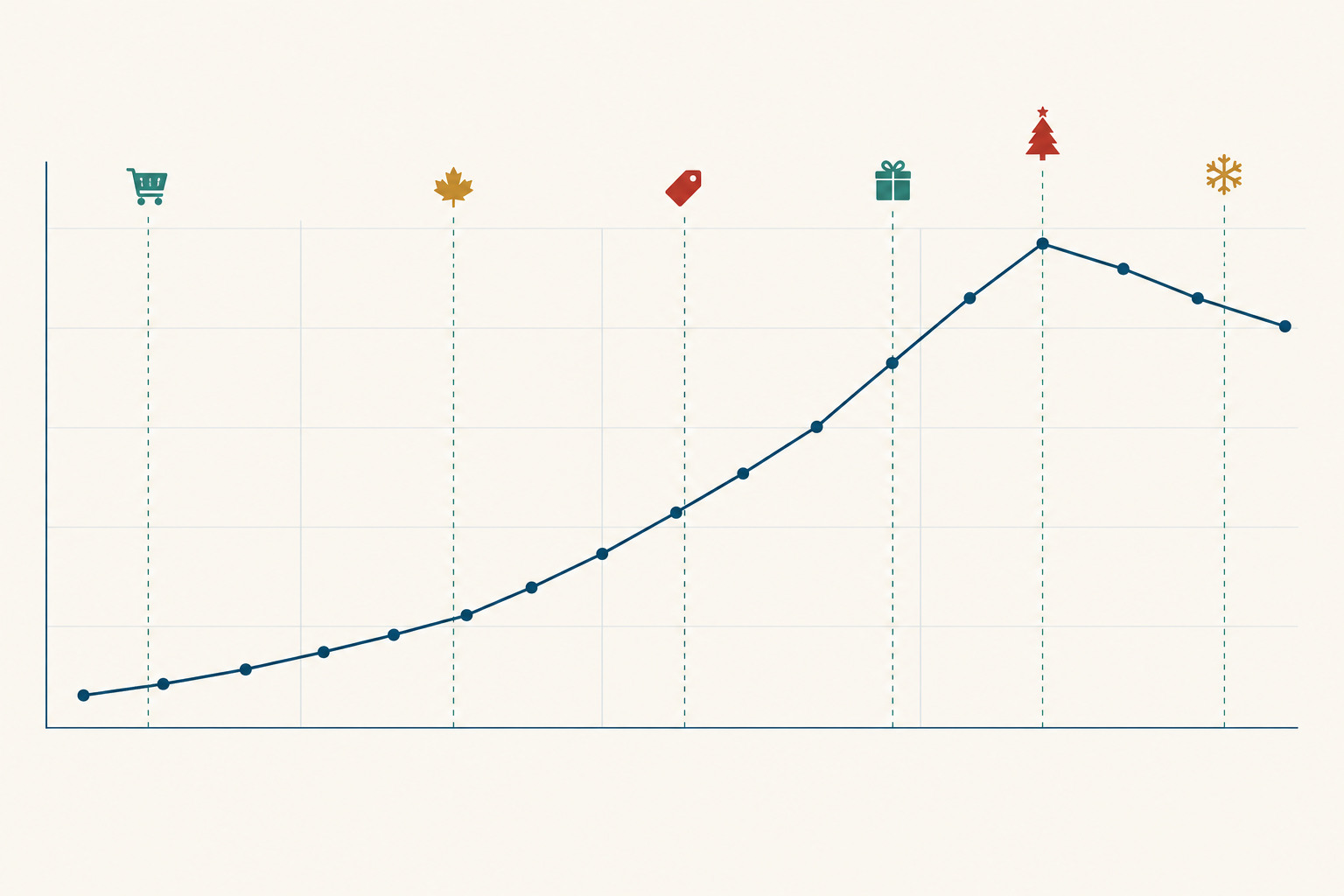
The chart above is illustrative, not measured UK CPM data.
Here's my honest take. The brands that look 'lucky' in Q4 have usually been watching the market for weeks. They saw a rival's early bundle appear, noticed a discount ad disappear and adjusted before anyone else did.
That's why rival ads make such a good timing signal. Competitors are spending real money, so whatever they're running is something they decided was worth paying for. Surveys and forecasts tell you what shoppers say they'll do. Live ads tell you what your competitors are betting on.
When Should DTC Brands Launch Holiday Ads in the UK?
There's no universal launch date, but there is a rhythm, and you can calibrate it against what your rivals actually do. Here's the timeline I'd use.
- Early October: baseline your rivals. Before the seasonal shift, record how many ads each rival is running, which creative themes dominate and where they send traffic. You can't spot a change if you don't know what normal looks like. In 2024, US retail events like Amazon's Prime Big Deal Days (8-9 October), Walmart Deals (8-13 October) and Target Circle Week (6-12 October) all landed in early October. Amazon runs its own deal events in the UK too, so check this year's dates.
- Mid to late October: watch for warm-ups. Look for teaser, waitlist and 'early access' creatives. They're often the first sign a rival is warming up audiences, and they can show up weeks before any discount does.
- Early November: see who goes early and who holds back. Some brands launch Black Friday offers in the first week of November. Others stay quiet and save the surprise. Knowing which is which helps you decide whether to compete for attention now or own the quieter moment later.
- Black Friday to Cyber Monday week: track the churn. Which ads are new? Which have stopped? Which are still running? In 2024, Adobe recorded $10.8 billion in US online spend on Black Friday and $13.3 billion on Cyber Monday, so this is the most crowded stretch of the year.
- Early to mid December: watch the pivot. Messaging usually shifts from discounts to delivery deadlines and gifting. A rival still shouting about percentage-off while everyone else talks about 'order by' dates could be clearing stock, or could simply be behind. You can't tell from the ad alone.
- Boxing Day into January: spot who rolls on and who goes quiet. Some brands roll straight into sales. Others pause entirely. Both are useful to know when you plan next year.
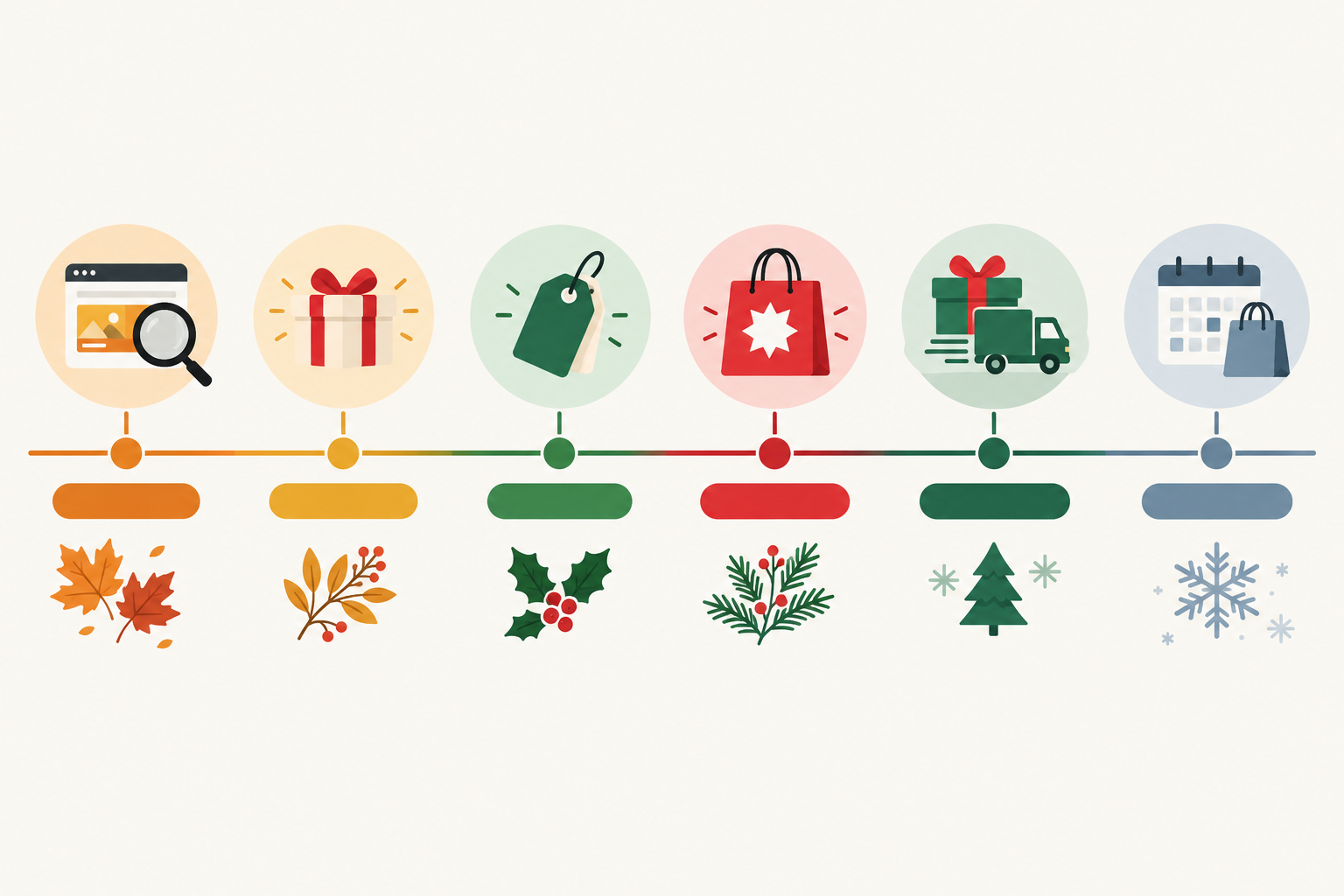
One caveat: timelines vary by category. Beauty brands lean hard on gifting sets and tend to start early. Fashion often goes big on Black Friday and then pivots to party wear. Home brands care a lot about delivery cut-offs. Supplements may hold off until the January 'new year, new routine' wave. So benchmark against rivals in your own category, not the market in general, and check the calendar each year before you lock in flights.
What to Watch in Competitor Ad Libraries During Q4
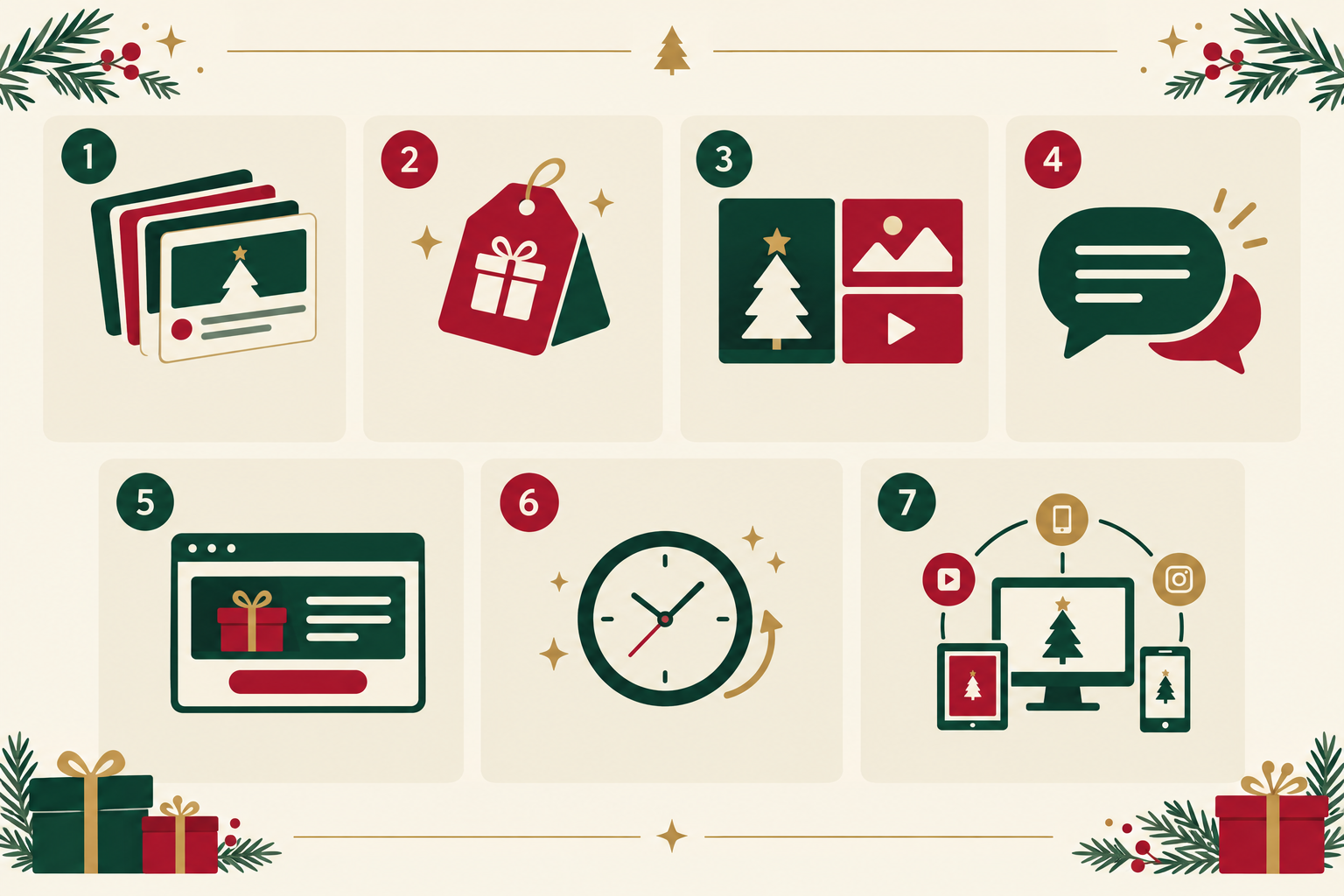
Once you know when to look, you need to know what to look for. This is the checklist I'd work through for each rival:
- Ad volume and pace. How many new ads appear each week, and when does volume spike? A sudden jump often marks a new campaign phase.
- Offer structure. Look past the headline discount at bundles, free gifts, tiered savings, free delivery thresholds, limited editions and loyalty perks. These show how a rival is trying to lift order value or dodge a pure price fight.
- Creative formats. UGC, static product shots, carousels, short-form video. Compare how the same brand adapts a concept between Meta and TikTok.
- Copy angles. Scarcity, gifting, value, social proof, delivery guarantees. Which one leads, and does it change as the season moves on?
- Landing page destinations. A dedicated holiday page suggests commitment. A standard collection page suggests a lighter-touch test.
- How long ads stay active. Long-running creatives are a lead worth investigating, though they aren't proof of profit.
- Cross-platform presence. Are they on Google Ads, TikTok and Meta at once? Some B2B-leaning brands even run LinkedIn ads for corporate gifting.
Observation versus inference
If you take one habit from this post, make it this one. I'll only say it once. Public ad libraries show what a rival is running, and when. They don't show spend, conversions, profit or stock levels. So 'three new product-demo variants appeared this week' is an observation. 'They're scaling a winning campaign' is a guess. An ad that disappears might have been a planned test, a scheduled flight, a creative rotation, a stock issue or a flop. An ad that runs for weeks might be performing, or might just have been left on.
Keep a dated log of what you see, and treat every inference as a question to check against your own data.
The limits of checking the Meta Ad Library by hand
The Meta Ad Library is a great free resource. You can see a rival's active ads, creative variations and start dates. Google's Ads Transparency Center and TikTok's Creative Center give similar views into their own platforms.
But doing it by hand runs into real limits in Q4:
- There's little history of what stopped. Once an ad goes inactive, it's harder to see what it was and when it ended, and that change is often the interesting bit.
- It's hard to compare week to week. You end up relying on screenshots and memory to work out what changed.
- It eats time across several rivals. Five rivals across three platforms is a lot of tabs, and Q4 is when your team has the least time.
This is the gap a monitoring workflow fills. With Rival Ads, you give us a competitor's website and we look for their advertiser presence on Meta, Google Ads, TikTok and LinkedIn, then collect their publicly visible active ads each week. The weekly comparison flags which ads are new, which are no longer showing and which are still active. You don't need to connect an ad account or log in to anything. To be clear about the limits, this only covers what's publicly visible. It doesn't measure rivals' spend or performance, so any read on what's 'working' is an interpretation.
How Do Competitors Time Their Holiday Promotions?
After watching enough rivals, you start to see archetypes. They aren't scientific categories, just patterns I keep running into. Here's how each tends to show up and how you might respond.
| Archetype | What it looks like in the ad library | The risk | How you might respond |
|---|---|---|---|
| The early teaser | Waitlist, 'early access' and sneak-peek ads from mid-October, few discount claims | Owns attention and builds a ready-to-buy list before you start | Launch your own early-access offer or lean on a different angle, such as product proof |
| The Black Friday all-in | Big spike in new ads in the week before, heavy discount creative, dedicated landing page | Dominates the peak window and pushes up costs | Decide whether the offer is table stakes. If so, match selectively. If not, differentiate with bundles or guarantees |
| The Cyber Week extender | Black Friday ads stay live or are refreshed through to Cyber Monday and beyond | Stretches the sale so customers wait for the deal | Plan a distinct Cyber Monday message instead of repeating Friday's |
| The anti-discount brand | No percentage-off claims, focus on craft, quality, gifting or 'we don't do Black Friday' | Wins shoppers fatigued by discounts | Consider whether a non-discount angle suits your positioning too |
| The late-December gifting specialist | Quiet through November, then a burst of gift guides and 'order by' ads in December | Catches late shoppers when others have run out of budget | Reserve budget for the final shipping window instead of spending it all by Cyber Monday |
A word on telling a real test from a one-off. Run length is a clue, not a verdict. A creative that vanishes after two or three days could be a quick experiment, a scheduling choice or a swap for a new version. One that runs for weeks and gets variations built around it looks more like a deliberate bet. Either way, note it and look closer before you react.
A hypothetical example
This is an illustration, not a real case study. Imagine a DTC skincare brand tracking five rivals from the start of October. In the second week, one rival's new ad appears: a three-product bundle with a free mini cleanser, linked to a dedicated gifting page. Nothing from the others yet.
The skincare team had planned to launch its own bundle on 15 November. Seeing the rival go early, it brings its teaser forward to late October, with a gift-ready set and a clear last-order-for-Christmas date. It holds its discount until Black Friday. By then the rival's bundle ad is no longer showing. The team can't know why, so it checks its own click and conversion data before deciding anything. Its own numbers look healthy, so it puts more budget behind its peak week. The rival's ad gave the team a prompt, and its own data made the call.
Matching (or Beating) Rival Urgency Messaging ⏰
Urgency is everywhere in Q4, and it's easy to get wrong. The difference that matters is between genuine urgency (a real deadline, real stock limits, a real delivery cut-off) and manufactured urgency (countdown timers that reset, fake 'only 3 left' warnings, sales that never actually end).
For UK brands this isn't just good manners. CAP Code rule 8.17 says marketers must not falsely claim that an offer is available only for a limited time to prompt an immediate decision. The ASA and the CMA also take misleading pricing and urgency claims seriously. This isn't legal advice, so check anything you're unsure about against current CAP and CMA guidance before it goes live.
Auditing rival urgency
When you review a rival's ads, look for stated deadlines and end dates, stock warnings and 'limited batch' claims, 'last order for Christmas' dates and countdown-style creatives. Then check whether the urgency matches what the landing page actually says.
Note how the message changes across phases. A sale deadline in November should give way to a delivery deadline in December.
Match, beat or ignore?
There are three sensible responses, and the right one depends on the situation.
- Match when the offer is table stakes in your category. If every skincare brand offers free delivery over a threshold and you don't, you may lose sales for a boring reason.
- Beat when you can offer something stronger, like a better guarantee, a later delivery cut-off, a unique bundle or an exclusive product. This is usually where the best creative ideas come from.
- Ignore when a rival's deep discount would hurt your margin. You don't know their costs or stock position, and a discount that works for them could lose you money.
A few copy angles to test: 'order by' dates tied to real shipping promises, limited-batch runs (only if they're genuinely limited), gift-ready packaging and extended returns for Christmas purchases.
One more reminder. Urgency should reduce uncertainty, not hide it. State the exclusions, the end date and time, and whether a discount applies automatically. If you show a 'was' price, make sure it's a genuine reference price you can substantiate under UK pricing rules. Clear terms help at checkout too. Baymard Institute's research puts average cart abandonment at roughly 70% across ecommerce, and unexpected extra costs rank among the top reasons. That's a global average and says nothing specific about urgency claims, but it's a good reason not to surprise shoppers late in the journey.
Avoiding Promo Fatigue With Smart Holiday Ad Timing
Promo fatigue is what happens when shoppers see the same '20% off, ends soon' message from every brand in their feed and stop paying attention. For you, that can mean rising costs, thinner margins and a brand that starts to look like a discount shop.
Rival data can help you dodge it. Here's how:
- Find the quiet windows. If rival ad volume dips the week after Cyber Monday, or mid-December gift-guide activity looks thin, attention may be less crowded. Test budget in those gaps and see whether your own results back it up.
- Stagger your offers. Instead of one long discount, think in stages: tease, launch, extend, final call. Each stage gets its own creative and its own reason to act.
- Rotate creative before frequency climbs. Use your own frequency and click-through data to decide when to refresh. If a rival has run the same ad unchanged for weeks, that's a reminder to check your own rotation, not a verdict on their results.
- Test non-discount angles. Gifting guides, early-access loyalty perks and value-add bundles can win attention without cutting price.
- Segment your audiences. Keep existing customers on a different cadence from new prospects. If your loyal buyers learn that you always discount in November, they'll start waiting for it.
Turning Rival Insights Into a Q4 Action Plan
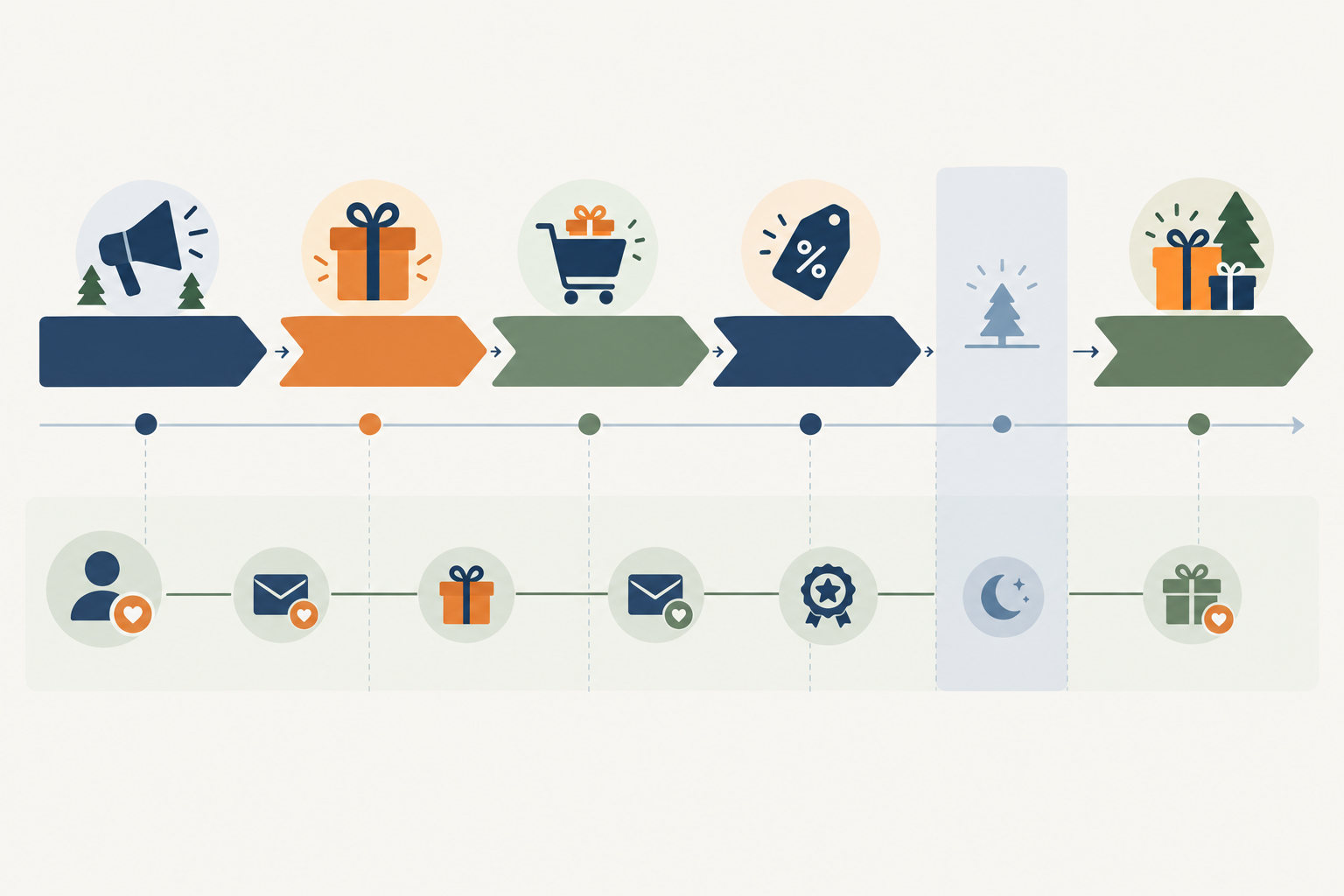
Insights only matter if they change decisions. Here's a simple process for turning what you see into a plan.
- Choose your rivals. Pick five to ten direct competitors and a few aspirational brands whose Q4 you admire.
- Set up weekly monitoring. Cover Meta, Google Ads, TikTok and LinkedIn, by hand or with a tool that doesn't need access to any ad account. The earlier you start, the better your baseline.
- Review changes every Monday. Flag new offers, ads that have stopped and ads that are still running. Keep it to a short, regular meeting so it actually happens.
- Translate findings into decisions. For each notable change, ask what it means for your launch date, offer, creative brief and channel mix, and check it against your own data.
- Share across the team. Whether you're in-house or an agency, make sure the right people see the right competitors.
- Run a post-season review. After January, use the archived ads to build next year's holiday playbook. What did rivals launch early? What did they drop? What would you do differently?
A quick product note: Rival Ads handles the collecting and weekly comparison for you, with plans from $29/month. Each week you get a dashboard and an email digest with an AI-generated analysis of the changes. Think of that analysis as a starting interpretation for your team to test, not a measure of rival performance. Agencies can also whitelabel it for clients. You can do a version of all this by hand. It just takes more hours than most teams have in Q4.
Common Mistakes to Avoid When Copying Competitor Holiday Ads
Competitor data is useful, but it's easy to misuse. Watch out for these:
- Copying an offer without knowing the rival's margins or stock position. What works for them may sink you.
- Reading a single week's data as a trend. One week is a snapshot, so look for patterns across several.
- Chasing every rival's move. You'll end up with a messy brand and a tired audience, so protect your own positioning.
- Mistaking ad volume for performance. More ads can mean a bigger test, not a better result.
- Ignoring your own first-party data, meaning what comes from your store, ad accounts and email list. What your customers respond to beats what rivals are doing.
- Leaving the review until peak week. By then there's no time to act. Start in October, not late November.
FAQ: Holiday Ad Strategy for DTC Brands
When should DTC brands launch holiday ads in the UK?
Most brands begin warm-up and teaser activity in October, launch Black Friday offers in early to mid November and shift to delivery-deadline messaging in December. The exact window depends on your category and rivals. Monitoring their ads from early October helps you choose a launch date that stands out without overspending.
How can I see what holiday ads my competitors are running?
You can browse the Meta Ad Library, Google's Ads Transparency Center and TikTok's Creative Center by hand, but it gets tedious across multiple rivals and platforms. A competitor ad monitoring tool such as Rival Ads collects rivals' publicly visible active ads weekly and shows what's new, what's no longer showing and what's still running.
How do I avoid promo fatigue during the holidays?
Stagger your offers, refresh creative before frequency builds, mix in non-discount messages like gifting and early access, and look for quieter windows in rival ad activity. Treating existing customers differently from new prospects also helps protect margins.
Is it worth copying a competitor's holiday offer?
Only when it's table stakes for your category and your margins support it. Use rival ads as a signal of market expectations rather than a template, and test your own angle, such as a better guarantee or bundle, before matching a discount.
How long should I keep monitoring competitors after Christmas?
Keep going through the January sales and into February. Archived ads give you a fuller picture of how rivals wound down their campaigns, which helps when you plan next year's holiday ad strategy.